
White Sands National Park’s shimmering gypsum dunes near Alamogordo
Published on 09/05/2026 at 15:35 | Editorial responsibility: Rafael Müller, Editor-in-Chief AD HOC NEWS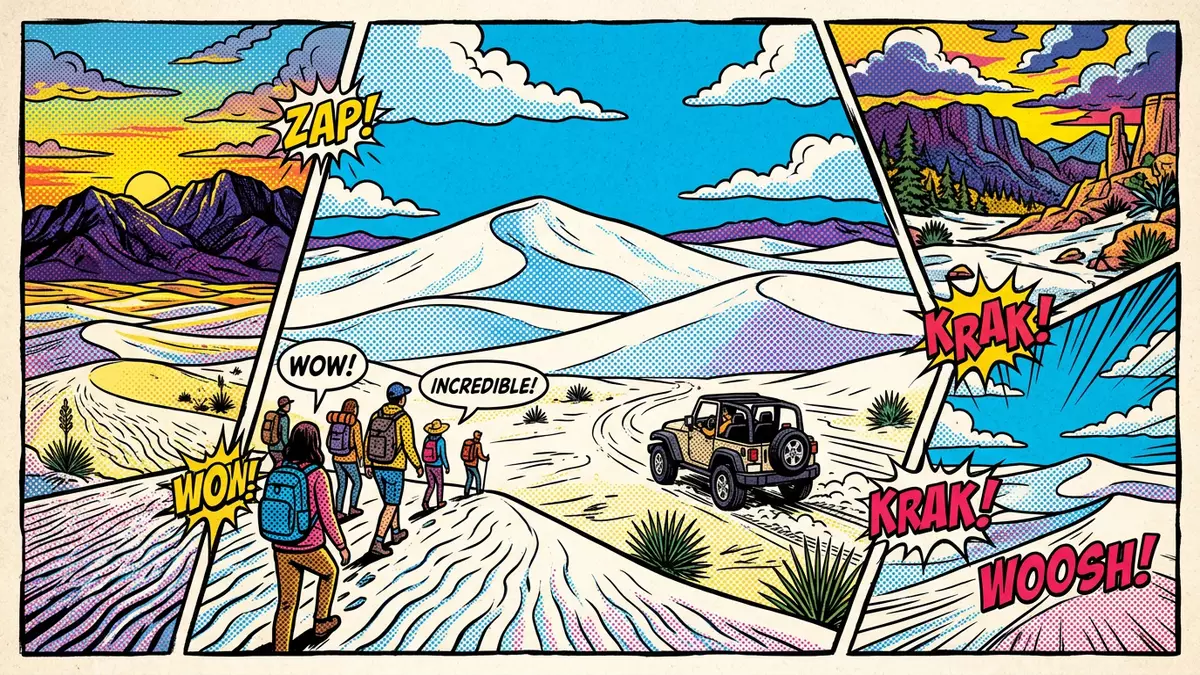
White Sands National Park near Alamogordo in New Mexico is a landscape of brilliant white dunes made of gypsum sand, spread across the enclosed Tularosa Basin between two mountain ranges. The park was redesignated in 2019 after decades as White Sands National Monument, and it preserves a striking portion of this vast gypsum dunefield.
A sea, a basin and a field of white dunes
The story of White Sands begins hundreds of millions of years ago when a shallow Permian sea covered what is now the south-west of the United States, laying down thick layers of gypsum and other minerals on the sea floor.the world’s largest gypsum dunefield These deposits were later uplifted to form part of the surrounding San Andres and Sacramento Mountains, which flank the Tularosa Basin to the west and east.between the San Andres and Sacramento mountains
As the region shifted towards the arid conditions of the Chihuahuan Desert, rain and snowmelt began dissolving the water-soluble gypsum from those mountains and carrying it into the basin, which has no natural outlet for surface water.an enclosed graben basin The water collected in depressions such as Lake Lucero, where evaporation left behind crusts of selenite crystals that were gradually broken down by weathering and erosion into fine grains of white sand.
Gypsum sand and a changing dunefield
Unlike most desert dunes, which are usually made of quartz, the sands at White Sands consist almost entirely of gypsum, a soft, pale mineral that gives the landscape its distinctive bright colour and cool touch underfoot.gypsum rather than quartz sand The dunefield in and around the park covers hundreds of square kilometres, with dunes rising to significant heights and constantly reshaped by prevailing winds from the south-west.
Different parts of the dunefield show distinct dune forms, with wave-like ridges, steeper slip faces and areas of bare gypsum flats where water has recently dried. As sand moves and dunes migrate, plant roots and occasional shallow hollows can stabilise sections of the surface for a time, creating a patchwork of shifting and semi-fixed features across the landscape.
A twentieth-century monument becomes a national park
Human interest in White Sands grew in the nineteenth century, with early scientific descriptions of the dunes appearing in journals around 1900 and local campaigns emerging later to protect the area as a park. In January 1933 President Herbert Hoover proclaimed White Sands a national monument under the Antiquities Act, setting aside more than 140,000 acres for their scenic and scientific value.Hoover’s 1933 proclamation
Work on access roads and a visitor centre followed through the 1930s, creating a basic infrastructure for visitors to reach the dunes. In 2019 the long-established monument was redesignated as White Sands National Park, recognising its significance within the United States’ system of national parks and formalising its status as a protected landscape in Otero and Doña Ana counties.a protected area in south central New Mexico
Visiting White Sands National Park: what travellers from Western Europe should know
- White Sands National Park lies in south central New Mexico in the Tularosa Basin between Alamogordo and Las Cruces, with the main entrance directly off US Highway 70.
- The terrain within the dunefield consists of soft gypsum sand and gentle slopes, and walking away from paved areas involves crossing open ground with limited shade.
- The official language is English and the currency is the United States dollar.
- Entry requirements depend on your nationality; UK travellers can check the FCDO travel advice at gov.uk/foreign-travel-advice, Irish travellers the Department of Foreign Affairs at ireland.ie.
Searching for White Sands National Park on social platforms
These links open searches for White Sands National Park on each platform.Frequently asked questions about White Sands National Park
Where is White Sands National Park located?
White Sands National Park is in south central New Mexico, within the Tularosa Basin between the San Andres and Sacramento Mountains near Alamogordo.
What should visitors expect on a visit to White Sands?
Visitors encounter extensive white gypsum dunes, bright desert light and open sandy terrain, with roads and walking areas giving access to different parts of the dunefield.
What makes White Sands National Park distinctive among desert landscapes?
The park preserves a large gypsum dunefield, where the sand is composed of gypsum rather than quartz and forms a luminous white landscape between two desert mountain ranges.


