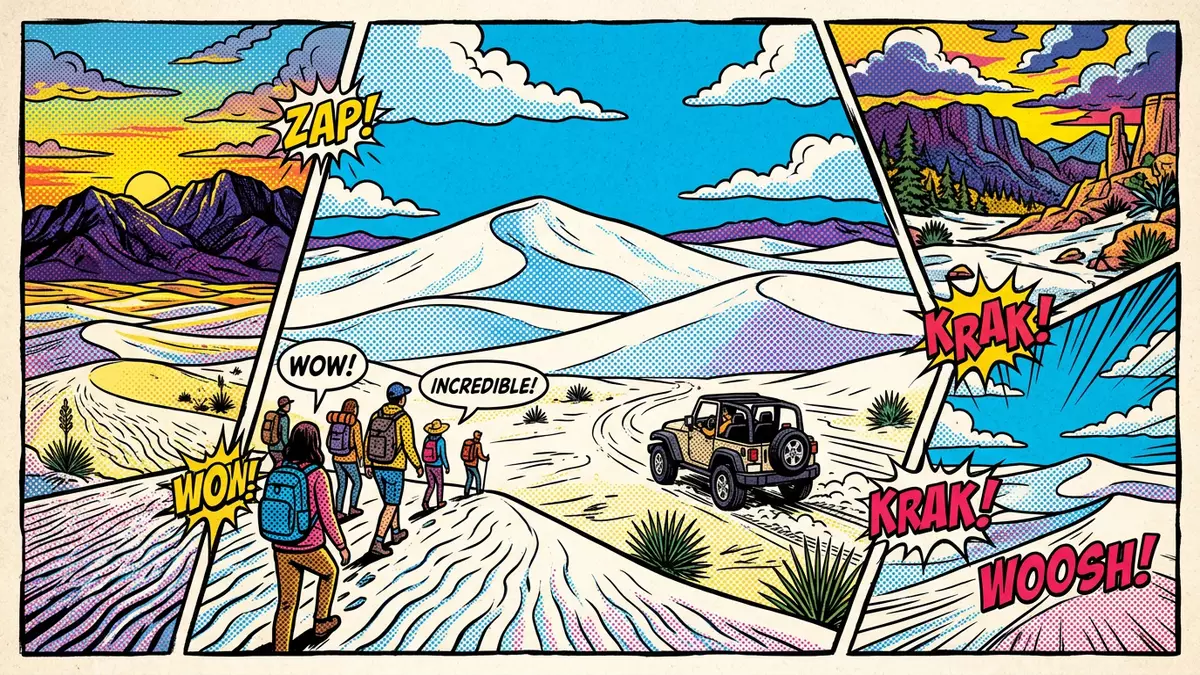
White Sands National Park and its vast gypsum dunes
Published on 08/08/2026 at 15:06 | Editorial responsibility: Rafael Müller, Editor-in-Chief AD HOC NEWS
White Sands National Park near Alamogordo is a landscape of bright gypsum dunes that rise and fall across the Tularosa Basin. The surface looks bare at first, yet it carries a long geological story and a clear sense of scale.
Gypsum dunes in the Tularosa Basin
The park is known for its white sand, but the material is gypsum rather than quartz. The dunes stretch across a broad basin framed by desert mountains, and their pale colour contrasts sharply with the darker land around them.
Gypsum sand is unusual because it is made from evaporated mineral deposits, not from the more familiar silica sand found on many coasts and deserts. The result is a fine, powdery-looking surface that reflects strong light and gives the park its distinctive appearance.
Tracing the human past through the desert
Long before the national park existed, this basin formed part of Native American travel and settlement territory, and the wider region has deep cultural history. The area also sits within the setting of the ancient salt flats and desert basins that shape southern New Mexico.
White Sands became a national monument in 1933 and was later redesignated as White Sands National Park in 2019. That change of status places it among the younger national parks in the United States, while the dunes themselves remain part of a much older landscape.
A place for walking, driving and photography
Visitors move through the dunes on roads, trails and simple open ground. The flat white expanses and low ridgelines create strong lines across the view, while the surrounding mountains keep the horizon close and clear.
The park also has a military and scientific context. The nearby region includes the White Sands Missile Range, and the broader area around Alamogordo has long been tied to testing, desert travel and the practical use of open land.
Visiting White Sands National Park: what travellers from Western Europe should know
- White Sands National Park is reached from Alamogordo by road.
- Admission arrangements and opening hours are set by the site's operator and change with the season; the official website is the only binding source.
- Late afternoon and early evening are strong choices for light across the dunes.
- The dunes involve deep sand, bright sun and a long walk on uneven ground in places.
- Cashless payment arrangements may vary on site, and simple desert clothing is sensible.
- Entry requirements depend on your nationality. UK travellers should check the FCDO travel advice at gov.uk/foreign-travel-advice; Irish travellers the Department of Foreign Affairs at ireland.ie; EU and EEA citizens their own national foreign ministry.
Searching for White Sands National Park on social platforms
These links open searches for White Sands National Park on each platform.
Frequently asked questions about White Sands National Park
Where is White Sands National Park?
It lies near Alamogordo in southern New Mexico, within the Tularosa Basin. The setting is a wide desert basin ringed by mountains.
What can a visitor expect there?
Expect bright gypsum dunes, open views and strong sunlight across pale sand. A visit is shaped by heat, wind, sand underfoot and the wide openness of the landscape.
What makes White Sands National Park distinctive?
The dunes are made of gypsum, which gives the park its white colour. The contrast between the pale sand and the surrounding desert land is the most immediate feature of the place.