
White Sands National Park, a white sea of gypsum near Alamogordo
Published on 09/07/2026 at 14:43 | Editorial responsibility: Rafael Müller, Editor-in-Chief AD HOC NEWS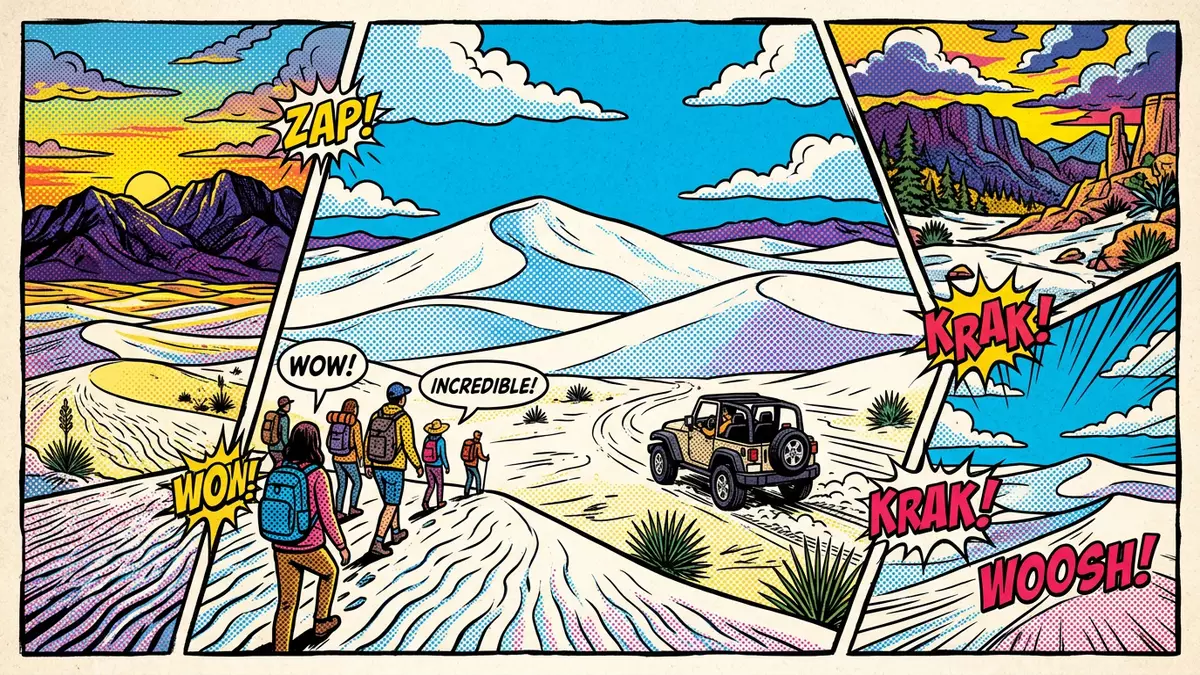
White Sands National Park in southern New Mexico turns the broad Tularosa Basin into a white landscape that looks like snow yet is made entirely of gypsum sand. Set between Alamogordo and Las Cruces, it preserves a large part of a desert dunefield whose fine white grains form sweeping dunes across the Chihuahuan Desert.
A sea of white gypsum in the Tularosa Basin
The defining feature of White Sands National Park is its field of dunes made from gypsum crystals rather than the quartz grains found in many other deserts. The protected area covers 145,762 acres (about 589.9 km²) and includes a substantial portion of a 275-square-mile (around 712 km²) gypsum dunefield that fills the basin floor.The protected area covers 145,762 acres The dunes themselves reach heights of up to 18 m (about 60 ft), forming ridges and slopes that shift under the prevailing winds while maintaining the overall whiteness of the landscape.dunes 10 to 60 feet high
Geographically, the park lies within the Tularosa Basin, a closed desert basin flanked by the San Andres Mountains to the west and the Sacramento Mountains to the east. Surface water that reaches the basin floor has no outlet and either evaporates or sinks into the ground, leaving behind mineral deposits. Over geological time this has created extensive alkali flats and the white gypsum sands that stretch across the basin as a bright band at the foot of the mountains.a graben basin in southern New Mexico
From Permian sea to desert dunes
The story of the gypsum dunes at White Sands reaches back to the Permian period more than 250 million years ago, when a shallow inland sea covered what is now southern New Mexico. As this sea repeatedly advanced and retreated, minerals accumulated in the water and settled on the sea floor as thick layers of gypsum. These marine deposits, including formations later identified as Yeso and San Andres, were gradually turned into stone.gypsum deposited during the Permian era
Tectonic stretching of the Earth’s crust in the region began around 10 million years ago, creating the Tularosa Basin as the land subsided and the surrounding ranges were uplifted. As the mountains rose, weathering released gypsum from the rock formations, and water carried it into the basin where it accumulated in lakes such as prehistoric Lake Otero and, later, modern Lake Lucero. As lake waters evaporated, gypsum crystallised on the lake bed and broke into smaller pieces that the wind transported towards the dune field, feeding an ongoing cycle of erosion, transport and deposition.the world’s largest gypsum dunefield began 280 million years ago
A national park shaped by sand and sky
White Sands was first established as a national monument on 18 January 1933, protecting a large area of the dune field as a unit of the National Park Service. Decades later, on 20 December 2019, its designation was changed to national park, reflecting its significance within the United States network of protected landscapes.established as a national monument in 1933re-designated as White Sands National Park in 2019 The nearest city is Alamogordo, and the park entrance sits along U.S. Route 70 between that city and Las Cruces, with the dunes extending across western Otero County and part of neighbouring Doña Ana County.the entrance is on US 70 near Alamogordo
The dunes at White Sands form a striking contrast with the darker desert soils and mountain slopes that surround them. Their gypsum composition gives them a bright, almost luminous colour under strong sunlight, and the wind continuously reshapes their crests and hollows. Within the park, roads and picnic areas lie against this backdrop of white sand, with boardwalks and marked routes leading into sections of the dunefield where visitors can experience the terrain at close quarters.
Visiting White Sands National Park: what travellers from Western Europe should know
- White Sands National Park lies in southern New Mexico in the United States, with its entrance on U.S. Route 70 between Alamogordo and Las Cruces. The site is reached by road, and Alamogordo has transport connections within the region.
- The park landscape consists of soft gypsum sand dunes and adjacent flats, with approaches on foot involving walking over loose sand that can give way underfoot and gentle slopes that extend across the dunefield.
- In winter, snow can fall in the surrounding desert valleys and on the nearby mountains, while summers in the basin bring strong sun and high daytime temperatures across the exposed sands.
- White Sands National Park is within the United States, where the official language is English and the currency is the US dollar.
- Entry requirements depend on your nationality; UK travellers can check the FCDO travel advice at gov.uk/foreign-travel-advice, Irish travellers the Department of Foreign Affairs at ireland.ie.
Searching for White Sands National Park on social platforms
These links open searches for White Sands National Park on each platform.
Frequently asked questions about White Sands National Park
Where is White Sands National Park located?
White Sands National Park is in southern New Mexico in the United States, within the Tularosa Basin between Alamogordo and Las Cruces along U.S. Route 70.
What can visitors expect on a visit to White Sands?
Visitors encounter extensive white gypsum sand dunes, with roads and marked routes leading into the dunefield where walking on loose sand and gentle slopes is part of the experience.
What makes White Sands National Park distinctive among desert landscapes?
The park preserves a large gypsum dunefield whose bright white dunes result from gypsum crystals rather than the quartz-based sands common in many other deserts.


