
White House, Washington, D.C.: a sandstone symbol of U.S. power
Published on 08/26/2026 at 07:15 | Editorial responsibility: Rafael Müller, Editor-in-Chief AD HOC NEWS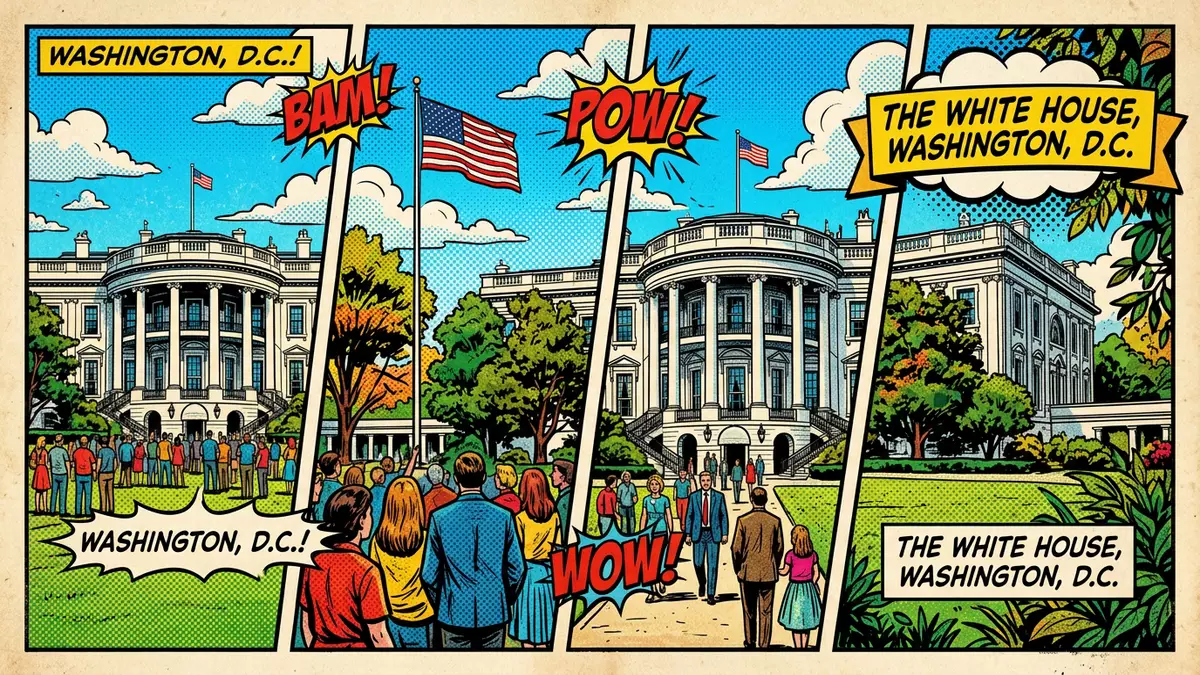
The White House in Washington, D.C. is the official residence and workplace of the president of the United States, standing at 1600 Pennsylvania Avenue NW as a central symbol of federal power in the capital.Every president since John Adams has lived here, and its pale Aquia Creek sandstone exterior and neoclassical lines make it one of the most recognisable government buildings in the world.The building serves as both home and office.
A president’s house shaped in the early republic
The White House grew out of the political project to create a permanent capital for the United States, laid out in the 1790s along the Potomac River in the new District of Columbia.Pierre Charles L’Enfant’s 1791 plan reserved a prominent site on Pennsylvania Avenue for the president’s residence, forming part of a ceremonial axis between the executive and legislative branches. Irish-born architect James Hoban won the competition to design the house in 1792, creating a rectilinear, three-storey mansion with a central block and later porticoes that echoed Georgian and neoclassical models familiar from Europe and the eastern seaboard.Hoban’s design was selected in competition in 1792.
Construction of the White House began in 1792, using pale sandstone quarried from Aquia Creek in Virginia, which was then whitewashed to create the luminous exterior that gave the building its common name.Aquia Creek sandstone forms the walls Enslaved African Americans, free Black workers, European craftsmen and local labourers all contributed to the construction, raising the masonry walls and fitting interiors suitable for both domestic life and state occasions.Accounts of the workforce highlight this mix of skills and backgrounds. The house was sufficiently complete for President John Adams and Abigail Adams to move in by 1800, making it the first occupied executive residence in Washington.
Fire, reconstruction and evolving architecture
The White House has not remained static; its appearance and internal structure reflect repeated episodes of damage, rebuilding and redesign. During the War of 1812, British troops marched into Washington on 24 August 1814, entered the president’s house and set it alight, leaving only the stone walls standing against the sky.The 1814 fire destroyed the interiors James Hoban returned to oversee reconstruction from 1815, restoring the original form while strengthening the structure, so that the rebuilt house could again host presidential households and public receptions by the end of the decade.Reconstruction under Hoban.
In the 1820s the building gained the north and south porticoes, the columned porches that frame views towards Pennsylvania Avenue and the South Lawn and have become defining elements of its profile.Porticoes built in the 1820s Later architectural interventions introduced wings and modern facilities. At the start of the twentieth century, the firm McKim, Mead & White reconfigured the complex, adding the West Wing and East Wing to transfer much of the day-to-day administration out of the main residence.East and West Wings were added in 1902 Architect Nathan C. Wyeth expanded the West Wing in 1909, creating the first Oval Office and consolidating the association between the wing and presidential decision-making. Between 1948 and 1952, the interiors and internal structure were completely rebuilt while the exterior walls were carefully preserved, marrying mid-twentieth-century construction with the familiar nineteenth-century façade.
Rooms, grounds and the working residence
The White House complex today combines several distinct elements: the central Executive Residence, the West Wing, the East Wing and surrounding gardens collectively known as President’s Park.National Park Service descriptions The Executive Residence itself is organised across four principal floors: a ground floor with service and utility spaces, a state floor laid out with ceremonial rooms, and two upper floors housing the private family apartments and guest rooms.The Executive Residence floors State rooms such as the East Room, Blue Room and State Dining Room host receptions, signings and formal dinners, while the upper levels remain largely domestic, housing bedrooms and living spaces for the presidential family.
Outside, the grounds extend across lawns and tree-lined walks that buffer the house from the city streets around it. The North Lawn faces Pennsylvania Avenue, where the building’s columned north portico rises above railings and a broad pavement, and where the address “1600 Pennsylvania Avenue NW” is widely recognised as shorthand for the U.S. presidency.The Nation’s Most Famous Address marker On the opposite side, the South Lawn slopes gently towards an area used for helicopter landings and outdoor events, framed by ornamental planting and views towards the Washington Monument. Together, the house and grounds function both as an operational centre for executive government and as a setting for ceremony and ritual, from annual receptions to visiting heads of state.
Visiting White House: what travellers from Western Europe should know
- The White House stands on Pennsylvania Avenue NW in central Washington, D.C., with the main address recorded as 1600 Pennsylvania Avenue NW.
- Public viewpoints line the streets around President’s Park, with level pavements and fenced perimeters giving clear external views of the north and south sides of the house.
- The official language is English and the national currency is the United States dollar.
- Entry requirements depend on your nationality; UK travellers can check the FCDO travel advice at gov.uk/foreign-travel-advice, Irish travellers the Department of Foreign Affairs at ireland.ie.
Searching for White House on social platforms
These links open searches for White House on each platform.Frequently asked questions about White House
Where is the White House located?
The White House stands in Washington, D.C., on Pennsylvania Avenue NW, with its address formally recorded as 1600 Pennsylvania Avenue NW in the District of Columbia.
What can visitors expect when seeing the White House?
Visitors encounter a pale sandstone mansion framed by lawns, trees and iron railings, with clear views of the columned north and south porticoes from surrounding streets and pavements.
What makes the White House distinctive among government buildings?
The White House combines Aquia Creek sandstone, neoclassical façades, porticoes and landscaped grounds with its continuous role as the president’s residence and office since 1800.


