
White House and the sandstone history of Washington, D.C.
Published on 09/24/2026 at 08:04 | Editorial responsibility: Rafael Müller, Editor-in-Chief AD HOC NEWS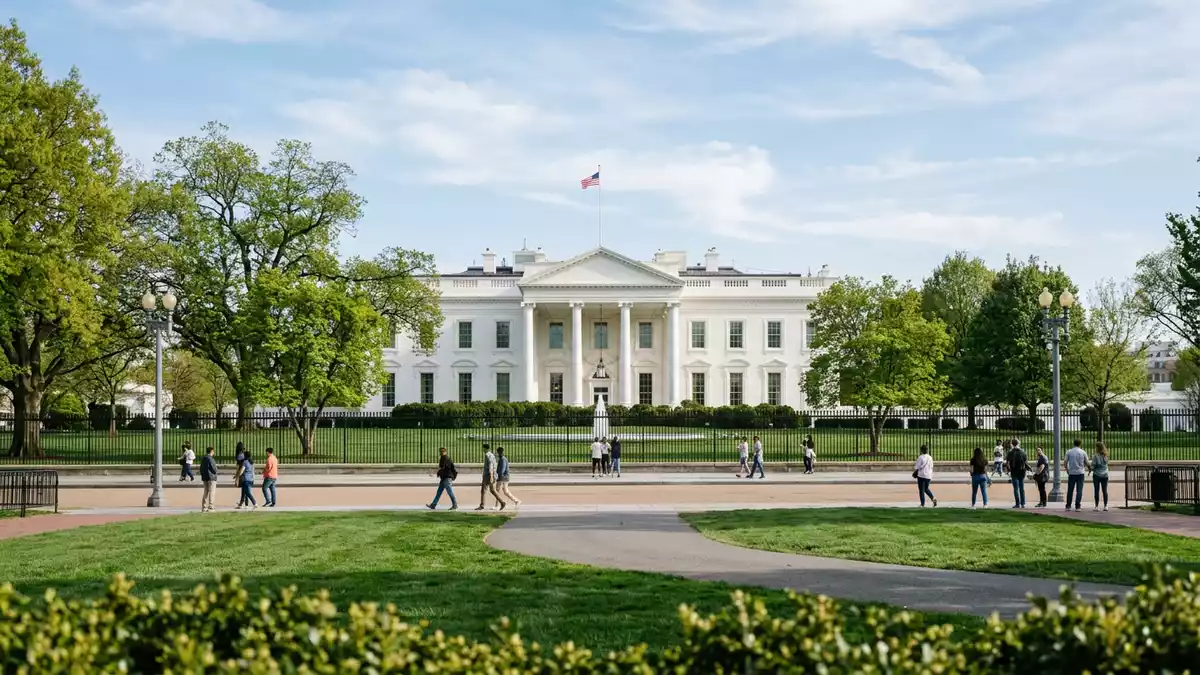
White House is a presidential residence, a working government building and a Georgian mansion in Washington, D.C. Its pale exterior is built from sandstone quarried along Aquia Creek in Virginia, giving the building a material identity as distinctive as its political role.
White House: a Georgian mansion in the federal city
George Washington selected the site in 1791, when the new federal district was taking shape beside the Potomac River. The house formed part of Pierre Charles L’Enfant’s plan for Washington, alongside the Capitol as an early public building in the capital.
Irish-born architect James Hoban won the design competition in 1792. His plan drew on Georgian and Palladian architecture, with a balanced façade, a central entrance and long wings extending across the grounds. The design is recorded in the White House design history.
Sandstone walls and the making of the residence
The cornerstone was laid on 13 October 1792. Construction continued through the decade, using light-grey sandstone from the Aquia Creek quarries in Virginia for the exterior walls.
Enslaved people worked alongside European immigrants, free African Americans and other labourers during construction. Their work included quarrying stone, cutting timber, making bricks and assembling the building. This human history belongs to the physical fabric of the house, not only to its political biography.
John Adams and Abigail Adams became the first residents in 1800, before every part of the building was complete. The National Park Service records the residence at 1600 Pennsylvania Avenue, where the president of the United States has lived since that year.
From President’s House to White House
The building carried several names during its early history, including President’s House and President’s Palace. The name White House entered common use around 1811 and became the formal name in 1901.
British forces burned the building in 1814 during the War of 1812. James Hoban supervised its reconstruction, and the rebuilt house retained its principal architectural character. The north and south porticoes were added during the following decades, extending the formal composition of the façade.
White House contains the private residence of the president’s family as well as ceremonial and administrative rooms. Its public identity rests on the meeting of two visible elements: a pale sandstone exterior shaped by Georgian design, and an interior connected with the constitutional life of the United States.
The building’s architectural language also links Washington with Dublin. The main façade has a Palladian arrangement associated with Leinster House, while its overall form belongs to the Georgian tradition. Its design, construction and early use are described in the historic architectural record.
Visiting White House: what travellers from Western Europe should know
- White House stands at 1600 Pennsylvania Avenue in central Washington, D.C., close to the National Mall and the city’s federal buildings.
- The building is viewed from public areas around Pennsylvania Avenue and Lafayette Square. The surrounding streets form part of a dense urban district rather than a rural site.
- The house is a working presidential residence, so visible areas and public access differ from the private and administrative rooms within the building.
- Washington, D.C. is in the United States. English is the official language used by federal institutions, and the currency is the US dollar.
Searching for White House on social platforms
These links open searches for White House on each platform.Frequently asked questions about White House
Where is White House?
White House is at 1600 Pennsylvania Avenue in Washington, D.C., within the federal district of the United States.
What can visitors expect to see?
Visitors can see the pale exterior, the formal façade and the surrounding public streets. White House remains a working presidential residence and government building.
What makes White House distinctive?
Its distinctive character comes from the combination of a Georgian and Palladian design, Virginia sandstone walls and continuous presidential use since 1800.


