
White House and its layered classical facade
Published on 09/08/2026 at 10:01 | Editorial responsibility: Rafael Müller, Editor-in-Chief AD HOC NEWS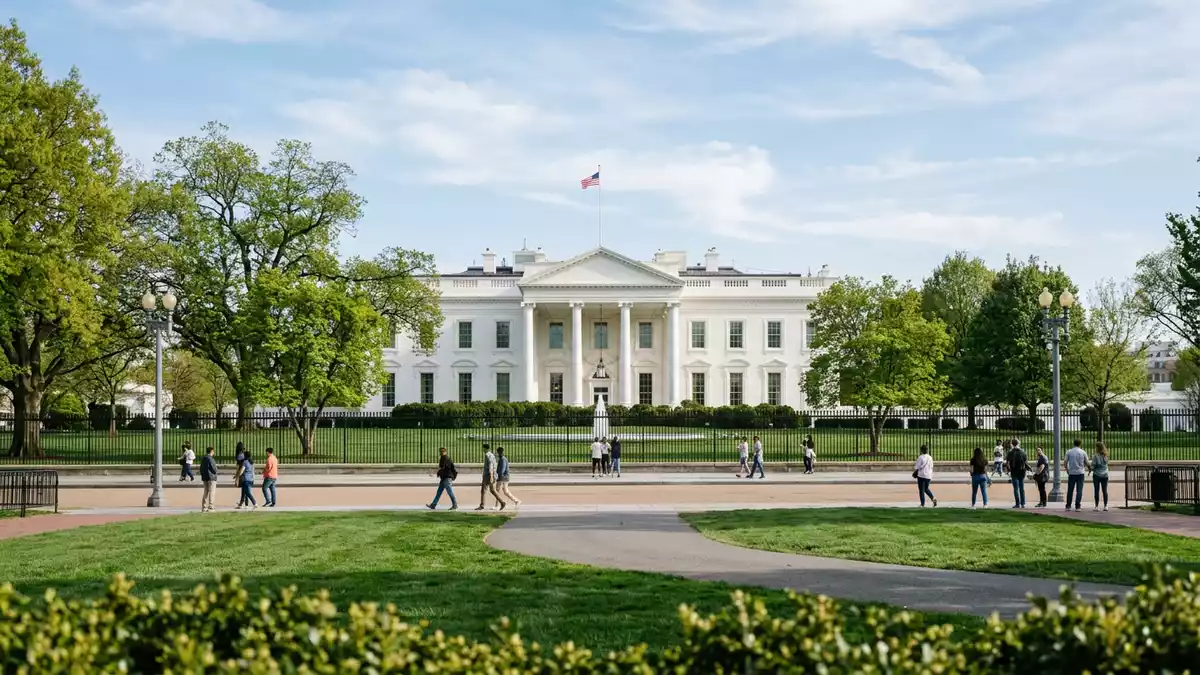
White House in Washington, D.C. is the official residence and workplace of the president of the United States. Its classical exterior, formal porticoes and long sequence of alterations make it a building of layers rather than a single moment. George Washington selected the site in 1791, and James Hoban won the design competition the following year.
James Hoban’s neoclassical house in Washington
The building rose from Hoban’s Irish-born training in Georgian and neoclassical design. Its long front, pale walls and balanced proportions give it a calm outline against the city grid.
The White House stands at 1600 Pennsylvania Avenue NW and has served as the president’s residence since 1800. Its name entered official use under Theodore Roosevelt in 1901, after years when it was called the President’s House and the Executive Mansion. official use in 1901
Rebuilding, porticoes and later additions
The present form reflects fire, reconstruction and expansion. The British burned the President’s House in 1814, Hoban returned to rebuild it, and the South Portico and North Portico were added under James Monroe and Andrew Jackson. reconstruct the Presidents House
The White House complex also grew through the twentieth century, with the West Wing added in 1901 and the Oval Office created later inside an enlarged office wing. Truman’s reconstruction left the outer walls in place while the interior and structure were remade.
The residence as a working state house
Inside, the White House combines family rooms, ceremonial rooms and offices within one address. The residence contains 132 rooms, 35 bathrooms and six levels, alongside staircases, elevators and a kitchen able to serve large formal dinners. 132 rooms
That mix of domestic and institutional space gives the building its distinctive character. The Ground Floor Corridor began as service space, while the State Floor has long been used for receiving guests and dignitaries.
Visiting White House: what travellers from Western Europe should know
- The White House stands in central Washington, D.C., on Pennsylvania Avenue NW. It is reached through the city street network and sits within the White House and President’s Park area.
- The building is a large formal residence with multiple levels, staircases and porticoes. Its exterior is best read as a sequence of fronts, wings and additions rather than a single facade.
- The official language is English and the currency is the United States dollar.
- Entry requirements depend on your nationality; UK travellers can check the FCDO travel advice at gov.uk/foreign-travel-advice, Irish travellers the Department of Foreign Affairs at ireland.ie.
Searching for White House on social platforms
These links open searches for White House on each platform.
Frequently asked questions about White House
Where is White House?
White House is in Washington, D.C., at 1600 Pennsylvania Avenue NW. It sits at the centre of the American presidency and forms part of the city’s official landscape.
What should a visit to White House involve?
A visit centres on the exterior, the grounds and the building’s ceremonial presence. The house itself is a working residence, not a museum in the usual sense.
What makes White House distinctive?
Its distinction lies in the combination of neoclassical form, presidential use and repeated rebuilding. The name, the porticoes and the layered history all remain visible in the structure.


