
Westminster Abbey and the layered history of English monarchy
Published on 09/10/2026 at 14:13 | Editorial responsibility: Rafael Müller, Editor-in-Chief AD HOC NEWS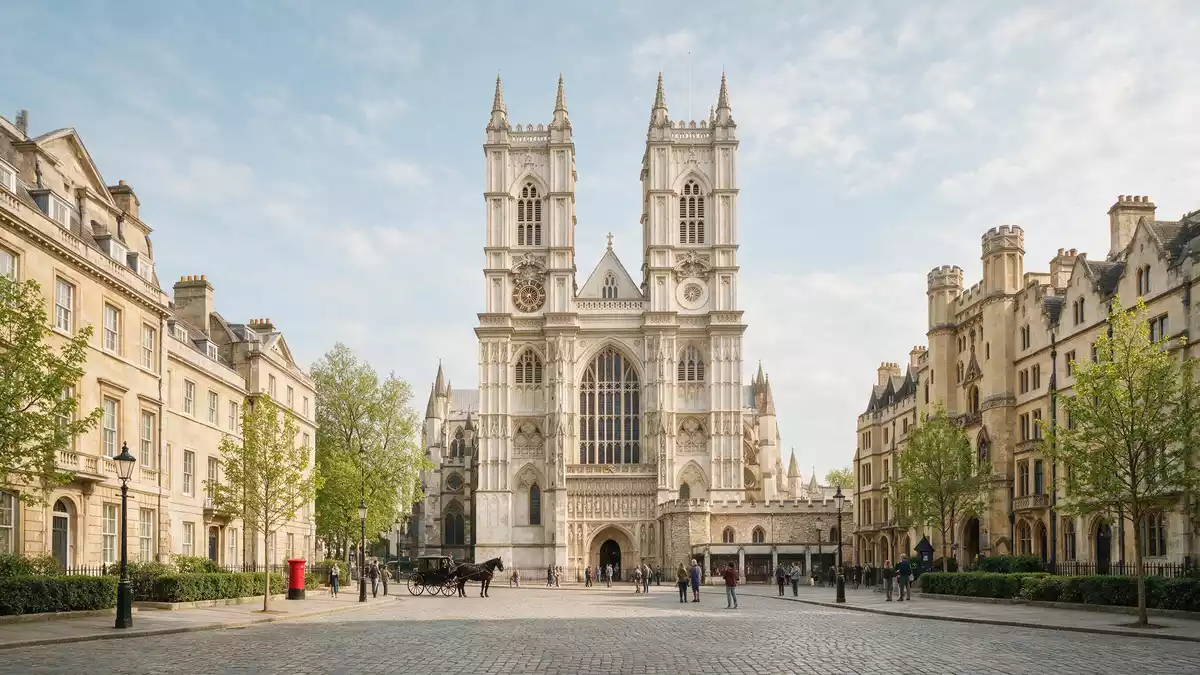
Westminster Abbey in London is a great Gothic church where English and later British monarchs have been crowned and buried for centuries, and where national memorials line the stone floors and walls.Westminster Abbey where monarchs are crowned The present building largely dates from the thirteenth century, when King Henry III ordered a rebuilding of Edward the Confessor’s earlier church in the pointed Gothic style of the period.Henry III’s Gothic rebuilding
A church built in stone and time
The origins of Westminster Abbey lie in a Benedictine monastery established on Thorney Island by the River Thames in the tenth century, where monks had settled by around 960. In the eleventh century King Edward the Confessor commissioned a large stone church on this site, consecrated in 1065, and he was buried within its walls.Edward the Confessor’s church in 1065 Little of this Norman structure survives above ground, because Henry III began replacing it with the current Gothic fabric from 1245, creating a taller, lighter interior inspired by French cathedral architecture.Present Gothic style building dates mainly from Henry III
From the thirteenth to the sixteenth centuries builders and masons extended and refined Westminster Abbey, using pale Reigate stone for many of the facings and shaping clustered piers, ribbed vaults and tall lancet windows into a coherent Gothic whole.Reigate stone and Geometric Gothic style The nave was rebuilt from the late fourteenth century under architect Henry Yevele, giving the Abbey one of the loftiest medieval interiors in England, while later architects added details and restored worn carvings, keeping the structure sound as London grew around it.Henry Yevele’s work on the nave
Gothic architecture and royal chapels
Standing outside Westminster Abbey, visitors see a composition of buttressed walls, pinnacles and traceried windows, rising above the surrounding streets and squares near the River Thames.Site adjacent to the River Thames The west front is framed by two towers completed in the eighteenth century, designs associated with Nicholas Hawksmoor that give the church a balanced façade in a style influenced by Baroque taste but anchored in the Gothic outline beneath.Hawksmoor’s west towers completed in 1745
Inside, the main body of Westminster Abbey is arranged on a traditional cruciform plan, with a long nave leading to the choir and high altar, and transepts extending to either side. At the east end lies the Henry VII Chapel, also known as the Lady Chapel, a masterpiece of early sixteenth-century Perpendicular Gothic, with elaborate stone vaulting and finely carved details.Henry VII Chapel as Perpendicular Gothic The surrounding cloisters, chapter house and monastic buildings reflect the Abbey’s origins as a Benedictine foundation, combining functional spaces with decorative tracery and carved bosses that reward close attention.Architecture across Gothic period
Coronations, burials and national memory
Westminster Abbey has been the coronation church of English and later British monarchs since the eleventh century, beginning with William the Conqueror’s crowning in 1066 and continuing through successive dynasties.Coronations since William the Conqueror Coronation rites are centred on the sanctuary and choir, where the monarch is anointed and crowned under the soaring vaults, surrounded by carved stalls and historic banners. The Abbey also holds the shrine of St Edward the Confessor, royal tombs and ledger stones that mark the resting places of kings, queens and other members of the royal family.Shrine of St Edward and tombs of kings and queens
Beyond royal burials, Westminster Abbey functions as a national pantheon, with memorials to writers, scientists, soldiers and public figures set throughout the interior. In the nave lies the tomb of the Unknown Warrior, representing soldiers of the First World War and later conflicts, surrounded by inscriptions and wreaths.Tomb of the Unknown Warrior In Poets’ Corner and other areas, plaques and statues record names from literature, music and politics, so that a walk through the Abbey becomes a passage through British cultural history as well as religious practice.Memorials to prominent individuals
Visiting Westminster Abbey: what travellers from Western Europe should know
- Westminster Abbey stands in the City of Westminster in central London, close to the River Thames and the Palace of Westminster, and is reached easily by Underground and bus services that stop around Parliament Square.
- Inside the church and cloisters, visitors move along flagstone floors and stone steps, with certain staircases that are narrow and steep, especially on routes leading towards upper viewing areas.
- The Abbey forms part of the World Heritage Site that also includes the Palace of Westminster and St Margaret’s Church, so nearby streets and squares bring views of Parliament, Westminster Hall and the adjoining smaller church.
- The official language is English and the currency is the pound sterling.
Searching for Westminster Abbey on social platforms
These links open searches for Westminster Abbey on each platform.Frequently asked questions about Westminster Abbey
Where is Westminster Abbey located in London?
Westminster Abbey stands in the City of Westminster in central London, close to the River Thames and Parliament Square, beside the Palace of Westminster.
What should visitors expect inside Westminster Abbey?
Visitors encounter a tall Gothic nave, royal tombs, memorials and chapels such as the Henry VII Chapel, along with cloisters and monastic spaces connected by stone passages.
What makes Westminster Abbey distinctive among churches?
Westminster Abbey combines thirteenth-century Gothic architecture with its long role as the coronation church and burial place of monarchs, and as a setting for national memorials.


