
Westminster Abbey and the architecture of British memory
Published on 08/21/2026 at 20:10 | Editorial responsibility: Rafael Müller, Editor-in-Chief AD HOC NEWS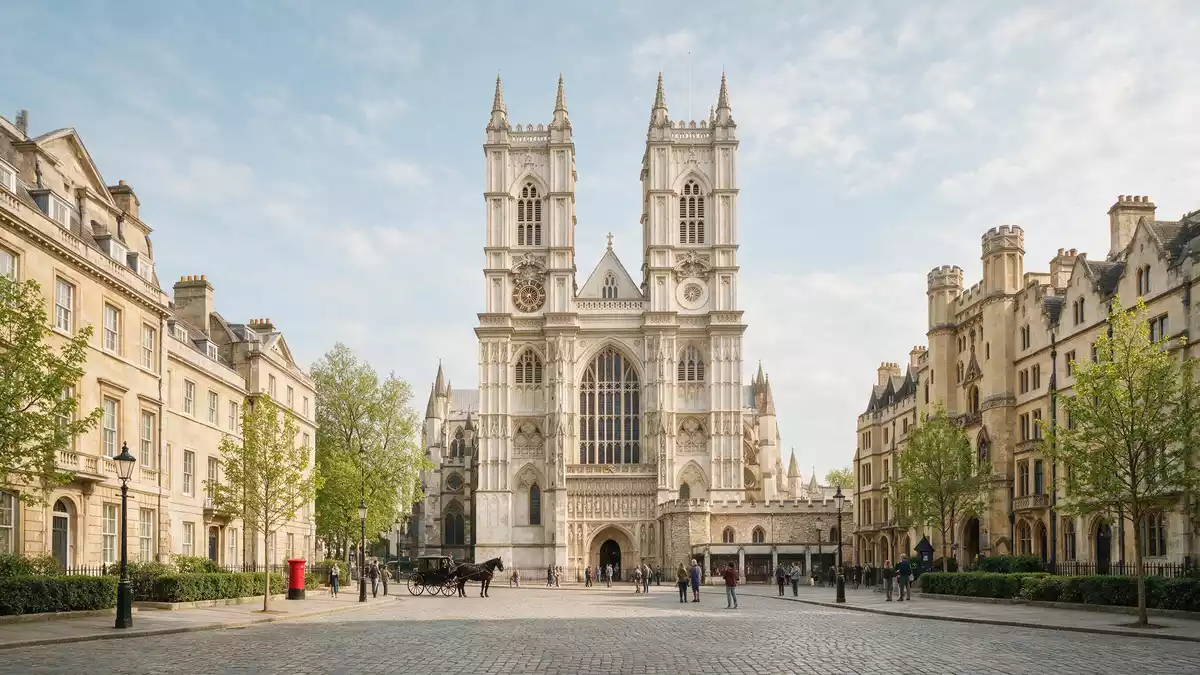
Westminster Abbey in London is a Gothic church where architecture, royal ceremony and commemoration share the same space in stone. Founded as a Benedictine monastery in the tenth century and rebuilt on a grand scale in the thirteenth century under King Henry III, it has become inseparable from the story of the British monarchy and the kingdom it serves.
A Gothic church built for kings and memory
The origins of Westminster Abbey lie in a monastic community on Thorney Island beside the Thames, where Benedictine monks established an abbey in the mid?tenth century.Benedictine monastery on Thorney Island In the 1040s King Edward the Confessor ordered a large stone church here, which was consecrated in 1065 and later became his burial place.Edward the Confessor’s church of 1065 Construction of the present building began in 1245, when Henry III decided to replace much of Edward’s church with a new design in the Gothic style that was then spreading across Europe.Henry III’s Gothic rebuilding from 1245
The church that visitors see now is largely the result of that thirteenth?century campaign, extended and completed over the fourteenth and fifteenth centuries.Architectural masterpiece of the 13th to 16th centuries Within the Gothic exterior lies the shrine of St Edward the Confessor, medieval royal tombs, and later additions such as the seventeenth?century Lady Chapel and the twentieth?century memorials in the nave. The building’s long nave, tall clustered piers and ribbed vaults frame a sequence of chapels and aisles where burials and monuments stand close to the main ceremonial route used for coronations and national services.
Coronations, royal occasions and the “House of Kings”
Westminster Abbey has been the setting for every English and British coronation since William I was crowned there on Christmas Day 1066.Coronation church since 1066 Over the centuries, forty monarchs have taken the coronation oath within its walls, reinforcing the abbey’s status as the ceremonial church of the state.Forty monarchs crowned in the Abbey The coronation route passes the shrine of Edward the Confessor and the medieval royal tombs, linking later rulers with the Anglo?Saxon king whose church first gave the site its prominence.
The abbey is equally known as a royal burial place, a role that earned it the description “House of Kings”. Until the eighteenth century many English and then British monarchs were buried here, including Elizabeth I and Mary I, whose tombs share a chapel space.Royal burials and the House of Kings Across the church more than 3,300 people are buried or commemorated, from scientists and poets to military leaders and politicians.Over 3,300 people buried or commemorated The result is a building where the monarch’s chair, the royal tombs and national monuments stand within the same architectural frame, turning the church into a kind of stone archive of British public life.
Royal peculiar, World Heritage site and living church
After the dissolution of the monastery in the sixteenth century, Westminster Abbey was refounded in 1560 as the Collegiate Church of St Peter in Westminster by Queen Elizabeth I.Refounded as Collegiate Church of St Peter in 1560 It became a “royal peculiar”, a Church of England institution under the direct jurisdiction of the monarch rather than a diocesan bishop.Status as a royal peculiar This unusual status helps explain why the abbey continues to host state services, royal weddings and funerals alongside its daily worship.
In 1987 the abbey, together with the neighbouring Palace of Westminster and St Margaret’s Church, was inscribed as a UNESCO World Heritage Site because of its architectural and historic significance.UNESCO World Heritage inscription in 1987 Visitors encounter not only the medieval Gothic fabric but also later additions and restorations, from nineteenth?century interventions to the modern statues on the west front. Services continue in the nave and choir, and the building remains both a parish church for a small community and a national stage for major occasions.
Visiting Westminster Abbey: what travellers from Western Europe should know
- Westminster Abbey stands in the City of Westminster in central London, close to the Palace of Westminster and the River Thames. Underground stations nearby include Westminster and St James’s Park.
- Inside the church, movement between the nave, transepts and chapels involves steps, narrow passages and stone floors that have been worn by centuries of use.
- The surrounding area includes Parliament Square, Whitehall and St James’s Park, making it easy to combine a visit to the abbey with other historic and political sites.
Searching for Westminster Abbey on social platforms
These links open searches for Westminster Abbey on each platform.Frequently asked questions about Westminster Abbey
Where is Westminster Abbey?
Westminster Abbey is a large Gothic church in the City of Westminster, London, close to the Houses of Parliament and the River Thames.
What should visitors expect inside?
Visitors encounter a tall medieval nave, chapels filled with tombs and memorials, and ceremonial spaces arranged around the shrine of Edward the Confessor.
What makes Westminster Abbey distinctive?
The abbey combines Gothic architecture with its long role as coronation church, royal burial place and national memorial, giving the building a rare concentration of British history.


