
Waza National Park, a Sahelian wildlife reserve in Cameroon’s Far North
Published on 09/09/2026 at 18:28 | Editorial responsibility: Rafael Müller, Editor-in-Chief AD HOC NEWS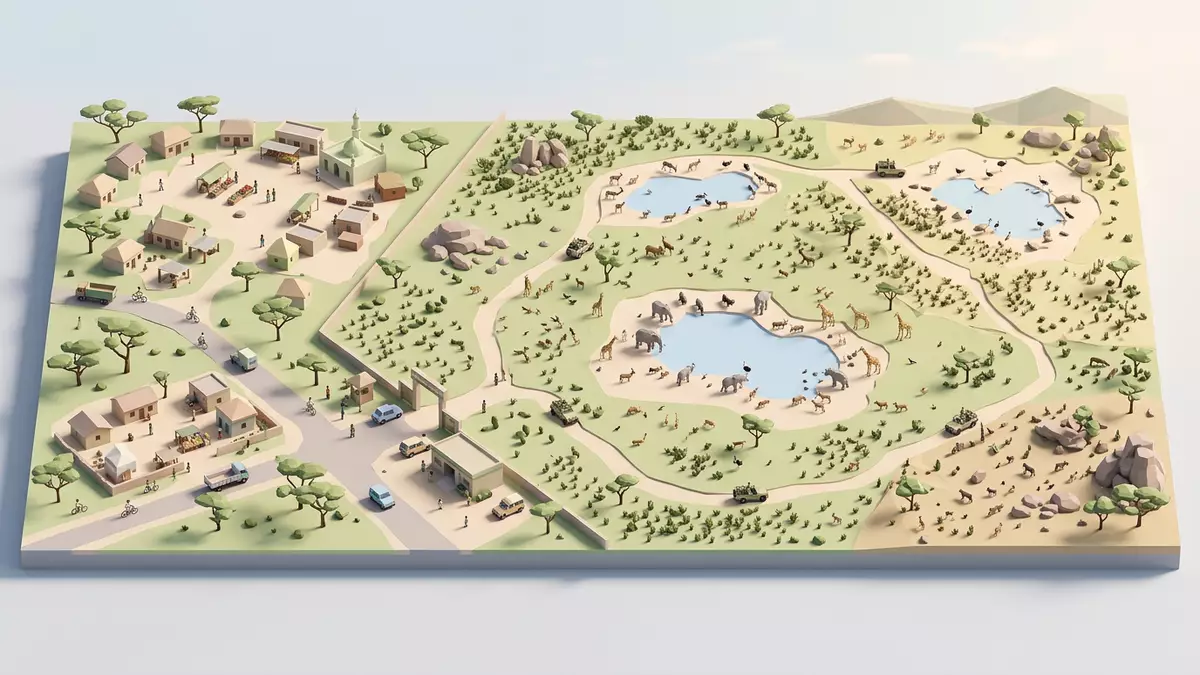
Waza National Park in Cameroon’s Far North Region is a Sahelian savanna reserve where acacia woodland, floodplains and grassland spread east of the town of Waza towards the borders with Nigeria and Chad. Founded as a protected area in the 1930s and recognised as a UNESCO biosphere reserve in 1979, it offers a broad landscape of semi?arid plains and seasonal wetlands in the Chad depression.
Sahelian plains on Cameroon’s northern frontier
Waza National Park lies in the Department of Logone?et?Chari in Cameroon’s Far North Region, in the broad lowland known as the Chad depression.Chad depression The protected area sits east of the town of Waza, less than 10 km from the borders with both Nigeria and Chad, in a zone where national frontiers meet wide Sahelian plains.east of the town of Waza Elevations around 300 m (984 ft) give the park a gently undulating character, with long horizons and open skies above the grassland.around 300 m
The core national park covers about 1,700 km² (656 sq mi), forming part of the larger Waza Biosphere Reserve recognised under UNESCO’s Man and the Biosphere Programme.1,700 km² Within this wider biosphere, the park lies in a transition zone between the Sahel and Sudan savanna, where semi?arid grassland blends with woodland and floodplain habitats.transition zone between the Sahel and Sudan savanna The wider Waza Biosphere Reserve extends across 170,000 ha, framing the stricter protection of the park with managed lands where local communities live and work.170,000 ha
From hunting reserve to biosphere reserve
Waza’s protected status dates back to 1934, when the area was first established as the Waza Reserve with a focus on controlling hunting.established as the Waza Reserve on 24 March 1934 Over the following decades the protected area was extended, and in 1968 it was upgraded to Waza National Park under Cameroonian law.1970,000 Hektar großes Biosphärenreservat In 1979 the park became part of the Waza Biosphere Reserve, one of Cameroon’s designated biosphere sites under UNESCO’s programme for balancing conservation and human use.designated 1979
This sequence of designations places Waza alongside Benoué and the Dja Faunal Reserve among Cameroon’s recognised biosphere reserves.three UNESCO?recognised biosphere reserves The biosphere framework distinguishes core zones, such as the national park, from buffer and transition zones where activities such as grazing and agriculture are managed under agreed guidelines.Waza Biosphere Reserve Waza has also been proposed, together with the Logone floodplain, as a potential Ramsar site for wetland conservation, reflecting the ecological value of its seasonal waters.proposed, together with the Logone flood?plain, as the first Ramsar Site for Cameroon
Savanna habitats and wildlife
Within its boundaries, Waza National Park protects a mosaic of Sahelian and Sudan savanna habitats, ranging from open grasslands to acacia woodland and seasonally flooded plains.savanna grasslands and acacia forests The park has been identified as a Key Biodiversity Area for its mixture of freshwater and terrestrial ecosystems, covering over 1,400 km² under KBA assessment and lying entirely within a protected area boundary.Key Biodiversity Area Satellite imagery shows the park as a large green patch in the northern landscape, bordered by more arid surroundings and by human?used land outside the core zone.Earth from Space
Waza is widely recognised for its wildlife, including lions, elephants, giraffes, antelopes and numerous bird species that move across the savanna and floodplains within the park.home to lions, elephants, giraffes, antelopes and numerous species of birds The biosphere reserve has been described as offering conditions suited to ecotourism focused on elephants, giraffes, various bird colonies and felines such as lions.ideal conditions for quality ecotourism Within the semi?arid Sahelian climate, these animals depend on the mixture of grassland grazing, woodland shelter and access to water in wetter periods of the year.semi?arid Sahel region
Visiting Waza National Park: what travellers from Western Europe should know
- Waza National Park is in Cameroon’s Far North Region, in the Department of Logone?et?Chari east of Waza, reached overland from regional centres in the north.
- The terrain consists of broad, open savanna plains with low elevations and seasonal floodplains, so approaches and game drives follow unpaved tracks across flat ground.
- The borders with Nigeria and Chad lie within about 10 km of the park, and Waza sits in the Chad depression, so regional geography and cross?border context shape overland travel.
- The official language is French and the currency is the Central African CFA franc.
- Entry requirements depend on your nationality; UK travellers can check the FCDO travel advice at gov.uk/foreign-travel-advice, Irish travellers the Department of Foreign Affairs at ireland.ie.
Searching for Waza National Park on social platforms
These links open searches for Waza National Park on each platform.
Frequently asked questions about Waza National Park
Where is Waza National Park?
Waza National Park is in Cameroon’s Far North Region, in the Department of Logone?et?Chari east of the town of Waza and close to the borders with Nigeria and Chad.
What can visitors expect at Waza National Park?
Visitors encounter Sahelian savanna landscapes with open grassland, acacia woodland and seasonal floodplains, along with wildlife such as elephants, giraffes, antelopes, lions and many bird species.
What makes Waza National Park distinctive?
Waza is distinctive as a Sahel–Sudan transition?zone savanna protected since 1934, recognised as a UNESCO biosphere reserve since 1979 and forming part of the wider Waza Biosphere Reserve in the Chad depression.


