
Wat Xieng Thong and the golden roofs of Luang Prabang
Published on 08/28/2026 at 22:18 | Editorial responsibility: Rafael Müller, Editor-in-Chief AD HOC NEWS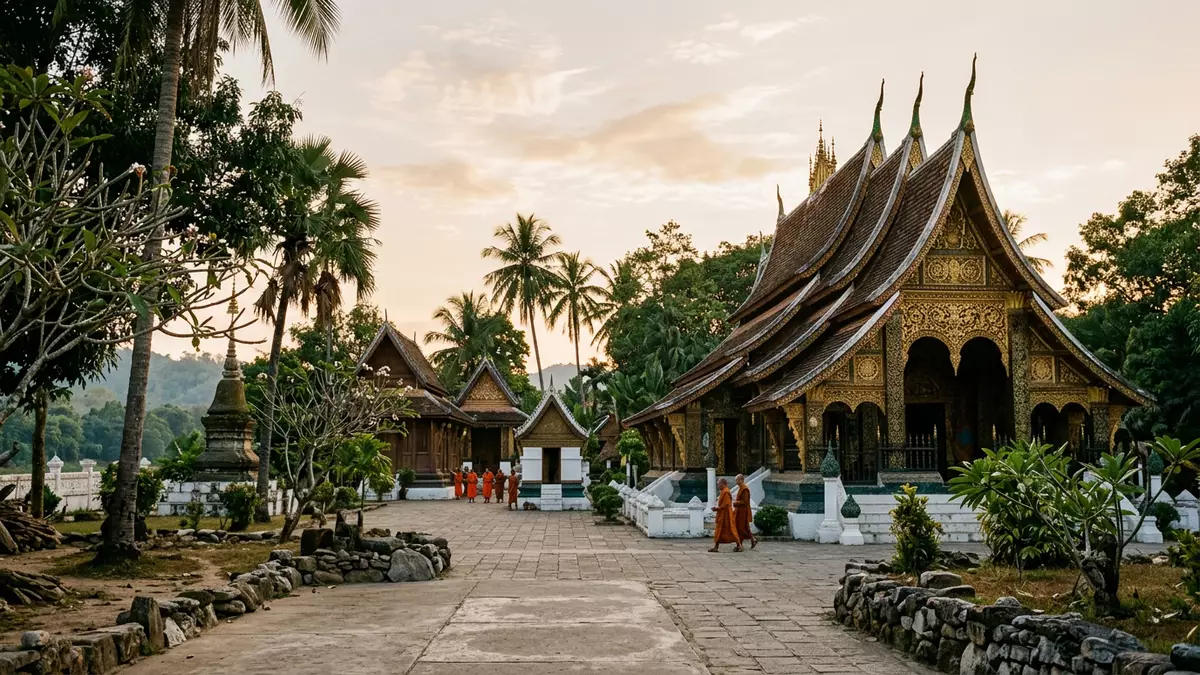
On the northern tip of Luang Prabang’s old peninsula, Wat Xieng Thong gathers low, gilded roofs and glass mosaics above the meeting of the Mekong and Nam Khan Rivers, a compact temple ensemble that still reflects the royal city of the sixteenth century. Founded in 1560 by King Setthathirath of the Lan Xang kingdom, it became the principal royal monastery of Luang Prabang and a reference point for Lao temple architecture.
The royal heart of Lan Xang beside the rivers
Wat Xieng Thong stands close to the place where the Mekong and Nam Khan Rivers converge, at the end of the narrow spur of land that carries Luang Prabang’s old town.meeting of the rivers The position linked the monastery physically to the town’s ceremonial axis, so that processions along the main street naturally reached its riverfront terrace. From the late sixteenth century onwards the complex formed one of the principal gateways to the city for formal arrivals by boat.
The temple was created under King Setthathirath, who ruled Lan Xang from 1548 to 1571 and is associated with major Buddhist foundations across the kingdom.built between 1559 and 1560 In 1560 he ordered the construction of a new monastery on what had been palace grounds at the peninsula’s tip, giving the site a direct link to royal authority.palace grounds at the end of the peninsula Over the following centuries Wat Xieng Thong remained under royal patronage, hosting coronations of Lao kings and major Buddhist festivals that tied court ritual to the seasonal rhythm of the rivers.
Roofs, timber and the Luang Prabang style
The main ordination hall, or sim, defines Wat Xieng Thong’s silhouette with a cascading timber roof that descends almost to the surrounding stone platform, a profile regarded as a model of Luang Prabang temple design.Luang Prabang style with two-tiered roof The sim, completed around 1560, forms the monastery’s core, built in timber and brick, with multiple roof tiers supported on sturdy wooden columns. The eaves sweep down to frame deep verandas on several sides, creating sheltered walkways between the hall and the surrounding chapels.
Gold on dark red and black surfaces plays a central role in the decoration. The front gables carry intricate gold stencils on an ochre ground, while interior walls are lined with gilded designs that depict mythological figures, floral scrolls and scenes from Buddhist stories.intricate gold designs on red background Around the sim stand subsidiary structures, including a small scripture library and chapels that once housed ceremonial artefacts. These buildings echo the main hall through their timber frames and layered roofs, so that the ensemble reads as a compact catalogue of sixteenth-century Lao sacred architecture.representative of typical Laotian architecture
Glass mosaics and the tree of life
One of Wat Xieng Thong’s most recognisable features lies on the outside of the rear wall of the sim, where a large glass mosaic depicts a stylised tree rising against a coloured ground, surrounded by animals and small human figures. Made of brightly coloured mirrored tiles set into plaster, the composition is known as the “tree of life” and echoes the temple’s alternative name as the Golden Tree monastery.golden tree of life mosaic Its reflective surfaces catch changes in daylight, picking out individual details of birds, foliage and figures as the sun moves around the building.
Glass mosaics extend beyond the tree panel. Several chapels and smaller halls around the courtyard carry bands of mirrored tiles arranged into scenes of everyday life in Luang Prabang: villagers carrying baskets, musicians, boats on the river and lines of monks in procession.glass mosaics depicting local scenes These mosaics date from later phases of embellishment in the twentieth century, complementing the older gilt woodwork without disturbing the sixteenth-century structure. Together, gold lacquer and glass give Wat Xieng Thong its characteristic mixture of depth, colour and reflected light across timber and brick surfaces.
Visiting Wat Xieng Thong: what travellers from Western Europe should know
- Wat Xieng Thong stands at the northern end of Luang Prabang’s peninsula, close to the junction of the Mekong and Nam Khan Rivers, and is reached on foot from the old town’s main street.
- The temple complex is set on a slightly raised stone platform; access to the sim and chapels involves short flights of steps and tiled surfaces that can feel smooth underfoot.
- English is not an official language in Laos and the national currency is the Lao kip.
- Luang Prabang is served by a small international airport outside the town; road links connect it with other centres in northern Laos.
- Entry requirements depend on your nationality; UK travellers can check the FCDO travel advice at gov.uk/foreign-travel-advice, Irish travellers the Department of Foreign Affairs at ireland.ie.
Searching for Wat Xieng Thong on social platforms
These links open searches for Wat Xieng Thong on each platform.
Frequently asked questions about Wat Xieng Thong
Where is Wat Xieng Thong located?
Wat Xieng Thong stands at the northern end of Luang Prabang’s old town in Laos, near the point where the Mekong and Nam Khan Rivers meet.
What can visitors expect when exploring Wat Xieng Thong?
Visitors encounter a compact temple complex with a sixteenth-century ordination hall, gilded woodwork, glass mosaics and chapels arranged around a stone platform.
What makes Wat Xieng Thong distinctive among Luang Prabang’s temples?
Its origins under King Setthathirath, its role as Luang Prabang’s royal monastery and its sweeping timber roofs and tree of life mosaic give the temple a particular architectural and historical weight.


