
Wat Si Saket in Vientiane and its cloister of Buddhas
Published on 08/29/2026 at 20:10 | Editorial responsibility: Rafael Müller, Editor-in-Chief AD HOC NEWS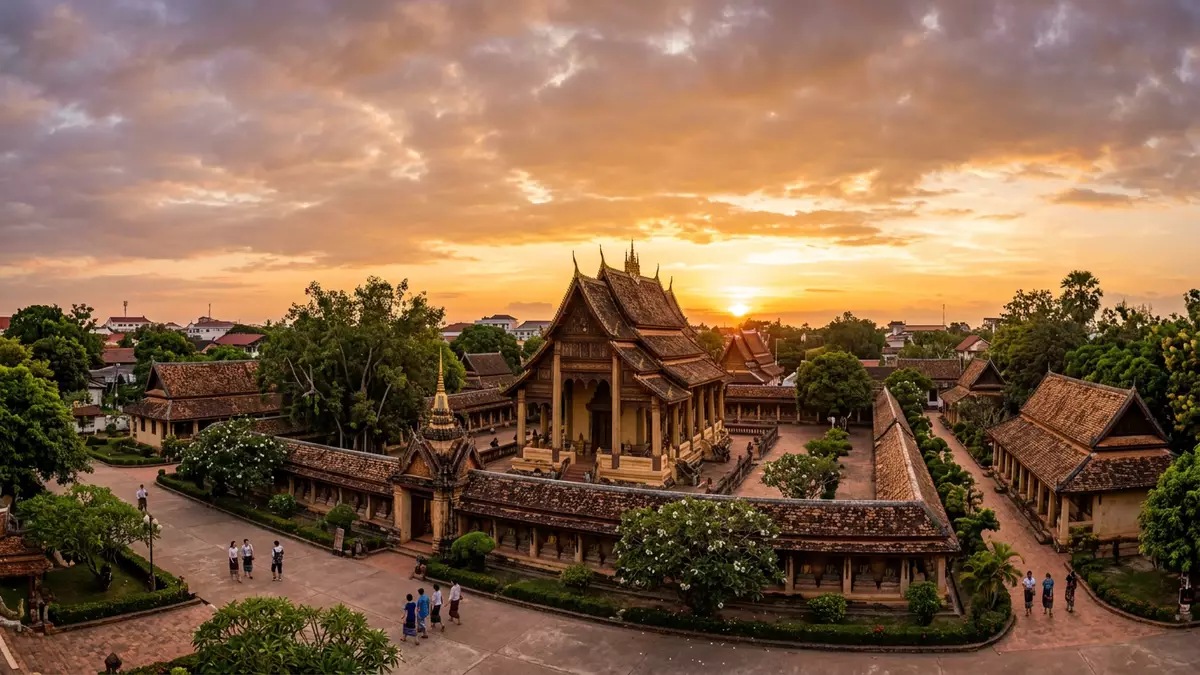
Wat Si Saket in Vientiane is a compact early nineteenth?century Buddhist monastery where the surrounding cloister, lined with thousands of Buddha images, rivals the main hall as the focus of attention. Built under King Anouvong of the Lao kingdom of Vientiane and consistently dated to the early nineteenth century, it stands in the historic administrative core of Laos’s capital opposite the Presidential Palace.
Wat Si Saket as Vientiane’s early nineteenth?century monastery
Wat Si Saket is a Theravada Buddhist wat in central Vientiane, on Lan Xang Road near its junction with Setthathirat Road and close to Haw Phra Kaew, the former home of the Emerald Buddha.Theravada Buddhist wat in Vientiane The temple compound occupies a roughly rectangular plot set back slightly from Lane Xang Avenue, forming part of a cluster of religious and civic buildings that mark out the old centre of the city.located on Lan Xang Road
Construction of Wat Si Saket is widely recorded as taking place in the early nineteenth century under King Anouvong, also known as Chao Anou, the last monarch of the Kingdom of Vientiane.built between 1819 and 1824 by Chao Anou Accounts describe the foundation as part of a phase in which Vientiane’s royal court maintained close ties with neighbouring Siam, present?day Thailand, and this relationship is reflected in the temple’s architectural language.edified in 1818 on the order of King Anouvong Wat Si Saket is frequently characterised as the oldest surviving Buddhist monastery in Vientiane, giving it particular weight in the city’s built landscape.oldest surviving Buddhist temple in Vientiane
A cloister lined with thousands of Buddha images
The most striking feature of Wat Si Saket is the cloister that runs around the inner edge of the compound, forming a continuous gallery of Buddha images set into recessed niches and standing on ledges.oldest surviving monastery with surrounding cloister Tourism authorities and guidebooks consistently describe the number of Buddha figures in the complex as running into the thousands, with some counts giving figures of more than 6,800 images in wood, stone and bronze.more than 6,800 Buddhas in wood, stone and bronze The effect is of a dense visual archive of devotion stretching along the inner walls, each recess carrying small seated Buddhas while larger statues stand in front.
Many of these images are recorded as dating mainly from the sixteenth and nineteenth centuries, tracing a long span of Lao religious practice within a single walk around the cloister.images dating from the sixteenth and nineteenth centuries The cloister itself is a covered gallery with colonnades facing the courtyard and thick outer walls pierced by the niches that hold the small Buddhas. Between the images, the plaster and brickwork bear traces of age and restoration, and the rhythm of repeated figures gives the walk around the courtyard a strong sense of structure. In the corners of the cloister, small chapels and altars add further layers of ornament and points of focus.
Siamese influences and survival after the sack of Vientiane
The main ordination hall of Wat Si Saket, with its tiered roof and veranda supported by robust columns, combines Lao and Siamese architectural elements in a way that is repeatedly noted in studies of the temple.fuses Lao and Siamese architectural elements The choice of vocabulary has been linked to the temple’s name, which echoes Wat Saket in Bangkok and incorporates the honorific “Si”, derived from the Sanskrit “Sri”. The roof of the viharn rises in superimposed tiers, each edged with finials, while naga motifs and other decorative elements underline the shared visual language of the Lao and Siamese traditions.
Wat Si Saket holds a particular place in Vientiane’s history because it substantially survived the destruction of the city in the late 1820s, when Siamese forces sacked Vientiane following King Anouvong’s rebellion.survived the destruction of Vientiane Contemporary and later accounts describe the monastery compound being used as accommodation and headquarters by the invading army, which may help explain why the structure was not burned.used as headquarters by Siamese armies in 1827 As a result, Wat Si Saket is repeatedly described as the oldest surviving Buddhist monastery in Vientiane and as one of the few religious complexes in the historic core that still show the layout of that era. Later, during the period of French colonial administration, restoration campaigns in the 1920s and 1930s reinforced its status as a historic monument as well as a working religious site.restored under French colonial administration
Visiting Wat Si Saket: what travellers from Western Europe should know
- Wat Si Saket stands on Lane Xang Avenue in central Vientiane, opposite the Presidential Palace and near Haw Phra Kaew, and is reached on foot or by road vehicles from the surrounding city streets.
- The monastery compound is enclosed by walls, with entrance through gates into a courtyard where the ground is largely level but the cloister and main hall involve steps and covered walkways.
- Wat Si Saket lies in the lowland plain of the Mekong, so approaches from the surrounding city follow paved streets rather than steep mountain paths.
- The official language in Laos is Lao and the currency is the Lao kip.
Searching for Wat Si Saket on social platforms
These links open searches for Wat Si Saket on each platform.
Frequently asked questions about Wat Si Saket
Where is Wat Si Saket located?
Wat Si Saket is in central Vientiane in Laos, on Lan Xang Road near Setthathirat Road and opposite the Presidential Palace.
What should visitors expect on a visit to Wat Si Saket?
Visitors encounter an enclosed monastery compound with a main ordination hall, surrounding cloister galleries and thousands of Buddha images set into niches along the inner walls.
What makes Wat Si Saket distinctive among Vientiane’s temples?
Wat Si Saket is widely described as the city’s oldest surviving Buddhist monastery, combining Lao and Siamese architectural elements and preserving a cloister lined with thousands of Buddha figures.


