
Wat Si Saket in Vientiane and its cloister of Buddhas
Published on 08/27/2026 at 22:06 | Editorial responsibility: Rafael Müller, Editor-in-Chief AD HOC NEWS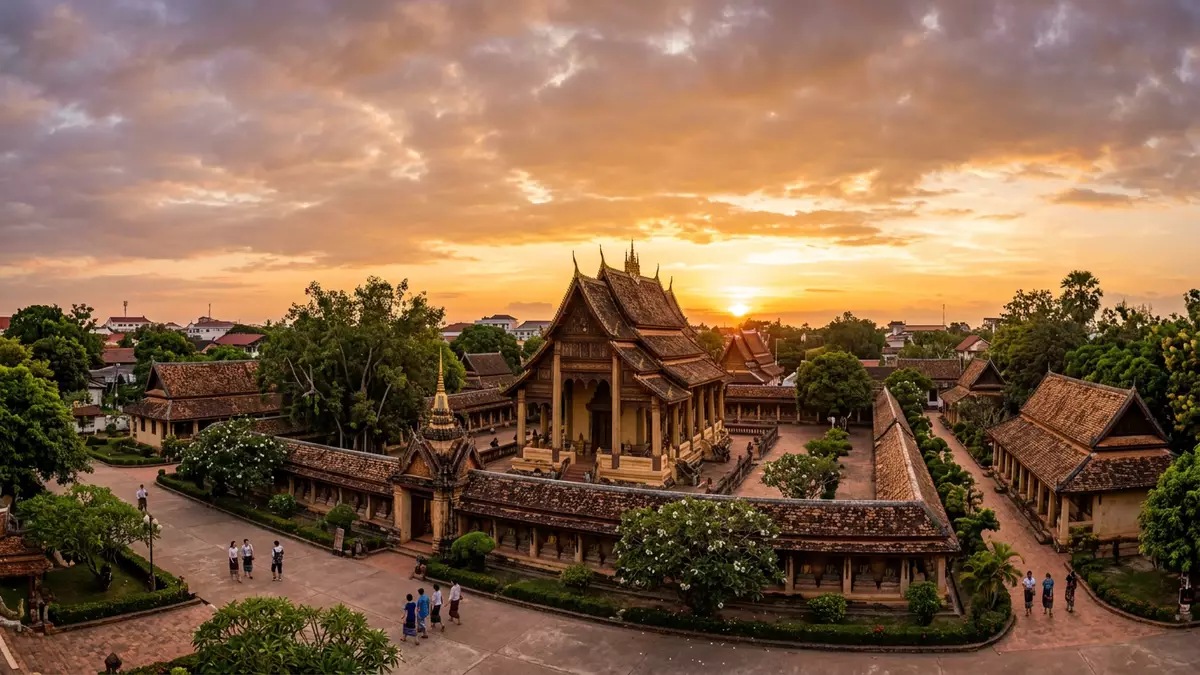
Wat Si Saket in Vientiane is an early nineteenth-century Buddhist temple whose cloister-like galleries are lined with thousands of Buddha images, making the surrounding arcade as compelling as the central ordination hall.
Wat Si Saket: an early nineteenth-century temple that survived a city’s destruction
Wat Si Saket stands close to the former royal precinct on Lane Xang Avenue in central Vientiane, in a walled compound that reads as a single, self-contained monastery complex.A Buddhist temple in Vientiane The temple is associated with King Anouvong, also known as Chao Anou, who ruled the Kingdom of Vientiane from 1805 to 1828 and commissioned the monastery in the early years of his reign.Gestiftet wurde Wat Si Saket im Jahr 1818 von König Anouvong
Construction is consistently linked in inscriptions and secondary sources to the period between 1818 and the early 1820s, placing Wat Si Saket firmly in the early nineteenth century.The temple was built between 1819 and 1824 In 1827 and 1828, conflict between Vientiane and Siam led to the sack of the city and the destruction of many religious buildings, yet Wat Si Saket remained standing and is widely described as the oldest surviving Buddhist temple in Vientiane.Built between 1819 and 1824 by Chao Anou
A cloister of thousands of Buddha images
The most striking feature of Wat Si Saket is the cloister that runs around the inner courtyard, forming a continuous gallery between the outer wall and the central ordination hall.A walled cloister whose galleries are lined with thousands of Buddha images Along this covered walkway, niches in the inner wall and shelves beneath them hold a dense assembly of Buddha figures in different materials and sizes, creating a rhythmic pattern of repeated silhouettes and varied detail. The number of images is frequently described in the thousands, with figures ranging from small ceramics to larger metal sculptures, many dating from the sixteenth to the nineteenth centuries.It features over 10,000 Buddha sculptures of varying sizes and styles
Inside the ordination hall, or s?m, the walls continue the theme of multiplication and narrative, with further Buddha niches and mural paintings depicting Jataka stories of the Buddha’s past lives.Hundreds of Buddha niches and Jataka murals A Khmer-style Naga Buddha, showing the Buddha seated on a coiled serpent sheltered by its hood, is displayed near the main image and is associated with the thirteenth century, linking the collection to older regional traditions.A slightly damaged Khmer-style Naga Buddha believed to date from the 13th century
Lao and Siamese architectural currents in one compound
Architecturally, Wat Si Saket combines elements associated with Lao monastic building and Siamese, or Thai, Buddhist architecture of the period.Built using Thai-style architecture with a surrounding terrace and five-tiered roof The ordination hall stands slightly off the main axis within the courtyard, surrounded by a colonnaded terrace and topped by a roof articulated into five tiers, a profile linked with Bangkok-style wats of the early Rattanakosin era.An ornate five-tiered roof and surrounding terrace Around it, subsidiary structures such as the library and small shrines echo and vary this language, contributing to a layered composition of roofs, columns and verandas.
Wat Si Saket later drew the attention of French colonial administrators and archaeologists, who undertook restoration campaigns in the 1920s and 1930s that stabilised the buildings and allowed damaged murals and structures to be conserved.Restored by archaeologists of the École française d’Extrême-Orient in the 1930s The compound’s position opposite Haw Phra Kaew and near the Presidential Palace reinforces its role within Vientiane’s ceremonial core, with the outer boundary wall and corner structures marking a clear separation between the monastic space and the surrounding city streets.Just across the street from the Presidential Palace
Visiting Wat Si Saket: what travellers from Western Europe should know
- Wat Si Saket stands on Lane Xang Avenue in central Vientiane, opposite Haw Phra Kaew and near the Presidential Palace, reached by city streets and local transport.
- The monastery complex is enclosed by a boundary wall, with cloister galleries and interior spaces connected by paved paths and steps that require short walks on foot.
- The climate in Vientiane is tropical, and the temple compound offers both shaded cloisters and more exposed courtyard areas around the ordination hall.
- The official language is Lao and the currency is the Lao kip.
- Entry requirements depend on your nationality; UK travellers can check the FCDO travel advice at gov.uk/foreign-travel-advice, Irish travellers the Department of Foreign Affairs at ireland.ie.
Searching for Wat Si Saket on social platforms
These links open searches for Wat Si Saket on each platform.
Frequently asked questions about Wat Si Saket
Where is Wat Si Saket located?
Wat Si Saket is a Buddhist temple in central Vientiane, Laos, standing on Lane Xang Avenue near the Presidential Palace and opposite Haw Phra Kaew.
What should visitors expect inside the temple compound?
Visitors encounter a walled monastery with a central ordination hall, cloister galleries lined with thousands of Buddha images, mural-painted interiors and subsidiary shrines and buildings.
What makes Wat Si Saket distinctive among temples in Vientiane?
Wat Si Saket is associated with King Anouvong’s early nineteenth-century building campaign and is regarded as the oldest surviving Buddhist temple in Vientiane, with cloisters of Buddha images and a five-tiered roofed ordination hall.


