
Wat Si Saket in Vientiane, a cloister of thousands of Buddhas
Published on 09/08/2026 at 20:42 | Editorial responsibility: Rafael Müller, Editor-in-Chief AD HOC NEWS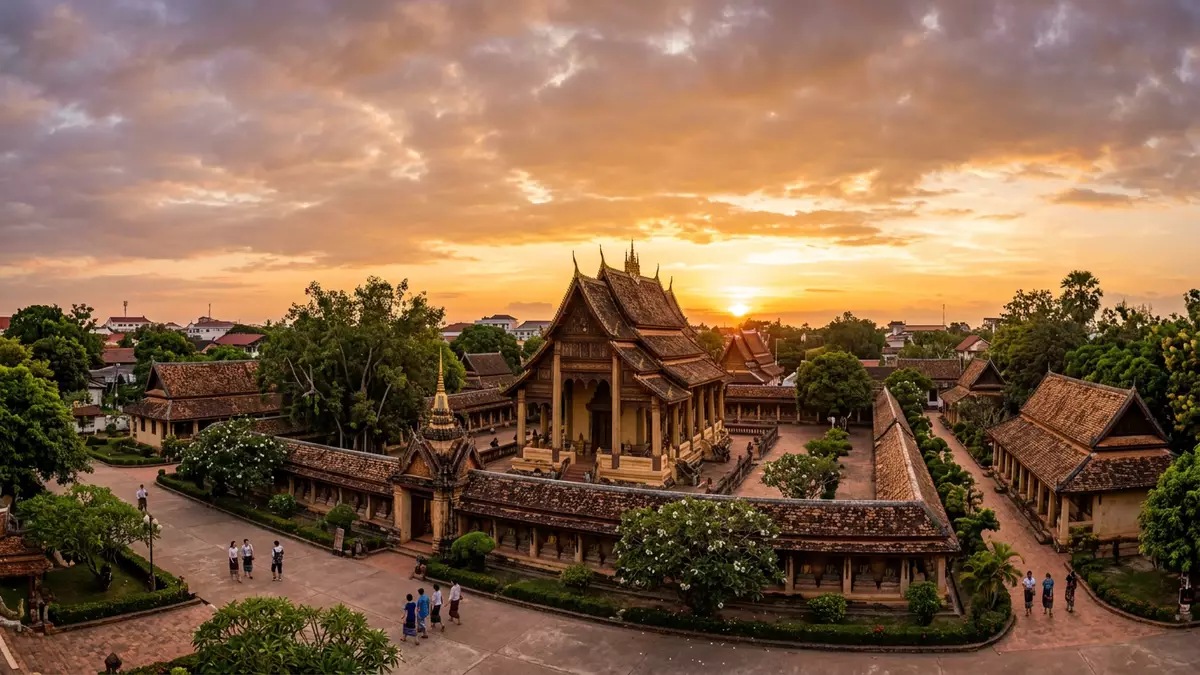
Wat Si Saket is an early nineteenth?century Buddhist monastery in central Vientiane whose cloistered courtyard and thousands of Buddha images turn a compact city temple into a dense, enclosed world of sculptures.Buddhist wat in Vientiane Built under King Anouvong, also known as Chao Anou, during the final decades of the Lao kingdom of Vientiane, it is widely described as the city’s oldest surviving temple complex.Gestiftet wurde Wat Si Saket im Jahr 1818
A courtyard monastery from the age of King Anouvong
The core of Wat Si Saket dates to the early nineteenth century, a period when Vientiane was still the seat of a Lao kingdom entangled with neighbouring Siam.completed in 1818 during the final years of the Lan Xang Kingdom King Anouvong, whose reign ran from 1805 to 1828, commissioned the monastery as part of his effort to shape Vientiane as a royal capital with religious institutions matching his ambitions.regierte von 1805 bis 1828 The temple’s name links it linguistically to Wat Saket in Bangkok, reflecting the close cultural and political contacts between the Lao court and Siam at the time.
The structure that visitors encounter is laid out around a walled courtyard, with the main ordination hall standing at the centre and a continuous gallery running around its edges.sanctuaire à nef unique au centre d'une cour entourée d'une galerie The architectural language combines Lao and Siamese elements: the sanctuary has a single nave, while the surrounding colonnades and roof lines recall temple forms from Bangkok and central Thailand.fuses Lao and Siamese architectural elements That blend of styles makes Wat Si Saket an architectural record of a political era, capturing a moment when Vientiane looked both inward to its own traditions and outward to its powerful neighbour.
Galleries of thousands of Buddha images
The most striking feature of Wat Si Saket is its continuous cloister of Buddha images, which lines the inner walls of the surrounding galleries in dense tiers.features over 10,000 Buddha sculptures Niches in the rendered walls hold small figures, while larger statues sit on pedestals along the colonnades, creating long perspectives where hundreds of images are visible at once.Vientiane's oldest temple Wat Sisaket The figures vary in material and style, with wood, bronze and other metals used alongside different regional iconographies of the Buddha, turning the cloister into a kind of open?sided sculpture storehouse.
Inside the central ordination hall, a large principal Buddha image presides over the interior, surrounded by further statues and ritual objects.contains 6,840 Buddha images Frescoes and painted decoration on the interior walls depict scenes from Buddhist cosmology and Jataka tales, although their condition reflects the age of the building and the climate of Laos. Together, the hall and galleries make Wat Si Saket a place where sculptural repetition and enclosure shape the visitor’s experience as strongly as the single main shrine.
Survival, restoration and setting in central Vientiane
Wat Si Saket stands on Lan Xang Road in the civic core of Vientiane, close to the Presidential Palace and directly opposite Haw Phra Kaew, the former Emerald Buddha temple now used as a museum.Just across the street from the Presidential Palace This setting places the monastery within a short walk of government buildings, broad avenues and other historic wats, making it part of a cluster of religious and secular architecture that forms the city centre.Located in the heart of Vientiane, directly opposite Haw Phra Kaew The temple compound itself is defined by its perimeter wall, separating the quiet, shaded interior from the traffic of Lan Xang Road.
In the late 1820s, conflict between Vientiane and Siam led to the sack of the city and the destruction of many religious and civic buildings, yet Wat Si Saket endured through that period.épargnée par les Siamois lors du sac de la ville en 1827 Later, under French colonial administration, the temple was restored in the early twentieth century, reinforcing its role as both an active place of worship and a historic monument.in den 1930er-Jahren wurde Wat Si Saket ... restauriert This sequence of survival and repair gives Wat Si Saket a layered character: a working monastery, a relic of a pre?colonial kingdom and a curated site within a capital reshaped by foreign rule.
Visiting Wat Si Saket: what travellers from Western Europe should know
- Wat Si Saket stands on Lan Xang Road in central Vientiane, directly opposite Haw Phra Kaew and close to the Presidential Palace, and is reached by city streets and local transport.
- The temple compound is enclosed by walls, with access to the courtyard and cloister via gateways and paths that lead across an open paved area.
- Within the courtyard, movement between the colonnaded galleries and the ordination hall involves low thresholds and interior floors rather than long staircases or steep climbs.
- The official language is Lao and the currency is the Lao kip.
- Entry requirements depend on your nationality; UK travellers can check the FCDO travel advice at gov.uk/foreign-travel-advice, Irish travellers the Department of Foreign Affairs at ireland.ie.
Searching for Wat Si Saket on social platforms
These links open searches for Wat Si Saket on each platform.Frequently asked questions about Wat Si Saket
Where is Wat Si Saket located?
Wat Si Saket is in central Vientiane, the capital of Laos, on Lan Xang Road opposite Haw Phra Kaew and close to the Presidential Palace.
What should visitors expect at Wat Si Saket?
Visitors encounter a walled monastery with a central ordination hall and surrounding galleries whose walls and niches hold thousands of Buddha images.
What makes Wat Si Saket distinctive among Vientiane’s temples?
Its early nineteenth?century courtyard layout, survival through the destruction of Vientiane in the 1820s and its dense cloister of sculptures give the temple a distinctive character.


