
Wat Si Saket and Vientiane’s cloister of Buddhas
Published on 09/22/2026 at 05:59 | Editorial responsibility: Rafael Müller, Editor-in-Chief AD HOC NEWS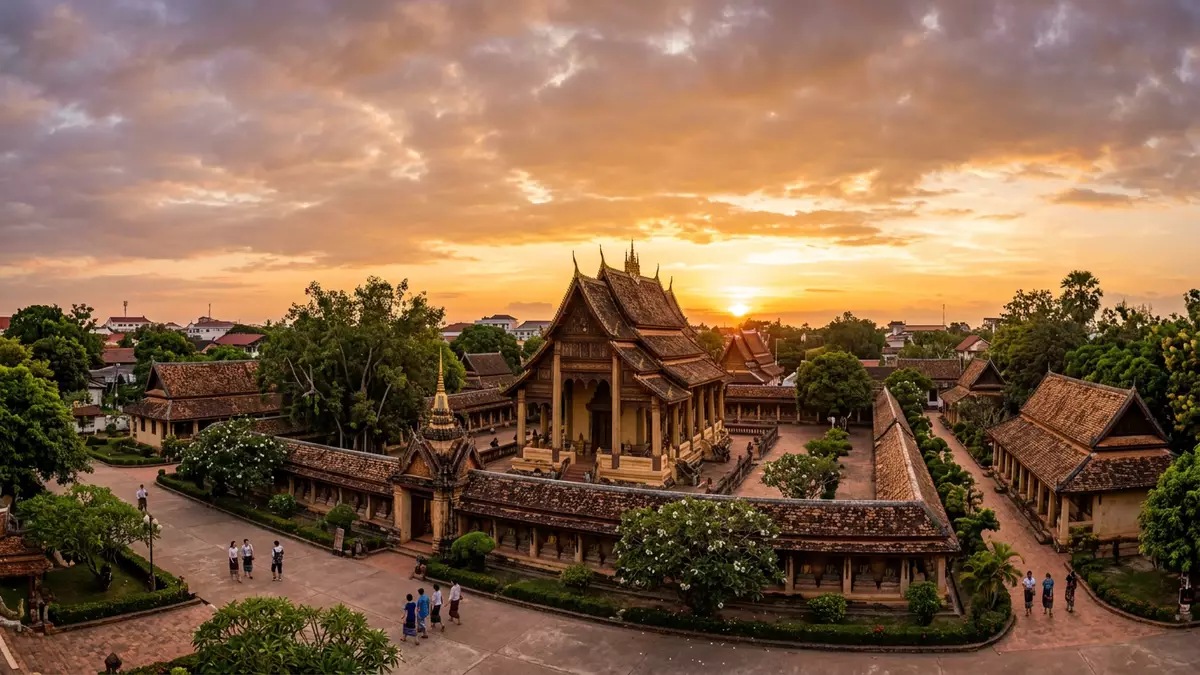
Wat Si Saket is a Buddhist temple in central Vientiane whose covered cloister surrounds the main ordination hall. Built under King Anouvong in 1818, the compound brings together a five-tiered roof, shaded galleries and thousands of Buddha images.
Wat Si Saket: a cloister filled with Buddha images
The cloister is the defining space of Wat Si Saket. Its walls contain rows of small niches, while larger figures sit on shelves in front of them. The collection includes images made from wood, bronze, stone, ceramic and silver, with forms associated with Lao, Siamese and Khmer Buddhist traditions.
Sources place the number of Buddha images above 6,800, although counts vary between descriptions. Figures range from small devotional objects to larger seated statues. Their different materials, gestures and proportions create a dense record of Buddhist image-making across several centuries.
King Anouvong and the early nineteenth century
Wat Si Saket was commissioned by King Anouvong, also known as Chao Anou, the last monarch of the Kingdom of Vientiane. Construction is dated to 1818, while another established account places the building work between 1819 and 1824. The different dates point to the early nineteenth-century setting of the temple rather than a single uncontested construction year.
The temple is associated with Vientiane’s royal centre and stands on Lan Xang Road, near the former royal precinct. Its name connects it with Wat Saket in Bangkok, while its architectural language reflects the close relationship between Vientiane and Siam during Anouvong’s reign.
A Bangkok-influenced temple in the Lao capital
The main hall is surrounded by a colonnaded terrace and covered galleries. A five-tiered roof rises above the hall, and the compound also contains a drum tower, a library building and smaller structures within the enclosed grounds.
Inside the ordination hall, painted Jataka scenes present stories of the Buddha’s former lives. The walls also contain Buddha niches, while a Khmer-style Naga Buddha is displayed near the principal seated image. Parts of the murals belong to the nineteenth-century fabric, and other sections relate to a restoration in 1913. French colonial restoration followed in 1924 and 1930.
Visiting Wat Si Saket: what travellers from Western Europe should know
- Wat Si Saket stands on Lan Xang Road at the corner of Setthathirat Road in central Vientiane. Haw Phra Kaew lies nearby, and the Presidential Palace is across the road.
- The compound combines outdoor courtyards, covered galleries and interior halls. Entering the ordination hall requires moving between these different surfaces and spaces.
- The official language is Lao and the currency is the Lao kip.
- Wat Si Saket remains a Buddhist place of worship as well as a museum. Clothing that covers shoulders and knees suits the religious setting.
Searching for Wat Si Saket on social platforms
These links open searches for Wat Si Saket on each platform.
Frequently asked questions about Wat Si Saket
Where is Wat Si Saket?
Wat Si Saket is on Lan Xang Road at its junction with Setthathirat Road in central Vientiane, Laos. It stands near Haw Phra Kaew and the Presidential Palace.
What can visitors see at Wat Si Saket?
The compound contains a cloister lined with Buddha images, a five-tiered roof, a drum tower, a library building and an ordination hall with Buddhist murals.
What makes Wat Si Saket distinctive?
Its enclosed cloister, large collection of Buddha images and early nineteenth-century architecture give the temple a distinctive place in Vientiane’s historic centre.


