
Wat Si Saket and the cloister of Buddha images
Published on 08/31/2026 at 15:13 | Editorial responsibility: Rafael Müller, Editor-in-Chief AD HOC NEWS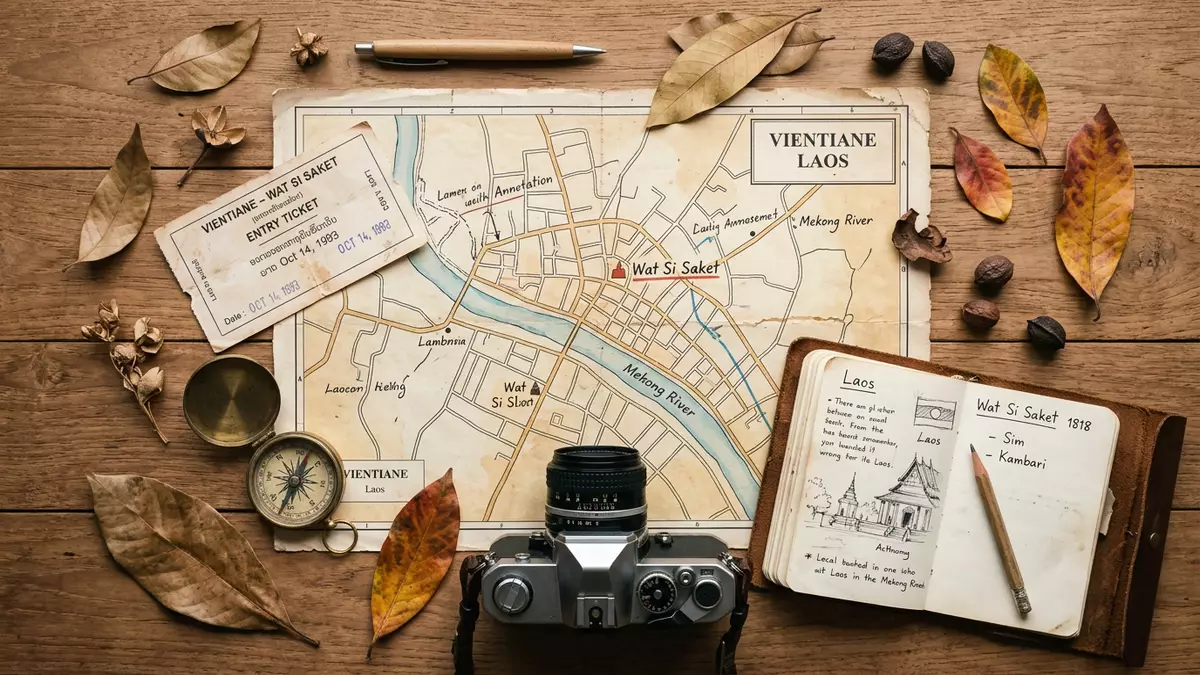
Wat Si Saket in Vientiane is an early nineteenth-century Buddhist monastery with a cloister lined by Buddha images. It was commissioned by King Anouvong and belongs to the reign of Anouvong, a name that sits at the centre of its history. The temple’s age and its enclosed galleries give it a compact, carefully ordered presence in the city.
Lanterns, galleries and a royal name
The complex combines a roofed ordination hall with a rectangular outer wall and a covered walkway. The galleries hold rows of small and larger Buddha figures in niches, so the walls read almost like a continuous devotional inventory.
The temple is linked with the early years of the Lao kingdom of Vientiane, and the name of Chao Anou appears in several accounts of its foundation. Its setting and form place it among the most recognisable religious compounds in the old centre of Vientiane.
Stone, paint and a long wall of images
The monastery’s most immediate feature is the repetition of imagery along the walls. Terracotta, wood and plaster sit together with painted surfaces, and the result is a dense visual field rather than a single monumental object.
The galleries frame the courtyard and the central hall, making the walk through the compound a sequence of enclosed and open spaces. The arrangement is modest in scale compared with a large palace complex, yet it carries a strong sense of continuity between architecture and worship.
A temple with an early nineteenth-century profile
Wat Si Saket belongs to the period when Vientiane was still a royal capital in its own right. Its architecture is associated with the reign of King Anouvong, and the compound preserves the look of an older Lao-Buddhist sanctuary.
The monastery’s long walls, enclosed court and layered rooflines make it easy to read as a living religious site rather than a ruin or a museum piece. That combination of use and preservation gives the place its particular weight within Vientiane’s historic centre.
Visiting Wat Si Saket: what travellers from Western Europe should know
- Wat Si Saket stands in central Vientiane, within reach of the city’s historic core and nearby temple quarter.
- The compound is flat and enclosed, with galleries around the courtyard and a central hall rather than long outdoor approaches.
- The site is in Laos, where the official language is Lao and the currency is the kip.
- Entry requirements depend on your nationality; UK travellers can check the FCDO travel advice at gov.uk/foreign-travel-advice, Irish travellers the Department of Foreign Affairs at ireland.ie.
Searching for Wat Si Saket on social platforms
These links open searches for Wat Si Saket on each platform.
Frequently asked questions about Wat Si Saket
Where is Wat Si Saket?
Wat Si Saket is in Vientiane, the capital of Laos, in the historic centre of the city.
What does a visit involve?
The compound is centred on galleries, a courtyard and the main temple hall, with Buddha images set into the walls.
What makes Wat Si Saket distinctive?
Its early nineteenth-century royal origin, enclosed cloister and long ranks of images give it a clear identity in the temple landscape of Vientiane.


