
Wat Saket and the hill above Bangkok’s old city
Published on 09/23/2026 at 18:23 | Editorial responsibility: Rafael Müller, Editor-in-Chief AD HOC NEWS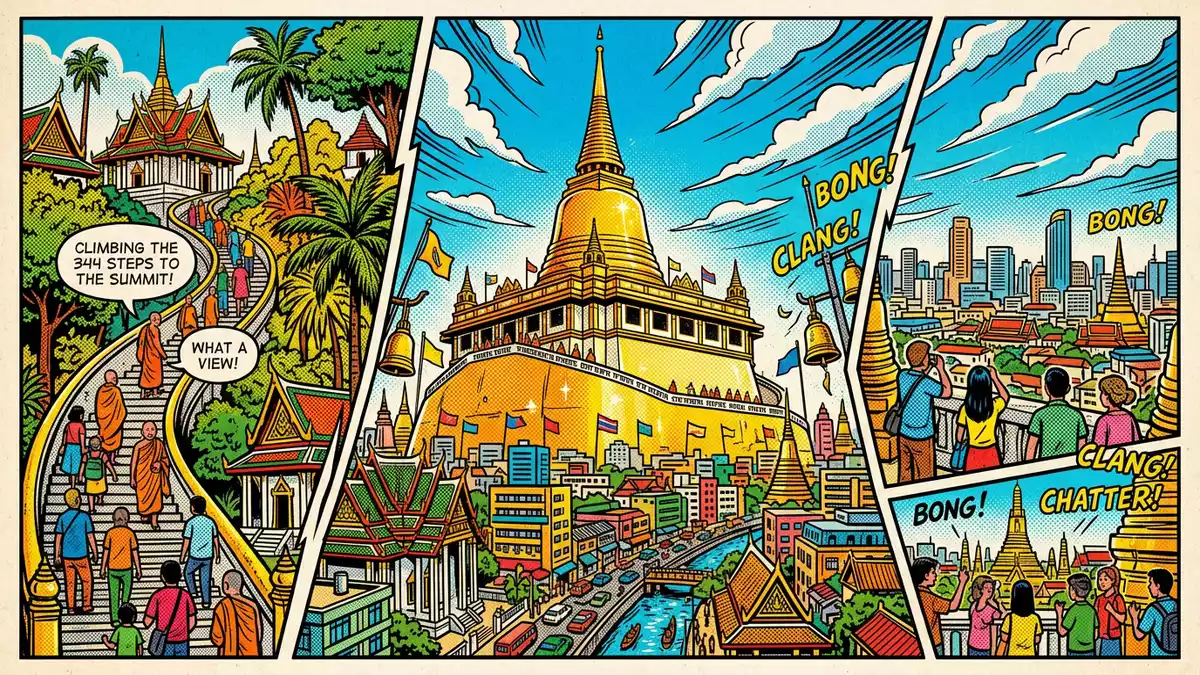
Wat Saket rises above Bangkok on Phu Khao Thong, an artificial hill crowned by a gilded chedi. The temple complex combines a Buddhist sanctuary, a nineteenth-century royal project and a stairway above the old city.
From the surrounding streets, the hill is the defining feature. At the summit, the gilded stupa and the open views belong to the temple’s architectural identity, while the lower compound contains halls, images and shaded paths.
Wat Saket begins with an Ayutthaya-era temple
The roots of Wat Saket reach back to the Ayutthaya period, when the temple was known as Wat Sakae. Its setting lies in Bangkok’s historic inner districts, outside the old royal core that developed after the city became the capital.
King Rama I renovated the temple after the founding of Bangkok in 1782 and gave it the name Wat Saket Ratcha Wora Maha Wihan. This places the sanctuary within the early Rattanakosin period, when temples formed part of the new capital’s religious and civic landscape. Wat Saket and the Golden Mount remain closely linked in the city’s geography and cultural vocabulary.
The temple is a working Buddhist complex rather than a single monument. Its identity includes the ordination hall, devotional spaces, images and the elevated shrine above them. The lower buildings provide the setting for Phu Khao Thong, whose name means Golden Mountain.
Phu Khao Thong turns a temple into a landmark
The artificial hill is the visible centre of Wat Saket. It rises about 80 m (262 ft) above the surrounding ground and is climbed by a winding staircase around the slope. Bells and vegetation line parts of the ascent, while masonry walls define the hill’s upper structure.
King Rama III began a large chedi project at Wat Saket during his reign, from 1824 to 1851. The structure collapsed during construction, and the remaining earth and brick became the basis of the mound. A smaller chedi was begun under King Rama IV and completed during the reign of King Rama V.
The completed summit shrine is gilded and contains a Buddhist relic. The stupa’s position above the temple compound gives Wat Saket a clear vertical composition: low halls and courtyards below, a planted artificial slope in the middle, and the gold-covered chedi at the top. Phu Khao Thong’s history connects the hill with the reigns of Rama III, Rama IV and Rama V.
The ascent ends at a terrace surrounding the chedi. Bangkok’s urban fabric spreads beyond the parapet, with rooftops, roads and temple buildings visible from the elevated platform. The view is inseparable from the hill’s design, because the summit itself is the destination of the climb.
Royal history and a darker chapter
Wat Saket also carries the history of Bangkok’s epidemics. During cholera outbreaks in the nineteenth century, the temple grounds were associated with cremation and the handling of people who had died during severe public-health crises. The subject forms part of the site’s historical record alongside its religious role.
The temple’s development continued across several reigns of the Chakri dynasty. Rama I established its place in the new capital, Rama III began the great hill project, Rama IV advanced the summit structure, and Rama V’s reign saw the completion of the gilded chedi.
These layers are visible in the contrast between the ordinary scale of the temple compound and the high artificial mound. Wat Saket is neither only a shrine nor only a viewpoint. It is a religious site whose architecture records royal patronage, changing urban geography and the long history of Bangkok’s Buddhist institutions.
The modern temple buildings belong largely to the early twentieth century. The complex includes marble elements, painted surfaces, devotional sculpture and monastic spaces, while Phu Khao Thong remains its most recognisable architectural feature. A history of the Golden Mount also links the summit relic with discoveries in India and the reign of Rama V.
Visiting Wat Saket: what travellers from Western Europe should know
- Wat Saket is on Boripat Road in Ban Bat, within Pom Prap Sattru Phai district of Bangkok. The temple lies in the old city area, close to the Khlong Mahanak canal.
- The summit is reached by a continuous staircase that winds around the artificial hill. The approach includes steps, inclines and exposed sections around the upper terrace.
- Bangkok’s official language is Thai and its national currency is the baht.
- Wat Saket is a Buddhist temple, so the lower compound and summit include active religious spaces, shrines and images.
Searching for Wat Saket on social platforms
These links open searches for Wat Saket on each platform.
Frequently asked questions about Wat Saket
Where is Wat Saket?
Wat Saket is in Bangkok’s Pom Prap Sattru Phai district, on Boripat Road in the Ban Bat area. It stands within the historic inner city, beside the Khlong Mahanak canal.
What can visitors expect at Wat Saket?
The complex contains Buddhist halls, images, courtyards and the staircase ascending Phu Khao Thong. The summit terrace surrounds a gilded chedi and overlooks Bangkok’s old city.
What makes Wat Saket distinctive?
Its central feature is an artificial hill carrying a gilded summit chedi. The hill combines royal history from the Chakri dynasty with an active Buddhist temple and an elevated city view.


