
Wat Saket and the Golden Mount above Bangkok’s old city
Published on 08/27/2026 at 14:02 | Editorial responsibility: Rafael Müller, Editor-in-Chief AD HOC NEWS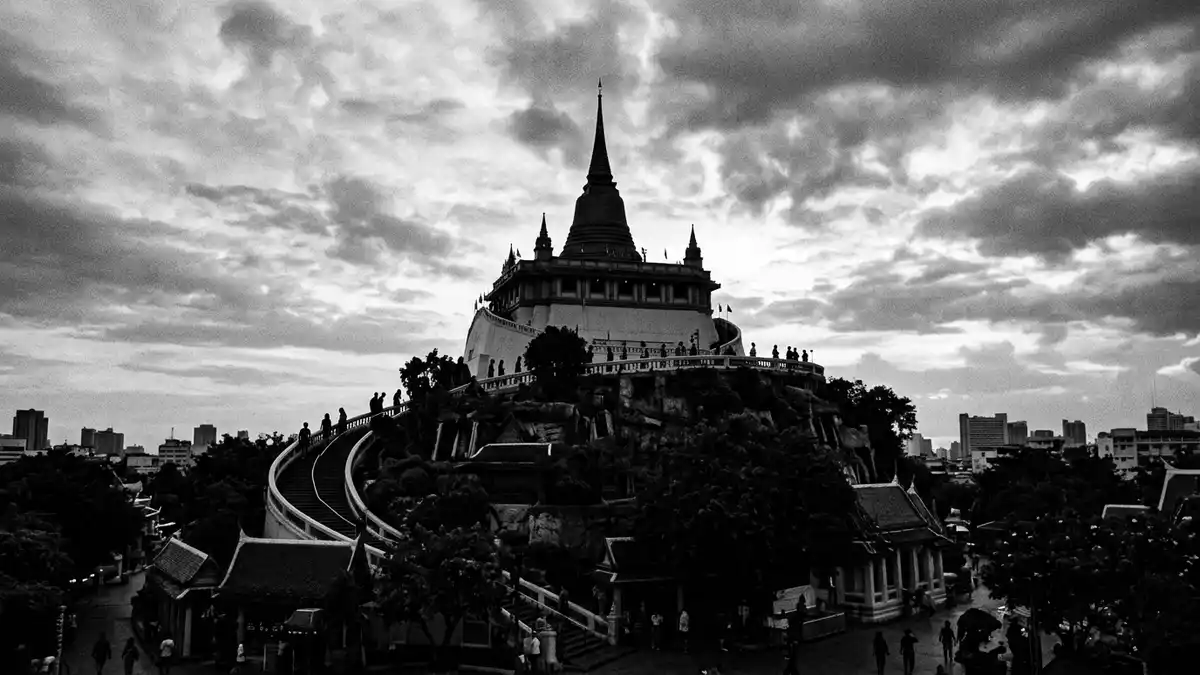
Wat Saket is a historic Buddhist temple in Bangkok, rising on the man-made Golden Mount with a gilded chedi that has watched the city expand around it for generations. The temple’s roots reach back to the Ayutthaya period, and its present form reflects the work of early Chakri kings from Rama I through Rama V.
An old Ayutthaya temple reshaped by the early Bangkok kings
Wat Saket stands just outside the historic core of Bangkok and is considered one of the city’s older temple complexes, with origins in the Ayutthaya era when it was known as Wat Sakae.origins in the Ayutthaya era After the founding of Bangkok as the capital of the Rattanakosin Kingdom, King Rama I ordered the temple to be renovated and renamed it Wat Saket Ratcha Wora Maha Wihan, underlining its place in the new royal city.
Several accounts note that Rama I used Wat Saket for important royal rituals, and the compound lay close to the early city walls that enclosed the historic centre.King Rama I renovated the temple In the nineteenth century the temple gained a sombre role as a cremation site during cholera epidemics, when large numbers of victims were brought here from the surrounding districts for rites and cremation in the grounds.cremation site during cholera epidemics
The Golden Mount: an artificial hill born from a collapsed chedi
Wat Saket is defined visually by Phu Khao Thong, the Golden Mount, a steep artificial hill within the temple compound topped by a large gilded stupa. The structure began in the reign of King Rama III, who commissioned a chedi of very large dimensions at the temple; the weight proved too much for Bangkok’s soft soil and the chedi collapsed during construction, leaving a broad mound of mud and brick.collapsed during construction
Over the following decades the abandoned mound took on the appearance of a natural hill and became overgrown, gaining the name Phu Khao Thong, the Golden Mount, as it became part of the temple landscape.took on the appearance of a natural hill During the reign of King Rama IV the hill was reinforced with timber and other supports so that a smaller chedi could be safely built on its summit.reinforced with timber In Rama V’s time the chedi was completed and a relic of the Buddha, reported to have come from India, was enshrined inside, turning the Golden Mount into a pilgrimage focus as well as a city landmark.relic of the Buddha enshrined
Architecture, atmosphere and views from the hill
The temple buildings at Wat Saket follow central Thai Buddhist architecture, with ordination halls, chapels and monastic quarters arranged around courtyards beneath layered roofs. The Golden Mount rises from this complex as a broad hill encircled by steps and terraces, leading upwards through planted levels to the white base and gilded chedi that form its summit profile.encircled by steps and terraces
At the top, the chedi’s gold-coloured exterior and ring of small bells give the summit a distinct character against Bangkok’s low-rise older districts. From the upper terraces visitors can see across the old city, with views towards the Grand Palace area and the dense street grid that surrounds the temple.views across the old city Within the broader compound, shrines and prayer halls display Buddha images and murals, while the base of the Mount contains relics and memorials reflecting the temple’s role in past epidemics.memorials reflecting the temple’s role
Visiting Wat Saket: what travellers from Western Europe should know
- Wat Saket lies on the eastern side of Bangkok’s historic Rattanakosin area, in the Pom Prap Sattru Phai district, and is reached by road or canal from central districts.
- The ascent of the Golden Mount follows a staircase that climbs the hill in stages, with a sustained gradient and a significant number of steps between the temple courtyard and the summit terrace.
- In Bangkok’s tropical climate the exposed sections of the stairway and summit can be hot and humid, while the lower courtyards and interior halls provide shaded spaces within the temple grounds.
- The official language is Thai and the currency is the baht; signs around the temple include Thai script and some English translations.
- Entry requirements depend on your nationality; UK travellers can check the FCDO travel advice at gov.uk/foreign-travel-advice, Irish travellers the Department of Foreign Affairs at ireland.ie.
Searching for Wat Saket on social platforms
These links open searches for Wat Saket on each platform.Frequently asked questions about Wat Saket
Where is Wat Saket located in Bangkok?
Wat Saket stands near the eastern edge of the Rattanakosin historic district in central Bangkok, in the Pom Prap Sattru Phai area.
What can visitors expect when climbing the Golden Mount?
The Golden Mount is a man-made hill with a long stairway that rises through terraces and shrines to a summit terrace and gilded chedi overlooking the old city.
What makes Wat Saket distinctive among Bangkok’s temples?
The combination of an Ayutthaya-era temple, its nineteenth-century Golden Mount and the Buddha relic housed in the summit chedi gives Wat Saket a layered historical and architectural character.


