
Wat Phra Yai and its golden Buddha above the sea
Published on 08/31/2026 at 07:10 | Editorial responsibility: Rafael Müller, Editor-in-Chief AD HOC NEWS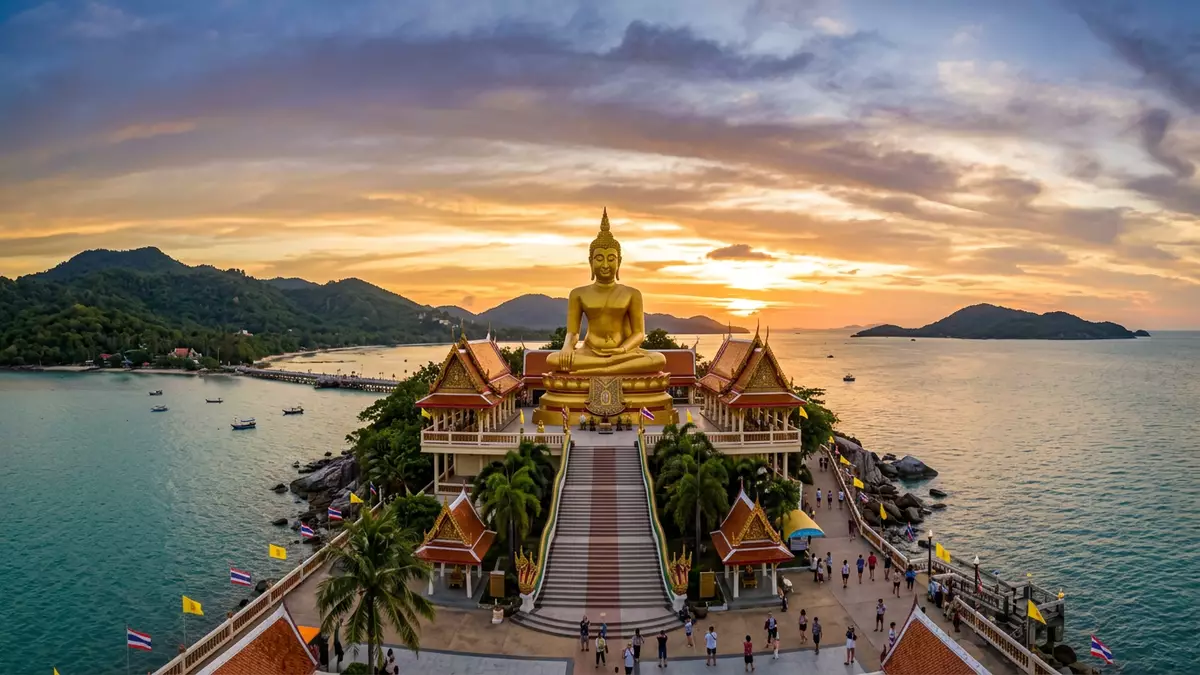
Wat Phra Yai on Ko Samui is defined by a vast gold-painted Buddha image raised on a small offshore island and reached by a causeway above the shallow sea. Built in 1972 as a modern addition to the island’s religious landscape, the temple has become a clear landmark in the northeast of Ko Samui, with its seated Buddha visible from planes approaching Samui International Airport. The Buddha image, about 12 m (39 ft) high, dominates Koh Faan, the rocky islet on which the temple complex stands.
A golden Buddha on Koh Faan
The central figure at Wat Phra Yai is a seated Buddha image in Bhumisparsha mudra, the earth-touching gesture associated with the moment of enlightenment.The golden seated Buddha rises about 12 m (39 ft) above its base, giving it a scale that stands apart from the surrounding low buildings and the waters around Koh Faan.The image is gold-painted and completed in 1972 The figure sits on a high platform, with a decorative wheel and stylised supports forming a backdrop that reads clearly against the tropical sky.
A long staircase leads from the temple forecourt up to the Buddha terrace, its balustrades shaped into naga forms that frame the climb.The stepped ascent to the statue From the upper platform, visitors can walk around the base of the image and look out over the sea, the nearby bays and the low hills of Ko Samui’s northeastern coast. At ground level, smaller shrines, prayer halls and Buddha images stand within the temple grounds, combining daily religious use with the steady flow of visitors who come to see the large image.
Temple, island and coastal setting
Wat Phra Yai occupies Koh Faan (also written Koh Fan or Koh Farn), a small island lying just off the northeastern tip of Ko Samui, near Bang Rak, historically known as Big Buddha Beach.The temple’s position on Koh Faan and Big Buddha Beach A short causeway carries a road from Route 4171 out across the water to the temple forecourt, turning the islet into an easily reached outpost rather than an isolated rock. The location places Wat Phra Yai close to Samui International Airport and within sight of the flight path, so the golden figure becomes part of the arrival sequence for many travellers.
The temple’s coastal setting shapes much of its atmosphere. The causeway crosses shallow tidal waters, with fishing boats and small piers scattered along the shore. From the Buddha terrace and other vantage points around the complex, views extend over the Gulf of Thailand towards nearby islands such as Ko Phangan.The outlook over the Gulf from Koh Faan Within the grounds, religious buildings mix with shops selling offerings, incense and souvenirs, reflecting Wat Phra Yai’s dual role as a functioning Buddhist temple and a recognised attraction on Ko Samui’s circuit of coastal sights.
Ko Samui’s modern-era Buddha landmark
The Buddha image at Wat Phra Yai was completed in 1972, placing it firmly in the late twentieth century rather than among Thailand’s older temple complexes.Completion of the statue in 1972 In the decades since, it has become one of Ko Samui’s most recognisable structures, standing on its island as the largest single figure in the area’s skyline.Wat Phra Yai as a major landmark on Ko Samui Its modern date gives the complex a different character from older wats elsewhere in Thailand: the main image is a product of concrete and contemporary construction methods, yet it sits within a religious tradition that stretches back centuries.
The design of the Buddha at Wat Phra Yai follows established iconography rather than experimental forms. The Mara posture, with the Buddha seated and one hand reaching towards the earth, is widely used across Thai temple art and links the Ko Samui figure with major Buddha images elsewhere in the country.The Mara posture at Wat Phra Yai Around the central image, the temple grounds include ordination halls and smaller shrines that serve the local community, making Wat Phra Yai both a symbol for visitors and a working religious site for residents of the Bang Rak and Bophut areas.
Visiting Wat Phra Yai: what travellers from Western Europe should know
- Wat Phra Yai stands on Koh Faan, reached by a short causeway from the northeastern coast of Ko Samui near Bang Rak and Bophut, with access from Route 4171.
- The temple complex includes a staircase of many steps leading to the Buddha terrace, so visiting the upper platform involves a sustained climb on stairs rather than on a ramp.
- The temple lies close to Samui International Airport on the island’s northeastern side, and the approach roads pass through built-up coastal areas with shops and other small businesses.
- The official language is Thai and the currency is the Thai baht.
- Entry requirements depend on your nationality; UK travellers can check the FCDO travel advice at gov.uk/foreign-travel-advice, Irish travellers the Department of Foreign Affairs at ireland.ie.
Searching for Wat Phra Yai on social platforms
These links open searches for Wat Phra Yai on each platform.Frequently asked questions about Wat Phra Yai
Where is Wat Phra Yai located?
Wat Phra Yai stands on Koh Faan, a small island off the northeastern coast of Ko Samui in Thailand, linked to Bang Rak by a short causeway.
What should visitors expect during a visit?
Visitors encounter a working Buddhist temple with a large gold-painted Buddha image, smaller shrines and a staircase leading to terraces with coastal views over Ko Samui and the surrounding sea.
What makes Wat Phra Yai distinctive among Ko Samui’s sights?
The combination of a 12 m (39 ft) seated Buddha in Mara posture, its completion in 1972 and its position on an offshore island reached by causeway makes Wat Phra Yai a distinctive landmark on Ko Samui.


