
Wat Phra That Doi Suthep and its golden hilltop terrace above Chiang Mai
Published on 08/26/2026 at 19:19 | Editorial responsibility: Rafael Müller, Editor-in-Chief AD HOC NEWS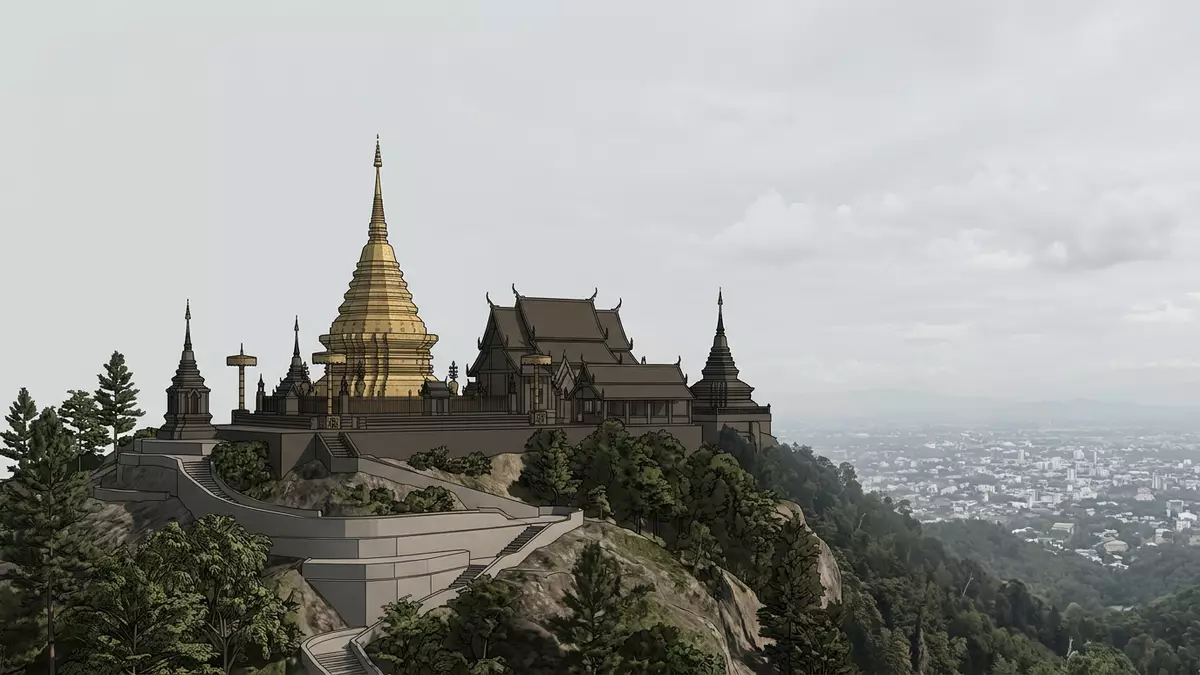
Wat Phra That Doi Suthep is a Buddhist temple complex on a mountain overlooking Chiang Mai in northern Thailand, known for its golden chedi and broad views across the city and surrounding hills. Rising on Doi Suthep within the former Lanna kingdom, the monastery is traditionally dated to the late fourteenth century, when the first shrine was established to house a revered relic of the Buddha. The combination of sacred status, Lanna architecture and the elevated terrace makes this hilltop temple one of the defining religious sites of Chiang Mai.
A Lanna-era sanctuary on a sacred mountain
Wat Phra That Doi Suthep stands within the historical territory of the Lanna kingdom, which flourished in northern Thailand from the thirteenth to the sixteenth century. The temple complex is closely associated with King Keu Naone, also known as Ku Na, who ruled Lanna during the late fourteenth century and is credited with founding the monastery to enshrine a relic attributed to the Buddha’s shoulder bonein 1383. The founding date appears consistently in accounts of the temple’s history and ties the site to a specific moment in Lanna religious and political lifein the late fourteenth century.
The temple’s origin story revolves around a white elephant carrying the relic up the forested slopes of Doi Suthep until it stopped, trumpeted and died, a sequence interpreted as a sign that a shrine should be built at that precise spotby King Ku Na. While this legend varies in detail between tellings, the consistent elements are the Lanna king, the relic brought from Sukhothai and the mountain as a chosen site for venerationabove Chiang Mai. Over subsequent centuries, the monastery was expanded and embellished, reflecting both the prosperity of Lanna and later restoration campaigns under Chiang Mai rulers.
The golden chedi and Lanna architectural ensemble
At the centre of Wat Phra That Doi Suthep stands a gold-plated chedi that rises above a paved terrace, surrounded by chapels, cloisters and smaller shrines. The central chedi is described as around 24 m (79 ft) high and follows a Northern Thai form, with a redented octagonal base and a tiered spire crowned by a multi-layered umbrellashowing Sukhothai and Burmese influences. Its gold-coloured surface reflects light across the terrace, and at its base, smaller gilded elements, niches and ritual objects create a dense field of devotional detail around the relic chamber.
Encircling the chedi, the temple courtyard contains viharns and chapels with layered, overlapping roofs typical of Lanna design, along with bells, statues and carved Naga balustrades. The monastery is described as a faithful example of Lanna art, combining chedis resembling bell towers, roofed chapels and planted areas within the compoundon Doi Suthep. Murals and sculptures depict episodes from Buddhist cosmology and regional religious life, while the arrangement of the terrace creates an enclosed, ritualised space around the chedi before the open views beyond.
Ascent, terrace and views over Chiang Mai
The physical approach to Wat Phra That Doi Suthep is a prominent part of the experience of the site. A long staircase lined with Naga serpent balustrades climbs from the lower level towards the terrace, forming a ceremonial route between the forest below and the temple courtyard aboveon the mountain. Accounts of the complex describe hundreds of steps on this staircase, which gradually reveal rooflines and shrines as visitors reach the upper levels.
From the upper terrace, balconies and viewpoints look out across Chiang Mai and the surrounding valley, giving wide views of the urban grid, the Ping River plain and distant hills. The temple lies within the Doi Suthep–Pui area, which was later designated as a national park, placing the monastery within protected forest terrainas Thailand’s 24th national park. The contrast between the enclosed, gilded courtyard around the chedi and the expansive landscape view beyond the balustrades is one of the most striking aspects of the site.
Visiting Wat Phra That Doi Suthep: what travellers from Western Europe should know
- Wat Phra That Doi Suthep stands on Doi Suthep mountain to the west of Chiang Mai, reached by road from the city and then by a staircase or mechanical ascent on the final slope.
- The approach from the lower level to the main terrace involves climbing a long stairway with many steps, flanked by Naga serpent balustrades, so the visit includes a sustained ascent on foot.
- The temple lies within the forested Doi Suthep–Pui area, at an elevation of well over 1,000 m (3,281 ft), so the air and weather conditions can differ from those on the plain below.
- The official language is Thai and the currency is the baht; English is used in some informational signs and by people working with international visitors.
- Entry requirements depend on your nationality; UK travellers can check the FCDO travel advice at gov.uk/foreign-travel-advice, Irish travellers the Department of Foreign Affairs at ireland.ie.
Searching for Wat Phra That Doi Suthep on social platforms
These links open searches for Wat Phra That Doi Suthep on each platform.
Frequently asked questions about Wat Phra That Doi Suthep
Where is Wat Phra That Doi Suthep located?
Wat Phra That Doi Suthep stands on Doi Suthep mountain to the west of Chiang Mai, in northern Thailand, within the Doi Suthep–Pui forested area.
What should visitors expect on a visit?
Visitors encounter a long Naga-lined staircase or mechanical ascent, a terrace with a gold-plated central chedi, multiple chapels and broad views over Chiang Mai and the valley below.
What makes Wat Phra That Doi Suthep distinctive among temples?
The combination of its Lanna-era origin, association with King Keu Naone and a revered relic, the gold-plated chedi and the elevated terrace overlooking Chiang Mai gives the monastery a distinctive character in northern Thailand.


