
Wat Pho and the vast golden reclining Buddha of Bangkok
Published on 09/22/2026 at 10:00 | Editorial responsibility: Rafael Müller, Editor-in-Chief AD HOC NEWS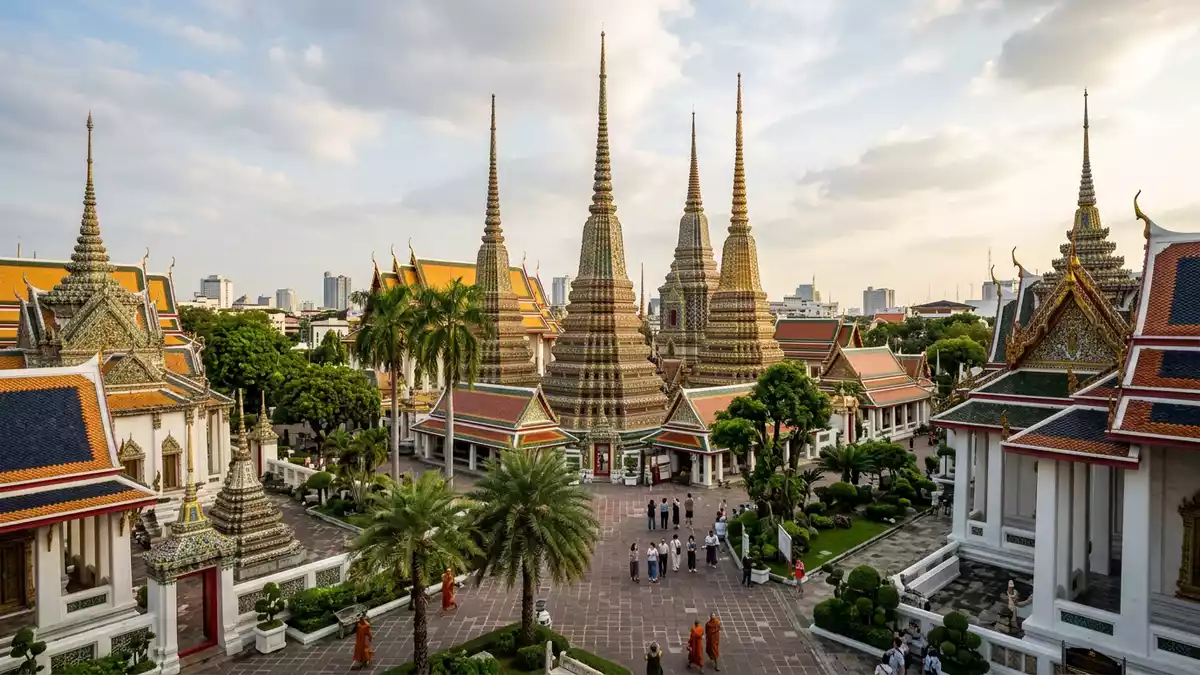
Wat Pho in Bangkok is a temple complex organised around a reclining Buddha image measuring 46 m (151 ft) long. Gold surfaces, painted details and the figure’s extended form occupy the image hall, while courtyards, chedis and pavilions continue across the surrounding royal monastery.
The complex carries the official name Wat Phra Chetuphon Wimon Mangkhalaram Rajwaramahawihan. Its buildings connect Bangkok’s Rattanakosin period with the Ayutthaya-era monastery that stood under an earlier name.
Wat Pho: the reclining Buddha and its architectural setting
The reclining Buddha is associated with King Rama III and dates from 1832. The image rests within a dedicated chapel, with the body extending along the length of the interior and the feet marked by detailed decorative work.
Wat Pho is not a single hall but an extensive ensemble of religious buildings. Chedis covered in glazed tiles rise among courtyards, while galleries contain rows of Buddha images and murals. Brick, stucco, ceramic decoration and painted surfaces appear together throughout the compound.
The temple’s formal name is preserved in its official historical name. The title places Wat Pho within Bangkok’s royal Buddhist tradition and distinguishes it from temples bearing similar shortened names.
Rama I, Rama III and the making of a royal monastery
Wat Pho began as Wat Phodharam, a monastery associated with the Ayutthaya period. King Rama I ordered its restoration in 1788, after Bangkok became the capital of the Chakri kingdom.
The restored monastery received a royal role near the Grand Palace. Its name changed during the reign of Rama I, and a major campaign under Rama III gave much of the complex its present architectural character.
Rama III’s period connected religious buildings with the recording of knowledge. Marble panels and inscriptions present material connected with Buddhist teaching, literature, medicine and traditional practices. These panels turn walls and galleries into part of the temple’s intellectual history.
The traditional centre of learning remains central to Wat Pho’s identity. The complex is associated with public instruction as well as worship, and its educational role extends beyond the reclining Buddha.
Marble inscriptions, massage and the living temple complex
Wat Pho’s marble inscriptions form a substantial record of Thai knowledge. Their subjects include medicine, astrology, literature and Buddhist thought, arranged across architectural surfaces rather than gathered in a separate museum.
The inscriptions entered UNESCO’s Memory of the World Register in 2011. This designation concerns the documentary heritage preserved at Wat Pho, not the entire temple complex as a World Heritage Site.
Traditional Thai massage is also connected with Wat Pho. Instruction, medical knowledge and religious practice share the same compound, giving the temple an identity that extends beyond its most photographed sculpture.
Religious activity remains visible in the layout. Worship halls, image galleries, chedis and shaded passages occupy distinct parts of the grounds, with decorative detail varying from one building to another. The marble inscription tradition is one of the clearest links between the site’s architecture and its educational history.
Visiting Wat Pho: what travellers from Western Europe should know
- Wat Pho lies on Sanam Chai Road and Maharaj Road in Bangkok’s Phra Nakhon district, beside the Grand Palace. The Sanam Chai underground station serves the historic riverfront area.
- The complex contains paved courtyards, tiled surfaces, steps and religious interiors. Footwear is removed before entering designated halls, and clothing must cover shoulders and knees in sacred spaces.
- Wat Pho stands near the Chao Phraya River. Tha Tien pier provides a named river connection beside the temple district.
- The official language is Thai and the currency is the Thai baht.
- Entry requirements depend on your nationality; UK travellers can check the FCDO travel advice at gov.uk/foreign-travel-advice, Irish travellers the Department of Foreign Affairs at ireland.ie.
Searching for Wat Pho on social platforms
These links open searches for Wat Pho on each platform.
Frequently asked questions about Wat Pho
Where is Wat Pho?
Wat Pho is in Bangkok’s Phra Nakhon district, beside the Grand Palace and close to the Chao Phraya River. Its roads include Sanam Chai Road and Maharaj Road.
What can visitors expect at Wat Pho?
The complex contains the reclining Buddha chapel, worship halls, chedis, murals, image galleries and courtyards. Religious buildings share the grounds with marble inscriptions linked to Thai learning.
What makes Wat Pho distinctive?
Wat Pho combines a 46 m (151 ft) reclining Buddha with a royal monastery, an extensive architectural ensemble and inscriptions recorded in UNESCO’s Memory of the World Register.


