
Wat Pho and the reclining Buddha of Rattanakosin Island
Published on 08/26/2026 at 07:51 | Editorial responsibility: Rafael Müller, Editor-in-Chief AD HOC NEWS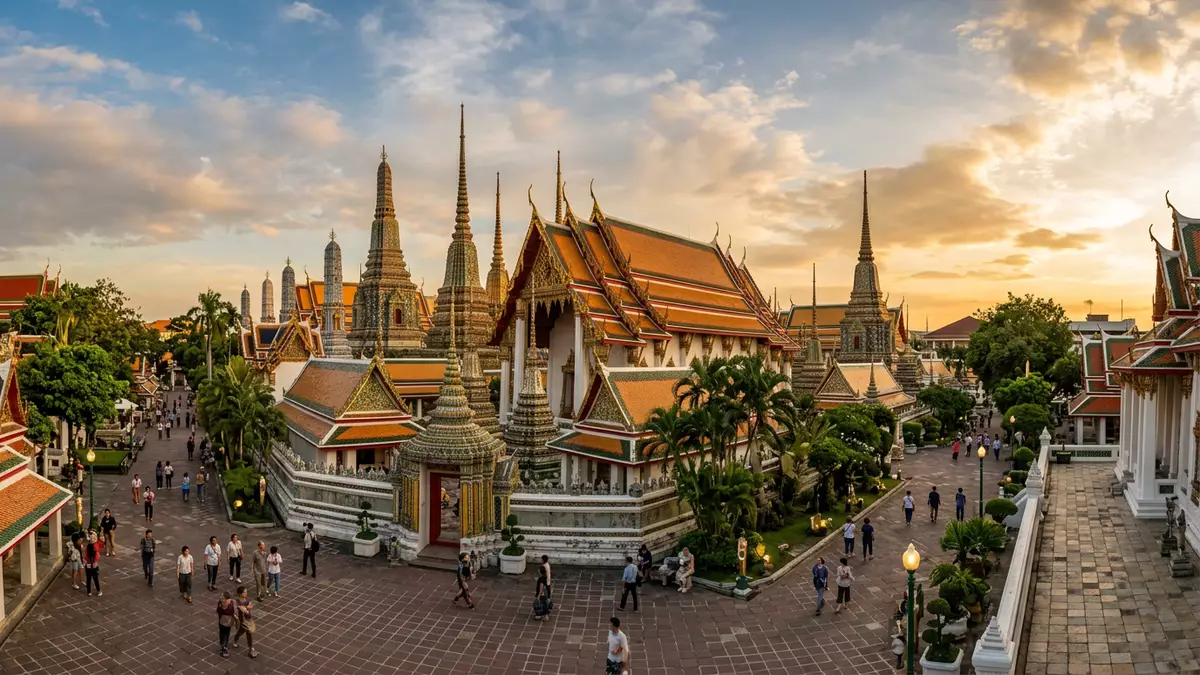
Wat Pho in Bangkok is best known for its monumental reclining Buddha, a gold-covered figure that fills its own hall and anchors one of the city’s most important temple complexes. Set on Rattanakosin Island near the Grand Palace, the monastery combines royal architecture, scholarly inscriptions and a living tradition of Thai massage within the same walled precinct.
The temple of the Reclining Buddha
Wat Pho’s full official name is Wat Phra Chetuphon Wimon Mangkhalaram Rajwaramahawihan, a designation that reflects its status as a royal Buddhist monastery in Bangkok’s historic core.Wat Phra Chetuphon Wimon Mangkhalaram The temple stands just south of the Grand Palace in the Phra Nakhon district, on the eastern bank of the Chao Phraya River, in an area often described as the old royal city.Maharat Road in Phra Nakhon
The origins of Wat Pho reach back to the Ayutthaya period, when a smaller monastery stood on this site before Bangkok became the capital in 1782.a small monastery during the Ayutthaya Kingdom King Rama I, founder of the Chakri dynasty, rebuilt the temple complex in the late eighteenth century as part of the establishment of the new capital on Rattanakosin Island.Rama I rebuilt the temple complex In the reign of King Rama III, the monastery was expanded and embellished on a grand scale, turning it into a centre of religious, artistic and scholarly life.
A 46-metre reclining Buddha in its own hall
The most striking sight at Wat Pho is the reclining Buddha, a gilded image that depicts the Buddha lying on his side in the pose associated with entry into nirvana.the reclining Buddha The figure is about 15 m high and 46 m long (roughly 49 ft by 151 ft), and occupies almost the full length of its dedicated viharn, so that visitors see it in sections as they move along the hall.15 meters tall, 46 meters long
The reclining Buddha was commissioned by King Rama III and installed in 1832, part of a wider phase of construction that added major structures and commemorative chedis to the complex.built by Rama III in 1832 Its surface is covered in gold leaf, while the soles of the feet are inlaid with mother-of-pearl panels depicting auspicious symbols associated with the Buddha’s qualities.feet are 5 meters long and exquisitely decorated Around the hall, rows of bronze bowls line one side, and columns, painted decoration and ceiling patterns frame the long perspective along the statue.
Chedis, cloisters and a school of Thai massage
Beyond the reclining Buddha hall, Wat Pho extends across a compound of around 80,000 square metres (about 20 acres), laid out in multiple courtyards, cloisters and minor chapels.an 80,000-square-meter Buddhist temple Within its precincts stand many chedis clad in glazed tiles and coloured ceramics, some large and grouped in clusters, others smaller and dedicated to individual members of the Chakri dynasty.chedis that honor his ancestors
The cloister galleries that wrap around inner courtyards are lined with seated Buddha images in regular rows, part of what is described as the largest collection of Buddha images in Thailand.largest collection of Buddha images in Thailand Stone sculptures of figures, animals and stylised guardians stand within the compound, while pavilions hold inscriptions and diagrams on subjects such as traditional medicine, yoga and massage. Wat Pho has long been associated with the teaching of Thai massage and is regarded as a key institution for this practice within Thailand.a respected traditional Thai massage school
Visiting Wat Pho: what travellers from Western Europe should know
- Wat Pho stands in Bangkok’s Phra Nakhon district on Rattanakosin Island, immediately south of the Grand Palace and close to the Chao Phraya riverfront.
- The temple compound is extensive, with paved courtyards, interior halls and some stairways, so a visit involves walking on hard surfaces and moving between covered and open areas.
- In the hot season the exposed courtyards can be very warm under direct sun, while the halls around the reclining Buddha and the cloisters provide shaded spaces.
- The official language is Thai and the currency is the baht.
- Entry requirements depend on your nationality; UK travellers can check the FCDO travel advice at gov.uk/foreign-travel-advice, Irish travellers the Department of Foreign Affairs at ireland.ie.
Searching for Wat Pho on social platforms
These links open searches for Wat Pho on each platform.
Frequently asked questions about Wat Pho
Where is Wat Pho located?
Wat Pho stands in Bangkok’s Phra Nakhon district on Rattanakosin Island, a short distance south of the Grand Palace and close to the Chao Phraya River.
What can visitors expect to see at Wat Pho?
Visitors encounter the vast reclining Buddha in its own hall, extensive cloisters lined with Buddha images, chedis decorated with glazed tiles and pavilions related to Thai traditional medicine.
What makes Wat Pho distinctive among Bangkok’s temples?
Wat Pho combines a monumental reclining Buddha from the reign of King Rama III with a large collection of Buddha images and a long-standing role in teaching Thai massage.


