
Wat Pho and the reclining Buddha of Bangkok
Published on 09/07/2026 at 22:38 | Editorial responsibility: Rafael Müller, Editor-in-Chief AD HOC NEWS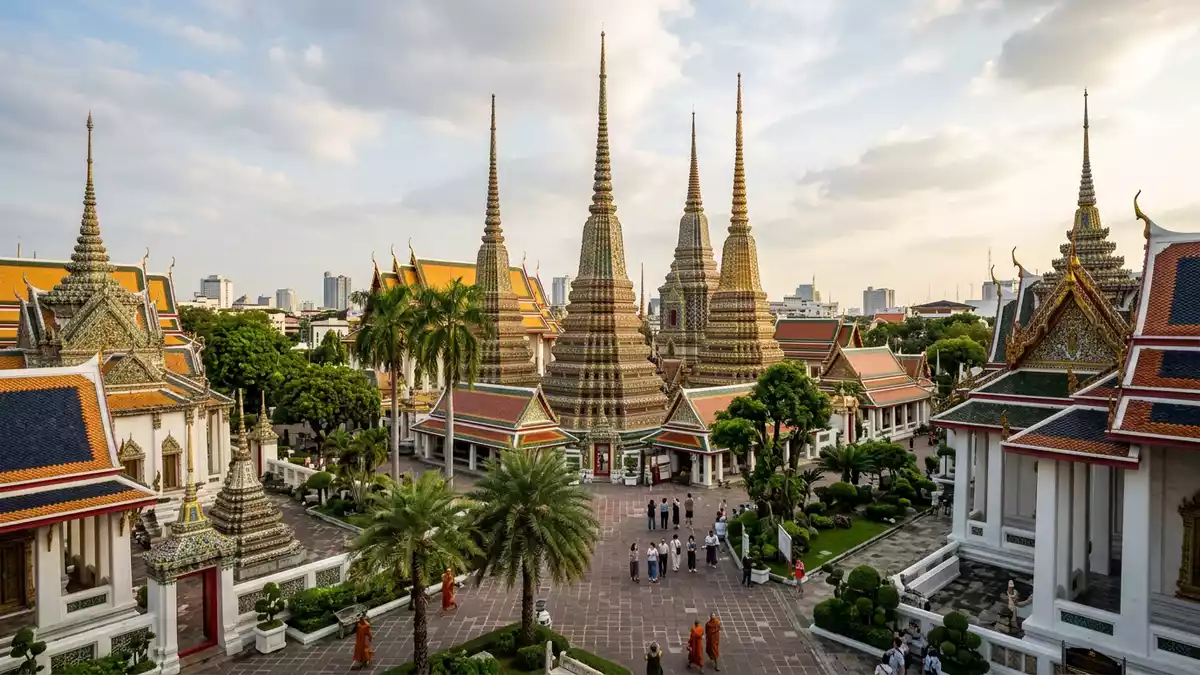
Wat Pho, officially Wat Phra Chetuphon Wimon Mangkhalaram Rajwaramahawihan, is a sprawling royal monastery on Rattanakosin Island in Bangkok, known above all for its gilded reclining Buddha and for its role as a centre of traditional Thai learning.Wat Phra Chetuphon The temple complex stands close to the Grand Palace in the historic core of the Thai capital and traces its origins to the Ayutthaya period, long before Bangkok became the seat of the Chakri Dynasty.Ayutthaya-period monastery
A royal temple shaped across the Chakri Dynasty
The heart of Wat Pho as visitors encounter it today grew out of a major restoration ordered by King Rama I, the founder of the Rattanakosin era, who had the older Wat Phodharam rebuilt and renamed in the late eighteenth century.restoration under King Rama I Work began in 1788 and continued for years, creating a first-grade royal monastery closely associated with the early Chakri kings and aligned with the ceremonial axis of the new capital.construction in 1788
Further expansion took place during the reign of King Rama III in the nineteenth century, extending the vihara halls and adding new chapels, a library hall, cloisters and teaching spaces within the enclosed compound.extensions under Rama III Stone inscriptions carved under Rama III record religious texts, traditional medicine and massage techniques, reflecting Wat Pho’s function as an early public repository of knowledge rather than solely as a monastic enclosure.stone inscriptions on medicine
The reclining Buddha: scale, detail and symbolism
The most striking single image at Wat Pho is the reclining Buddha, a brick and stucco figure covered in lacquer and gold that occupies an entire hall on the western side of the monastic area.brick and stucco reclining Buddha The image dates from the early Bangkok period and measures 46 m (151 ft) in length and 15 m (49 ft) in height from the base to the topknot, making it one of the largest Buddha figures in Thailand.46 metre reclining Buddha
The Buddha is shown lying on his side in the lion sleep posture, depicting the moment of entering parinirvana, and visitors walk along the length of the hall to take in different sections of the figure.parinirvana posture The soles of the feet are inlaid with mother-of-pearl panels, arranged into dozens of small scenes that represent auspicious characteristics associated with the Buddha, and a series of offering bowls line one side of the hall beneath mural paintings.mother-of-pearl soles of the feet
Courtyards, chedis and a living school of Thai massage
Beyond the reclining Buddha hall, Wat Pho spreads across courtyards, cloisters and garden spaces filled with Buddha images, Chinese guardian statues and monumental chedis clad in coloured ceramic tiles.temple complex and chedis The compound contains hundreds of Buddha figures, many brought from other centres of the old Siamese kingdom, and four large chedis commemorate the first four kings of the Chakri Dynasty, giving the temple a strong dynastic dimension.commemorative chedis
Wat Pho also functions as a training centre for traditional Thai medicine and massage, an activity embedded in the temple through illustrated inscriptions and teaching halls established under Rama III.teaching of traditional Thai massage Visitors encounter diagrams carved in stone that set out acupressure points and therapeutic lines, and the on-site school continues to offer instruction and treatments, linking the historic role of the monastery as a cradle of medical knowledge with contemporary practice.Thai traditional medicine inscriptions
Visiting Wat Pho: what travellers from Western Europe should know
- Wat Pho stands on Rattanakosin Island in central Bangkok, immediately south of the Grand Palace and close to the Chao Phraya River, reached by road or river transport.
- The temple compound contains multiple courtyards, cloisters and halls connected by paved walkways, with some interior areas accessed by modest flights of steps.
- The official language is Thai and the currency is the Thai baht.
- Entry requirements depend on your nationality; UK travellers can check the FCDO travel advice at gov.uk/foreign-travel-advice, Irish travellers the Department of Foreign Affairs at ireland.ie.
Searching for Wat Pho on social platforms
These links open searches for Wat Pho on each platform.Frequently asked questions about Wat Pho
Where is Wat Pho located within Bangkok?
Wat Pho stands on Rattanakosin Island in Bangkok’s historic centre, beside the Grand Palace and close to the Chao Phraya River.
What should visitors expect inside the temple complex?
Visitors encounter the large reclining Buddha, cloisters lined with Buddha images, colourful chedis, gardens and teaching halls dedicated to traditional Thai massage.
What makes Wat Pho distinctive among Thai temples?
Wat Pho combines royal monastery status, one of Thailand’s largest reclining Buddha images and a long-established role as a centre of traditional Thai medicine and massage.


