
Wat Pho and the reclining Buddha of Bangkok
Published on 08/30/2026 at 12:24 | Editorial responsibility: Rafael Müller, Editor-in-Chief AD HOC NEWS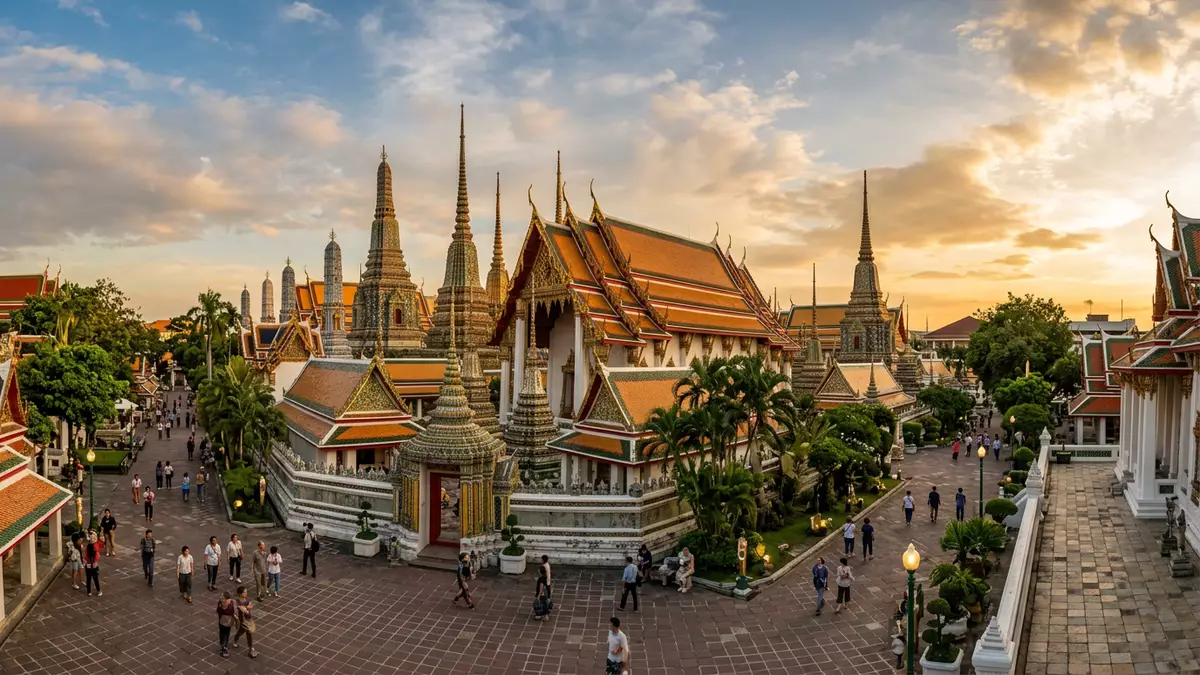
Wat Pho in Bangkok gathers a colossal reclining Buddha, dense temple courtyards and a historic massage school into one sprawling riverside complex. Officially known as Wat Phra Chetuphon Wimon Mangkhalaram, it stands beside the old royal quarter and has roots in the early Rattanakosin period under King Rama I.
A temple-city around the reclining Buddha
Wat Pho occupies a large rectangle of land in the Phra Nakhon district, with gateways leading into a network of paved courts and roofed halls. Within the enclosure, tiled chedis, cloisters and chapels are packed closely together, giving the impression of a compact city built to the scale of statues and stupas rather than streets. The complex is recognised as one of Bangkok’s historic royal temples, lying just south of the Grand Palace on the old island of Rattanakosin.Phra Nakhon district
The dominant figure inside this miniature city is the reclining Buddha, a gigantic gilded statue created in the reign of King Rama III in the nineteenth century. Wat Pho’s own description records that the image is about 46 m long and 15 m high, constructed in brick and stucco and then lacquered and gilded.The Reclining Buddha of Wat Pho The Buddha lies on his side in a posture associated with his entry into nirvana, and the figure fills its hall so completely that the viewing path squeezes along the flanks and at the soles of the feet.
Courtyards, chedis and teaching inscriptions
Beyond the reclining Buddha’s hall, Wat Pho is crowded with structures that trace the development of Bangkok’s early Chakri dynasty. The temple incorporates earlier foundations once known as Wat Phodharam, which King Rama I ordered to be restored in 1788, starting a project that continued for several years and culminated in a new royal monastery beside the Grand Palace.King Rama I ordered restoration in 1788 Later, in the reign of King Rama III during the first half of the nineteenth century, the complex was greatly enlarged, with the construction of the present hall for the reclining Buddha and additional vihara and library buildings.
Walking the outer courtyards brings rows of slender chedis clad in glazed ceramic, clusters of small Buddha statues and long cloisters lined with seated images into view. Wat Pho is known for housing an extensive collection of Buddha images gathered from across Thailand, and cloister walls carry murals that range from religious scenes to depictions of daily life.largest collection of Buddha images in Thailand Between the religious structures stand stone figures, small pavilions and shady corners that break up the paved expanses and offer varied perspectives on the chedis and roofs.
Massage school and traditional knowledge
Wat Pho is also closely associated with Thai traditional medicine and massage. Stone inscriptions and illustrations were installed around the temple during the reign of King Rama III as a form of public instruction, covering topics such as herbal remedies and pressure points on the human body.centre for public education and traditional Thai massage These inscriptions are part of a wider corpus of knowledge from Wat Pho that has been recognised in documentary heritage programmes, underlining the temple’s role as an early educational centre as well as a place of worship.
From this tradition grew a massage school within the temple grounds, where techniques of Thai massage and related therapeutic practices are taught. Diagrams showing lines along the body appear on some of the walls, echoing the formal teaching that takes place in the classrooms. For many visitors, time in the massage pavilions complements the visual experience of the courtyards and Buddha images, linking the temple’s architecture with a living tradition of bodywork.
Visiting Wat Pho: what travellers from Western Europe should know
- Wat Pho stands in the Phra Nakhon district of Bangkok on Rattanakosin island, immediately south of the Grand Palace and close to the east bank of the Chao Phraya River.
- The temple grounds are largely paved, with long walking routes around courtyards and several stairways between levels; the hall of the reclining Buddha has a defined one-way path.
- The climate in Bangkok is hot and humid throughout much of the year, and the open courtyards of Wat Pho offer limited shade away from trees and pavilions.
- The official language is Thai and the currency is the Thai baht. Entry requirements depend on your nationality; UK travellers can check the FCDO travel advice at gov.uk/foreign-travel-advice, Irish travellers the Department of Foreign Affairs at ireland.ie.
Searching for Wat Pho on social platforms
These links open searches for Wat Pho on each platform.
Frequently asked questions about Wat Pho
Where is Wat Pho in Bangkok?
Wat Pho stands in the Phra Nakhon district on Rattanakosin island, immediately south of the Grand Palace and close to the east bank of the Chao Phraya River.
What can visitors expect to see at Wat Pho?
Visitors encounter the vast reclining Buddha, extensive courtyards with chedis and cloisters of Buddha images, mural-covered halls and areas dedicated to traditional Thai massage.
What makes Wat Pho distinctive among Bangkok’s temples?
Wat Pho combines an early Chakri dynasty royal monastery, one of Thailand’s largest reclining Buddha images and a historic role in Thai traditional medicine and massage education.


