
Wat Pho and the reclining Buddha of Bangkok
Published on 08/27/2026 at 07:10 | Editorial responsibility: Rafael Müller, Editor-in-Chief AD HOC NEWS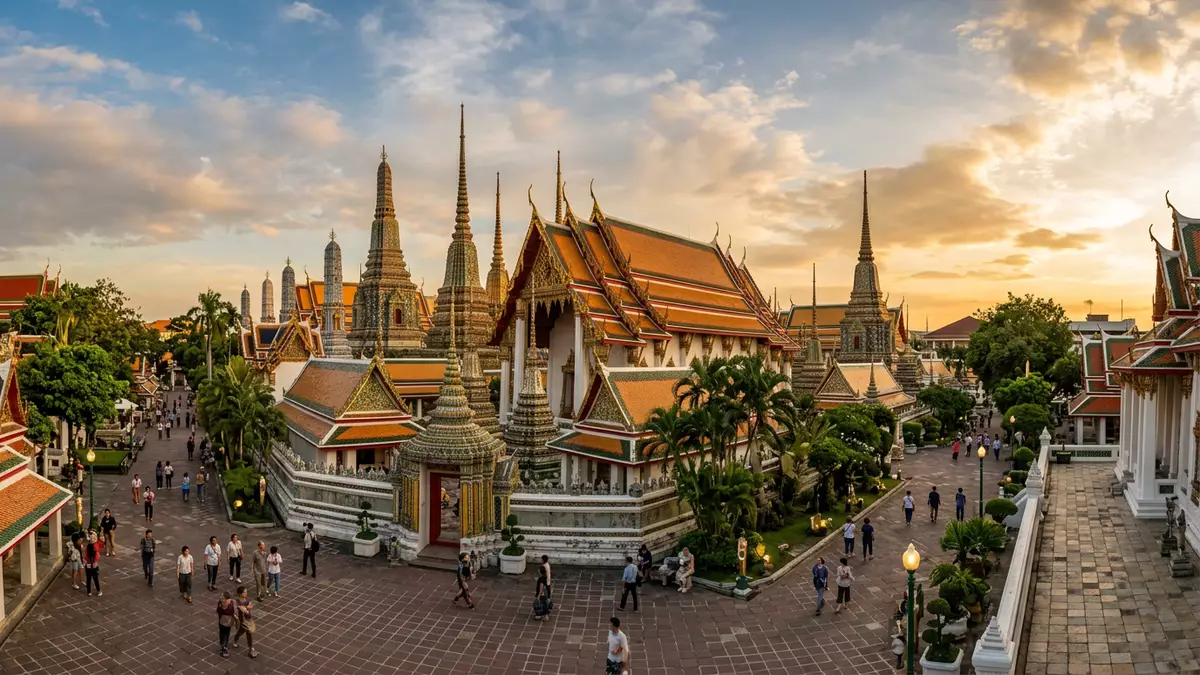
Wat Pho in Bangkok, formally known as Wat Phra Chetuphon Wimon Mangkhalaram, is one of Thailand’s great royal monasteries and the home of a vast reclining Buddha at the heart of the old city. In its present form the temple complex took shape under King Rama I in the late eighteenth century and King Rama III in the nineteenth century, as the new Chakri dynasty centred its power on the Chao Phraya river. Stepping through its gates brings a visitor into a dense landscape of gilded halls, towering chedis and cloistered courtyards that reflect more than two centuries of royal patronage.
The royal monastery beside the Grand Palace
Wat Pho stands on Sanam Chai Road in the Phra Nakhon district, immediately south of the Grand Palace and the former royal court of Bangkok. The site incorporates an older monastery known as Wat Photaram from the Ayutthaya period, which was rebuilt on a grander scale once Bangkok became the capital under King Rama I in 1782.Restoration in 1788 under Rama I turned the complex into a first-grade royal monastery associated closely with the new dynasty.The rebuilt temple of 1788
King Rama III expanded Wat Pho further in the nineteenth century, extending major vihara halls and commissioning new structures across what became several hectares of temple ground.A long restoration under Rama III gave the monastery much of the layout visible today, with distinct zones for ordination, worship, teaching and residence. The complex lies within walking distance of the river piers that line the Chao Phraya, and its boundary walls form one side of the ceremonial avenues that radiate from the Grand Palace.Location on Sanam Chai and Maharaj roads
The reclining Buddha and sacred halls
The most recognisable image at Wat Pho is the reclining Buddha, known in Thai as Phra Buddhasaiyas, which fills a long vihara on the western side of the complex. The statue dates from the reign of King Rama III in the early nineteenth century and measures about 46 m (151 ft) from head to feet and around 15 m (49 ft) high.Dimensions of the reclining Buddha Its body is covered in gold-coloured leaf, and the soles of the feet carry intricate inlaid designs that depict auspicious symbols from Buddhist cosmology.The gold-plated reclining image
South of the reclining Buddha hall stands the Phra Ubosot, or ordination hall, which forms the ritual core of Wat Pho and is used for monastic ceremonies.Phra Ubosot as the assembly hall The building originated in the reign of King Rama I in an Ayutthaya-influenced style and was enlarged in the reign of King Rama III, with layered roofs and richly decorated pediments. Inside, the principal Buddha image Phra Buddha Theva Patimakorn sits on a three-tiered pedestal, and some ashes of King Rama I are kept beneath the base, binding the sanctuary directly to the founding monarch of the Chakri dynasty.The Ubosot and principal Buddha image
Chedis, courtyards and monastic life
Beyond the main halls, Wat Pho unfolds as a dense network of cloisters and open courtyards dominated by chedis, or stupas, clad in coloured ceramic and mosaics. Dozens of medium-sized chedis line the cloister walks, while a group known as Phra Maha Chedi Si Rajakarn gathers four particularly large stupas together on a shared terrace.Ninety-five chedis and the Phra Maha Chedi Si Rajakarn Each of these four major chedis is dedicated to a king of the Chakri dynasty and carries its own colour pattern in tiles and mosaics, marking the close connection between the temple and successive reigns.Four high chedis honouring the first Chakri kings
Wat Pho remains an active monastery with a substantial resident community of monks and novices, whose living quarters occupy the southern section of the enclosure.Monastic and teaching functions Its grounds have long served as a place of Buddhist learning and traditional Thai scholarship, with inscriptions and images in some cloisters that record subjects ranging from religious doctrine to medical knowledge. The overall impression is of a working religious institution embedded in a historic architectural setting, rather than a monument frozen in a single era.
Visiting Wat Pho: what travellers from Western Europe should know
- Wat Pho stands on Sanam Chai Road in the Phra Nakhon district of Bangkok, immediately south of the Grand Palace complex and close to river boat piers on the Chao Phraya.
- The temple grounds form a sizeable, paved enclosure with several courtyards, so a visit involves walking between halls and navigating outdoor stairways and covered walkways.
- The complex contains multiple interior spaces, including the reclining Buddha hall and the Phra Ubosot, where footwear is removed at the entrance and floors are typically finished in stone or tile.
- The official language is Thai and the currency is the Thai baht. Entry requirements depend on your nationality; UK travellers can check the FCDO travel advice at gov.uk/foreign-travel-advice, Irish travellers the Department of Foreign Affairs at ireland.ie.
Searching for Wat Pho on social platforms
These links open searches for Wat Pho on each platform.
Frequently asked questions about Wat Pho
Where is Wat Pho located in Bangkok?
Wat Pho stands on Sanam Chai Road in the Phra Nakhon district, directly south of the Grand Palace and close to the Chao Phraya river.
What can visitors expect to see at Wat Pho?
Visitors encounter the large reclining Buddha, the Phra Ubosot with its principal seated Buddha image, extensive cloisters of gilded Buddha statues and courtyards filled with mosaic-clad chedis.
What makes Wat Pho distinctive among Bangkok’s temples?
Wat Pho combines a monumental reclining Buddha from the reign of Rama III with royal burial chedis and an active monastic and teaching complex linked closely to the Chakri dynasty.


