
Wat Pho and the reclining Buddha of Bangkok
Published on 08/13/2026 at 14:10 | Editorial responsibility: Rafael Müller, Editor-in-Chief AD HOC NEWS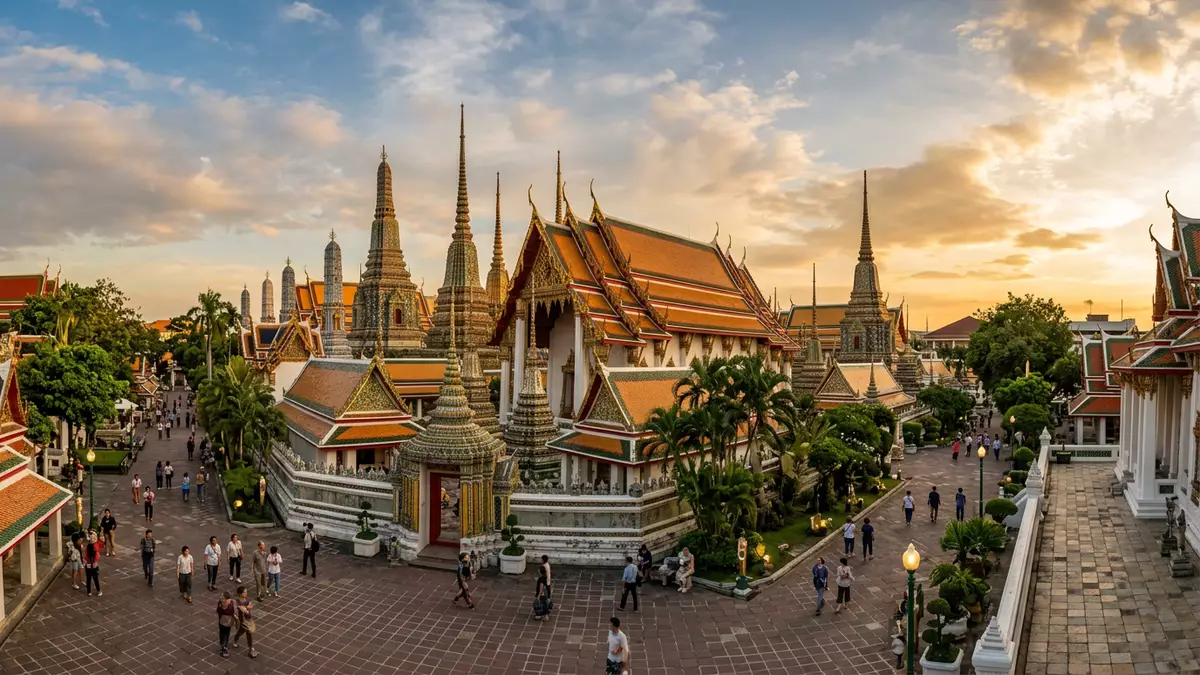
Wat Pho in Bangkok brings together an immense reclining Buddha, a royal temple complex and a longstanding tradition of Thai massage within one walled compound on Rattanakosin Island.
A royal temple beside the Grand Palace
Wat Pho stands in the Phra Nakhon district of Bangkok, immediately south of the Grand Palace on the eastern bank of the Chao Phraya River. The temple complex is officially known as Wat Phra Chetuphon Wimon Mangkhalaram Rajwaramahawihan, a designation that marks its status as a major royal monastery of the Rattanakosin era.Wat Phra Chetuphon Wimon Mangkhalaram The site developed around an earlier temple called Wat Phodharam, which was associated with teaching traditional Thai medicine before the founding of Bangkok as the capital.earlier Wat Phodharam temple
Large-scale restoration and enlargement took place under King Rama I from the late eighteenth century, integrating Wat Pho into the new royal city and giving it the name that links it directly to the monarch.temple of King Rama I Further expansion followed during the reign of Rama III in the nineteenth century, when numerous inscriptions and structures were added across the grounds.extensions under Rama III Together these phases created a temple precinct that covers several hectares, laid out with cloisters, chapels, courtyards and pagodas enclosed by perimeter walls.a temple of eight hectares
The reclining Buddha and surrounding chapels
The most immediately striking feature at Wat Pho is the monumental reclining Buddha housed in a dedicated viharn along one side of the complex. This gilded figure is built in brick and stucco, then lacquered and covered in gold leaf, measuring 46 m (151 ft) in length and 15 m (49 ft) in height from the base to the top of the head.46 metres long and 15 metres highdimensions of the reclining Buddha The soles of the Buddha’s feet are inlaid with mother-of-pearl panels that depict auspicious symbols associated with the Buddha, forming a detailed decorative field at the far end of the hall.mother-of-pearl on the soles
Outside the reclining Buddha hall, Wat Pho contains numerous pagodas, chapels and cloisters that reflect Bangkok-period temple architecture. The complex includes a large number of chedi, or stupas, some associated with particular reigns of the Chakri dynasty and decorated with coloured ceramic and floral motifs.stupas within the compound Cloistered galleries hold collections of Buddha images in various postures, forming long lines of figures against painted or tiled walls and underscoring the temple’s role as a repository of religious sculpture.collection of Buddha images
Wat Pho as a centre of Thai traditional knowledge
Beyond its function as a place of worship, Wat Pho is closely associated with Thai traditional medicine and massage, giving the temple a role in the history of education in Thailand. Inscriptions set into stone and plaques across the complex record texts on medical practice, massage techniques and other subjects, forming what has been described as an early public repository of knowledge.inscriptions on traditional medicinetexts on medicine and massage A formal school of Thai massage and traditional medicine was established at Wat Pho in the twentieth century, continuing the temple’s longstanding link with therapeutic practices in an institutional form.school of Thai massage founded in 1955
Visitors encounter diagrams of the human body and stone figures in yoga-like postures within parts of the temple grounds, illustrating massage points and stretches associated with Thai traditional medical theory.figures showing massage positions This educational layer sits alongside the religious and architectural elements, making Wat Pho a place where devotional art, royal patronage and codified knowledge about the body share the same physical setting.
Visiting Wat Pho: what travellers from Western Europe should know
- Wat Pho lies on Rattanakosin Island in central Bangkok, directly south of the Grand Palace in the Phra Nakhon district, reached by riverside ferries and city streets.
- The temple grounds form a sizeable walled compound with paved courtyards, cloisters and interior stairways, so a visit involves walking on hard surfaces and moving between indoor and outdoor areas.
- The official language is Thai and the currency is the baht.
- Entry requirements depend on your nationality; UK travellers can check the FCDO travel advice at gov.uk/foreign-travel-advice, Irish travellers the Department of Foreign Affairs at ireland.ie.
Searching for Wat Pho on social platforms
These links open searches for Wat Pho on each platform.
Frequently asked questions about Wat Pho
Where is Wat Pho located in Bangkok?
Wat Pho is in the Phra Nakhon district on Rattanakosin Island, immediately south of the Grand Palace on the eastern bank of the Chao Phraya River.
What can visitors expect to see at Wat Pho?
Visitors encounter the large reclining Buddha, cloistered galleries of Buddha images, numerous pagodas and chapels, along with inscriptions and figures linked to Thai traditional medicine.
What makes Wat Pho distinctive among Bangkok’s temples?
Wat Pho combines royal temple architecture, the vast reclining Buddha and a historic role in Thai massage and medical education within a single, extensive compound.


