
Wat Pho and the art of the reclining Buddha in Bangkok
Published on 09/21/2026 at 13:23 | Editorial responsibility: Rafael Müller, Editor-in-Chief AD HOC NEWS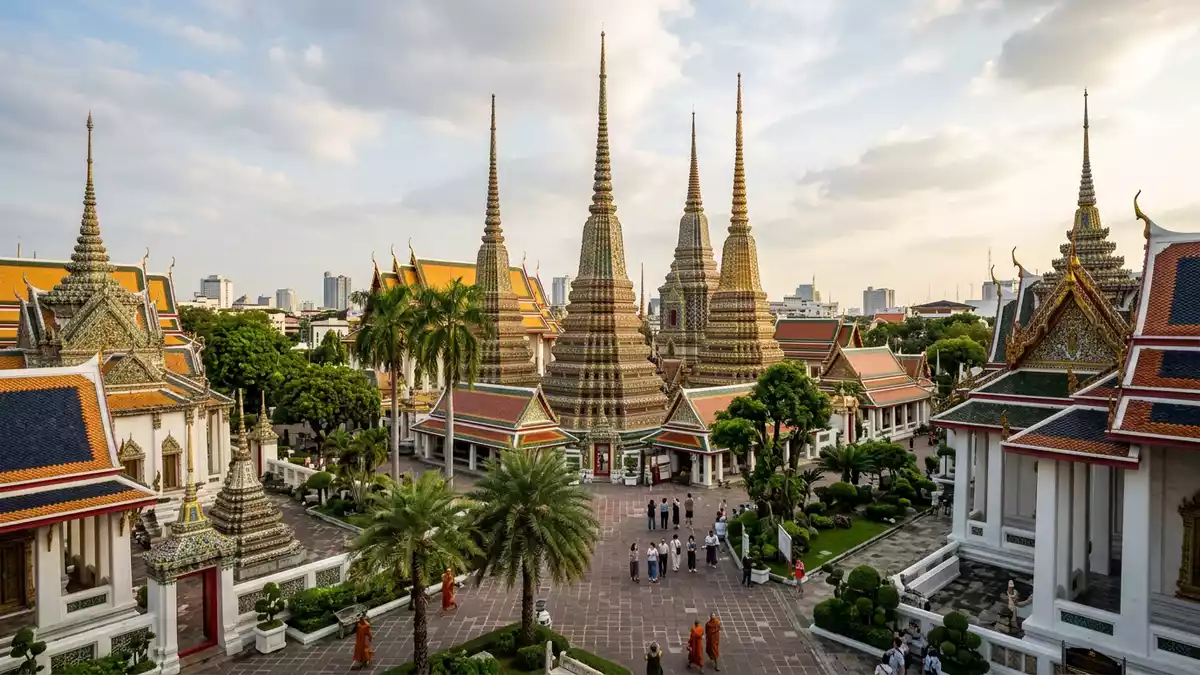
Wat Pho in Bangkok brings together a monumental reclining Buddha, a royal monastery and a walled maze of courtyards that chart the rise of the Rattanakosin capital. Officially known as Wat Phra Chetuphon Wimon Mangkhalaram Rajwaramahawihan, it stands beside the Grand Palace as a first-grade royal temple associated with King Rama I of the Chakri dynasty.
The royal temple beside the Grand Palace
Wat Pho stands in the Phra Nakhon district of Bangkok, on Rattanakosin Island just south of the Grand Palace and close to the Chao Phraya River. The complex occupies a large block bordered by Sanam Chai and Maharat roads, forming one of the city’s most substantial temple precincts.Wat Pho is located in the Phra Nakhon district The official temple history records that King Rama I ordered a major restoration of an older monastery here in 1788, completing a renamed royal temple at the start of the Rattanakosin era.King Rama I ordered restoration in 1788
The temple is part of a group of royal foundations that shaped the early Chakri capital, with the Grand Palace to the north and Wat Arun across the river. Within its walls lie chapels, cloisters, libraries and chedis laid out in a dense pattern, so that walking through the grounds feels like moving between small, self-contained courts instead of a single open plaza. The layered roofs, gables and coloured tiles give the complex a distinct skyline even when viewed from nearby streets.
From Ayutthaya roots to Rattanakosin renewal
Wat Pho traces its origins to the late Ayutthaya period, when a monastery known as Wat Photaram stood on this site or close to it, before Bangkok became the capital. In the late eighteenth century King Rama I incorporated this older sanctuary into his new royal city and raised its status to that of a principal royal monastery.Wat Photaram dates to the late Ayutthaya period The formal name Wat Phra Chetuphon Wimon Mangkhalaram was fixed in the nineteenth century and remains in ceremonial use.
A second significant phase came under King Rama III in the 1830s, when the grounds were enlarged and the temple took on its present role as a centre of learning. In this period, inscriptions on stone slabs were installed around the cloisters and pavilions, recording knowledge from traditional Thai medicine to literature and cosmology.Wat Pho developed as an open public centre of learning These stone texts helped establish Wat Pho as a place where scholarly material and religious architecture are interwoven, and they still punctuate walkways and galleries in the complex.
The reclining Buddha and the temple courtyards
The most recognisable feature of Wat Pho is the reclining Buddha, a gilded image more than 40 m (over 130 ft) long and about 15 m (around 50 ft) high, housed in its own elongated hall along the complex’s western side.The reclining Buddha measures 46 m long and 15 m high Built in 1832 in the reign of King Rama III, the statue shows the Buddha lying on his side with his head supported, a posture associated with his final passing into nirvana.The reclining Buddha dates to 1832 in King Rama III’s reign
Visitors walk the length of the image inside the hall, where the Buddha’s body is covered in gold leaf and the soles of the feet carry inlaid mother-of-pearl panels. Outside this hall, the wider temple grounds contain cloister walks lined with Buddha images, small open pavilions used for teaching and herbal medicine, and groups of chedis clad in coloured ceramics. The combination of the vast reclining figure inside and the more intimate courts outside makes Wat Pho as much a complex of linked spaces as a single sanctuary.
Visiting Wat Pho: what travellers from Western Europe should know
- Wat Pho stands in Bangkok’s historic Phra Nakhon district on Rattanakosin Island. It lies just south of the Grand Palace and near the east bank of the Chao Phraya River.
- The temple complex is reached by city streets that bring visitors to entrances on Sanam Chai and Maharat roads. Within the walls, movement is on foot across paved courtyards and between halls.
- The grounds are largely level but include steps at thresholds between courtyards and at the entrances to halls, including the long hall that houses the reclining Buddha.
- The official language is Thai and the currency is the baht. Entry requirements depend on your nationality; UK travellers can check the FCDO travel advice at gov.uk/foreign-travel-advice, Irish travellers the Department of Foreign Affairs at ireland.ie.
Searching for Wat Pho on social platforms
These links open searches for Wat Pho on each platform.
Frequently asked questions about Wat Pho
Where is Wat Pho in Bangkok?
Wat Pho stands in the Phra Nakhon district on Rattanakosin Island, just south of the Grand Palace and near the east bank of the Chao Phraya River.
What should a visitor expect inside Wat Pho?
Expect a large temple precinct with a gold reclining Buddha in its own hall, cloistered courtyards filled with Buddha images and chedis, and pavilions interspersed with small gardens.
What makes Wat Pho distinctive among Bangkok’s temples?
Wat Pho combines the scale of its reclining Buddha, its role as a royal monastery under the Chakri kings and its nineteenth-century stone inscriptions that turn the temple into a physical encyclopaedia.


