
Wat Pho and Bangkok’s reclining Buddha
Published on 09/23/2026 at 13:44 | Editorial responsibility: Rafael Müller, Editor-in-Chief AD HOC NEWS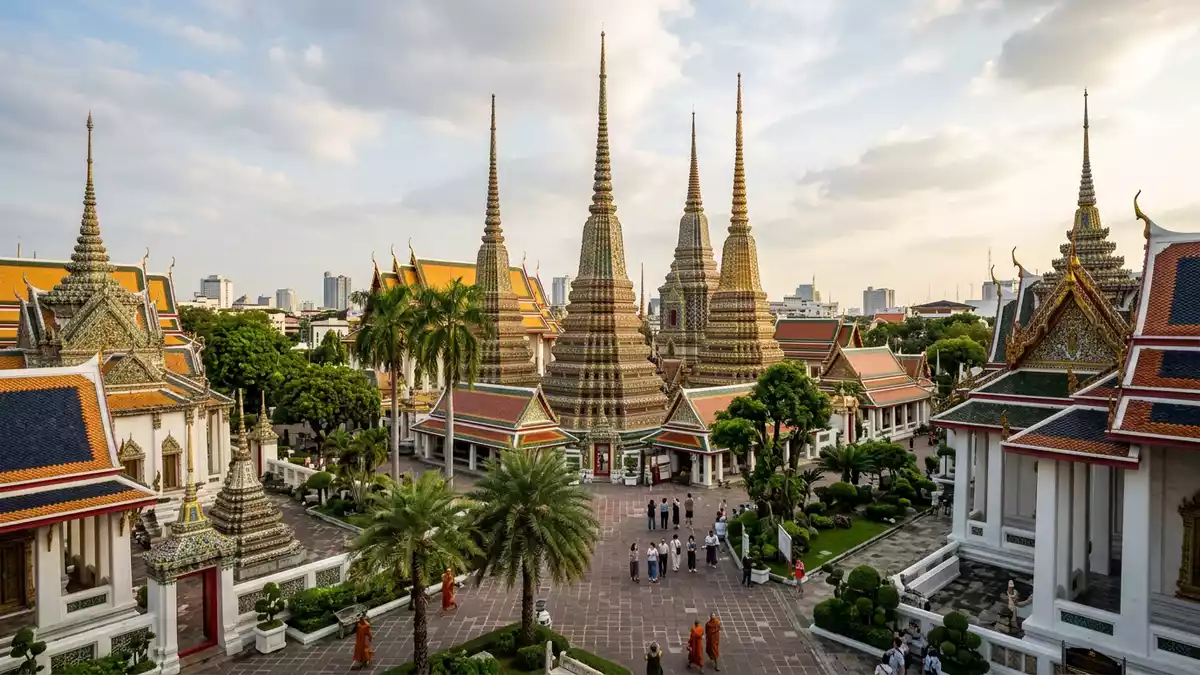
Wat Pho in Bangkok is a temple complex where a reclining Buddha occupies a long, richly decorated hall. The image, covered in gold leaf, measures 46 metres long and 15 metres high, while the surrounding grounds contain chedis, vihara halls, galleries and stone inscriptions.
Wat Pho: the reclining Buddha in gold leaf
The reclining Buddha, known as Phra Buddhasaiyas, rests inside the western vihara. Its gilded surface contrasts with the dark interior and the patterned decoration around the image. The soles of its feet carry mother-of-pearl inlay showing 108 auspicious symbols, arranged in detailed panels.
The hall forms part of a larger royal monastery in Phra Nakhon, south of the Grand Palace. Wat Pho’s full name is Wat Phra Chetuphon Wimon Mangkhalaram Rajwaramahawihan. Its many structures create a dense sequence of courtyards, tiled roofs, gateways and cloisters.
From Ayutthaya foundations to a royal monastery
Wat Pho has roots in the Ayutthaya period, which lasted from 1351 to 1767. The earlier temple was known as Wat Photharam. After Bangkok became the capital, King Rama I ordered its restoration and established it as a royal monastery.
Major work continued during the reign of King Rama III, who ruled from 1824 to 1851. The complex gained additional halls, gardens, a library building and the western vihara containing the reclining Buddha. The temple’s present form therefore brings together Ayutthaya foundations and Rattanakosin-era expansion.
Colourful ceramic mosaics cover many of the chedis and architectural surfaces. Chinese-influenced details appear beside Thai rooflines, guardian figures and carved stone panels. The result is a temple complex assembled from repeated forms, contrasting materials and closely placed buildings.
Wat Pho as a centre of learning
Wat Pho is also associated with the public recording of knowledge. During the nineteenth century, inscriptions on marble slabs and architectural surfaces presented subjects including medicine, literature, history and Buddhist teaching.
The epigraphic archive entered UNESCO’s Memory of the World Register in 2011. Its inscriptions remain part of the temple environment, placed among corridors, pavilions and courtyards rather than confined to a separate museum collection.
Wat Pho has a long connection with traditional Thai medicine and Thai massage. Teaching and practice form part of the site’s cultural identity, alongside worship, royal architecture and Buddhist imagery. The temple therefore combines a sacred complex with a place connected to education and healing traditions.
Visiting Wat Pho: what travellers from Western Europe should know
- Wat Pho stands at 2 Sanam Chai Road in Phra Nakhon, Bangkok. It lies beside the Grand Palace area and near the Chao Phraya River, with Tha Tien pier nearby.
- The complex contains hard paved surfaces, courtyards, thresholds and temple steps. Modest clothing and the removal of shoes inside designated halls form part of temple etiquette.
- The official language is Thai and the currency is the baht.
Searching for Wat Pho on social platforms
These links open searches for Wat Pho on each platform.
Frequently asked questions about Wat Pho
Where is Wat Pho?
Wat Pho is in Phra Nakhon, Bangkok, beside the Grand Palace area and close to the Chao Phraya River. Its address is 2 Sanam Chai Road.
What can visitors expect at Wat Pho?
The complex contains Buddhist halls, chedis, courtyards, cloisters and marble inscriptions. Temple etiquette includes modest clothing and removing shoes inside designated halls.
What makes Wat Pho distinctive?
Its 46-metre reclining Buddha is the best-known feature. Wat Pho also combines royal architecture with an epigraphic archive and traditions of Thai medicine and massage.


