
Wanli Changcheng near Peking in stone and brick
Published on 08/26/2026 at 17:25 | Editorial responsibility: Rafael Müller, Editor-in-Chief AD HOC NEWS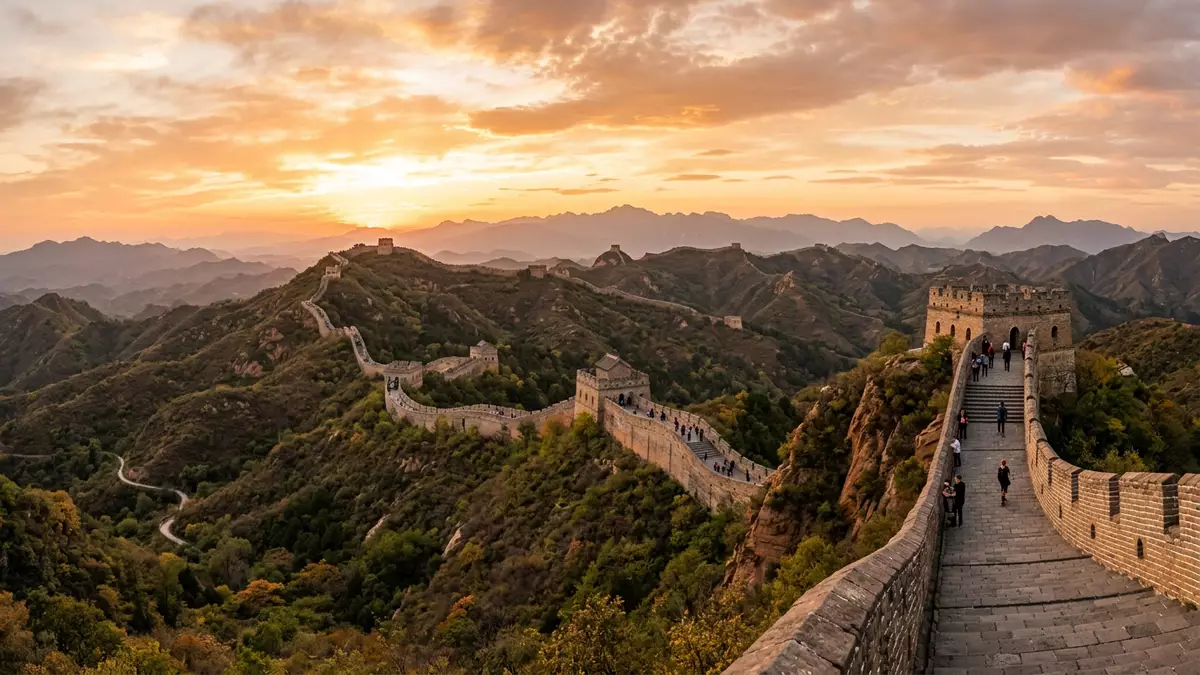
Wanli Changcheng near Peking is a long line of stone and brick that follows ridgelines, valleys and passes across northern China. The name refers to the Great Wall, and the surviving wall near Beijing is linked above all with the Ming dynasty.
Stone, brick and watchtowers north of Peking
The wall is not a single uninterrupted barrier but a chain of ramparts, towers and sections that vary with the ground beneath them. Near Peking, the surviving fabric is dominated by Ming-era rebuilding, while the older name Wanli Changcheng remains the common Chinese label.
That mix of masonry and terrain gives the site its immediate character. The wall climbs over ridges, drops through passes and returns to the skyline in broken lines of crenellated work.
The Ming wall in historical context
The Great Wall took shape over many centuries, with major phases in the third century BC and the Ming period. The form visible near Peking belongs to the later rebuilding phase, when brick and stone became the most recognisable materials.
The site also carries a formal international designation: the Great Wall of China was inscribed as a UNESCO World Heritage site in 1987. That status covers the wider fortification system, not just one stretch near the capital.
Sections and setting around the capital
Badaling and Mutianyu are among the sections most associated with Peking, both lying in the hills north of the city. Badaling sits in Yanqing District, and the wall there rises in a clear sequence of walls, towers and gate-like openings.
Mutianyu lies to the north-east in a separate valley, where the wall again follows the top of the land. The result is a landscape of masonry seen against mountain slopes, with no single uniform profile across the whole route.
Visiting Wanli Changcheng: what travellers from Western Europe should know
- The wall near Peking is reached by road into the northern districts of Beijing, and rail links serve some sections. Badaling lies in Yanqing District, while Mutianyu sits in a north-eastern valley.
- The terrain includes steep slopes, stone steps and long climbs along exposed ramparts. In places, the wall runs along uneven ground rather than level paths.
- Badaling and Mutianyu present different faces of the same fortification system. One sits in a more direct mountain setting, while the other opens into a broader valley.
- The wall crosses several provinces and municipalities, with Beijing among the best-known areas for surviving sections. Its masonry and towers remain the defining features of the site.
Searching for Wanli Changcheng on social platforms
These links open searches for Wanli Changcheng on each platform.
Frequently asked questions about Wanli Changcheng
Where is Wanli Changcheng?
Wanli Changcheng runs through northern China, and the best-known sections near Peking lie in the Beijing municipality. Badaling is in Yanqing District, while Mutianyu lies to the north-east of the city.
What does a visit involve?
The wall brings together stone steps, towers and long stretches along uneven mountain ground. Visitors encounter a fortification that changes character from section to section rather than one continuous facade.
What makes Wanli Changcheng distinctive?
The wall combines a vast historic scale with individual stretches that can still be read in the landscape. Its Ming-era masonry and watchtowers remain the clearest features near Peking.


