
Wanli Changcheng near Peking and the Ming Great Wall
Published on 08/30/2026 at 10:34 | Editorial responsibility: Rafael Müller, Editor-in-Chief AD HOC NEWS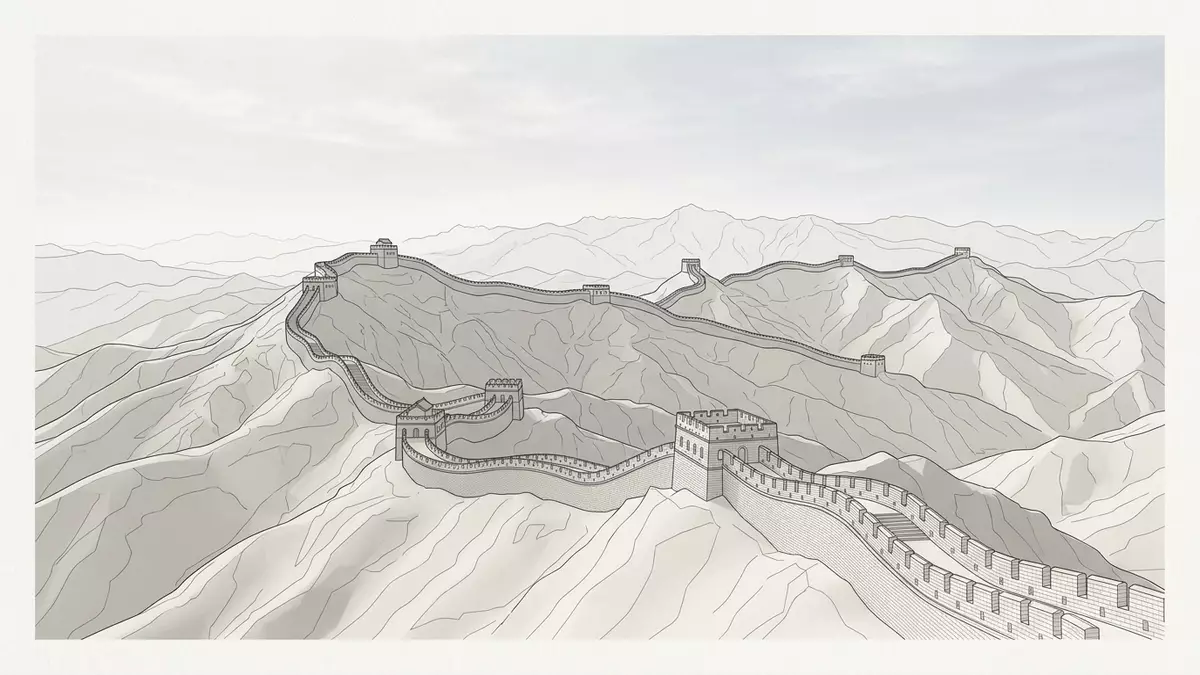
Wanli Changcheng, the Chinese name for the Great Wall of China, stretches across northern China and comes into sharp focus in the Ming-era wall that threads through the hills north of Peking. Here the fortifications built and rebuilt between the fourteenth and seventeenth centuries turn a vast border defence into a sequence of stone and brick ramparts that can be walked, climbed and seen at close quarters.
Ming ramparts on the northern hills
The sections of Wanli Changcheng nearest Peking belong largely to the Ming dynasty, whose rulers oversaw extensive rebuilding of the wall between 1368 and 1644 in stone and brick along the northern frontier.Ming dynasty rebuilding North of the city, stretches such as Badaling in Yanqing District show this construction clearly in their paved ramparts, parapets and watchtowers stepping along the spine of the mountains.Badaling near Beijing city
At Badaling, the wall runs along a ridge with fortifications climbing towards higher ground on either side, forming a defended route over the hills rather than a single straight line. The masonry is laid in regular courses, with battlements punctuated by projecting towers that overlook the surrounding valleys. Stone ramparts and brickwork sit against the mountain slopes, and inside the wall a walkway follows the line of the fortifications, rising and falling with the terrain.
Wanli Changcheng as a long defensive system
Wanli Changcheng literally means “Ten-Thousand-Li Long Wall”, using li as a traditional Chinese unit of distance, and the name points to the scale of the fortifications across northern China.Ten-Thousand-Li Long Wall The Great Wall as a whole was started centuries before the Ming period, with early walls and earthworks linked into a more continuous system around 220 BC under Qin Shi Huang, the first emperor of a unified China.Qin Shi Huang linking fortifications
Along its course from Shanhaiguan in Hebei Province to Jiayuguan in Gansu Province, the Great Wall combines built walls, trenches, fortresses and natural barriers such as rivers and steep hills into a defensive system rather than a single uninterrupted structure.route from Shanhaiguan to Jiayu Pass In the Beijing area, this large system is distilled into accessible stretches like Badaling and Mutianyu, where restored masonry shows how the wall followed the contours of the hills with battlements and parapets tracing narrow crests.
World Heritage status and the wall near Peking
The Great Wall of China was inscribed on the UNESCO World Heritage List in 1987, recognising both its long construction history and its role as a symbol closely associated with China itself.World Heritage inscription in 1987 Near Peking, Ming-era stretches form a prominent part of that listing, and the wall north of the city is one of the best-preserved areas of stone and brick fortifications on the route.Great Wall section near Peking
Badaling and neighbouring passes lie among mountains within the Beijing municipality, with Yanqing District to the north-west containing long visible runs of the wall, and other valleys to the north-east holding further Ming stretches. Watchtowers rise at intervals along these ramparts, marking points where defenders could observe the approaches and communicate along the line of the fortifications. From the masonry itself to the layout over the hills, Wanli Changcheng near Peking shows how a border defence built over many dynasties became a continuous presence in the landscape.
Visiting Wanli Changcheng: what travellers from Western Europe should know
- Wanli Changcheng near Peking is reached by road and rail routes running into the northern districts of Beijing, with well-known sections such as Badaling lying in Yanqing District to the north-west.
- The terrain on the wall is steep in places, with long flights of stone steps climbing along mountain ridges and walkways that rise and fall with the natural contours.
- Nearby Mutianyu lies in a valley to the north-east of central Peking, providing another Ming wall section among wooded hills within the wider Beijing municipality.
- The official language is Chinese and the currency is the renminbi yuan.
Searching for Wanli Changcheng on social platforms
These links open searches for Wanli Changcheng on each platform.
Frequently asked questions about Wanli Changcheng
Where is Wanli Changcheng near Peking located?
The Great Wall sections associated with Wanli Changcheng near Peking lie within the Beijing municipality, including Badaling in Yanqing District to the north-west and other Ming stretches in valleys to the north and north-east.
What should visitors expect on the wall near Peking?
Visitors encounter stone and brick ramparts running along mountain ridges, with steep stairways, parapets and watchtowers that follow the line of the hills rather than a level urban street.
What makes Wanli Changcheng near Peking distinctive?
The Ming-era wall near Peking combines centuries of border history with accessible masonry, bringing a long defensive system of towers, passes and ramparts into a concentrated landscape north of the city.


