
Wanli Changcheng: Beijing’s stone rampart across the hills
Published on 08/16/2026 at 14:23 | Editorial responsibility: Rafael Müller, Editor-in-Chief AD HOC NEWS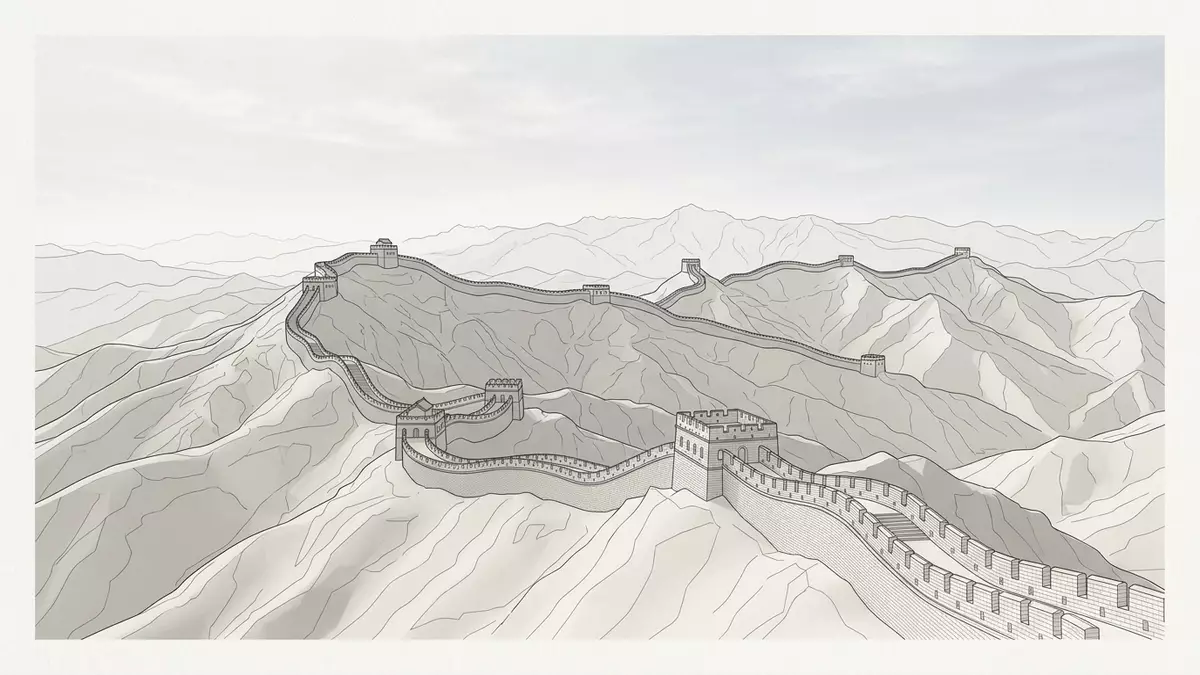
North of Peking, Wanli Changcheng runs in stone across the ridges, a continuous line of fortifications that English readers know as the Great Wall of China. Built in successive phases from the 3rd century BC into the Ming dynasty, the wall around Beijing shows how frontier defence became a landscape-scale project of Chinese empires.
From ancient frontier line to Ming dynasty rampart
The name Wanli Changcheng, meaning a wall of ten thousand leagues, refers to a system of fortifications that first took shape during the Spring and Autumn Period and the Warring States Period of the Eastern Zhou dynasty, when rival kingdoms raised separate defensive lines along their borders.Spring and Autumn Period and Warring States walls These early barriers were later linked and strengthened under the Qin dynasty in the 3rd century BC, creating longer continuous stretches on the northern frontier.continuous construction from the 3rd century BC to the 17th century AD
The sections of Wanli Changcheng accessible from Beijing largely date from the Ming dynasty, between 1368 and 1644, when the capital and the imperial tombs required substantial protection from the northern steppes.Ming dynasty dating of many visible sections Ming builders rebuilt earlier walls, added passes and beacon towers, and used durable materials such as granite and bricks to create thick ramparts with parapets and crenellations suited to firearms as well as archers.granite construction of a Beijing section The result is a military landscape that still follows ridgelines, valleys and strategic passes north of the city.
The Great Wall around Beijing: ridges, passes and districts
Within the municipality of Beijing, Wanli Changcheng appears in several distinct stretches, each anchored to a particular valley or mountain chain. Travel guides commonly list Badaling, Juyongguan, Huanghuacheng, Jiankou, Mutianyu, Gubeikou and Simatai as the main sections reachable from the city, marking a sequence of walls from the Bohai Sea inland towards the passes of the interior.seven sections of the Great Wall in Beijing Each rises and falls with the terrain, threading along ridges, dropping into saddles and crossing above reservoirs and lakes.
Badaling lies in Yanqing District to the north-west of urban Beijing, occupying a natural pass where the wall climbs steep slopes and forms a wide carriageway along the crest.location and dimensions of Badaling Mutianyu, in Huairou District to the north-east, runs for several kilometres along a mountain ridge and links with neighbouring stretches such as Jiankou and Lianhuachi, making it part of a continuous defensive chain rather than an isolated monument.Mutianyu in Huairou District, linked to other sections Together, these sections show how Wanli Changcheng around Beijing is tied to geography: where passes narrow, the wall thickens, and where ridges run long, watchtowers repeat at short intervals.
Wall, watchtower and beacon: details in the stone
Walking a restored stretch of Wanli Changcheng near Beijing, the basic elements recur in stone and brick. The rampart itself usually rises to around 7 m or more, high enough to form a distinct skyline along the hills.average height and width of a Beijing section The top of the wall is paved and wide enough for soldiers to move in formation, while parapets on either side are pierced by embrasures for weapons. Materials vary from section to section, but granite blocks and large bricks form much of the visible fabric in the Ming-era stretches north of the city.granite construction and dimensions
The watchtowers stand at regular intervals, rising above the rampart as enclosed strongpoints with multiple levels and openings. Some sections combine wall towers, free-standing fortress-like towers and beacon platforms that form a signalling chain along the ridge.defensive system of walls, watchtowers and beacon towers On Mutianyu, densely spaced towers and side walls create an enclosed corridor of masonry, while at Badaling the wall bends and climbs in broad curves, with the crest forming a walled road between towers.tower spacing and wall width for troops These features make Wanli Changcheng near Beijing more than a single line: it is a layered defence of walls, gates and outworks, all embedded in the mountain landscape.
Visiting Wanli Changcheng: what travellers from Western Europe should know
- Wanli Changcheng near Peking is reached by travelling north into districts such as Yanqing and Huairou, where sections like Badaling and Mutianyu rise along mountain ridges.
- Many accessible stretches involve steep stone steps, sloping ramparts and uneven paving, and walks along the wall can include sustained ascents and descents on exposed ridgelines.
- In the hills north of Beijing, winter brings snow to parts of the wall, while summer can be hot and humid, so conditions on the stone surfaces vary considerably through the year.
- Nearby features include reservoirs and valleys such as those around Huanghuacheng, where the wall descends towards water, giving some sections a direct relationship with lakes and impounded rivers.
- The official language is Chinese and the currency is the renminbi.
Searching for Wanli Changcheng on social platforms
These links open searches for Wanli Changcheng on each platform.
Frequently asked questions about Wanli Changcheng
Where is Wanli Changcheng near Peking?
Wanli Changcheng around Peking runs through several districts of Beijing, including Yanqing to the north-west and Huairou to the north-east, where restored wall sections trace the ridges.
What should visitors expect on a visit?
A visit typically involves walking on stone ramparts, ascending and descending steep flights of steps, and exploring watchtowers and beacon platforms set along the mountain slopes.
What makes Wanli Changcheng distinctive near Beijing?
The wall around Beijing is distinctive for its Ming dynasty granite and brick construction, its dense pattern of watchtowers, and its route along exposed ridge crests overlooking valleys and reservoirs.


