
Waikiki between Ala Wai Canal and Diamond Head
Published on 09/19/2026 at 12:55 | Editorial responsibility: Rafael Müller, Editor-in-Chief AD HOC NEWS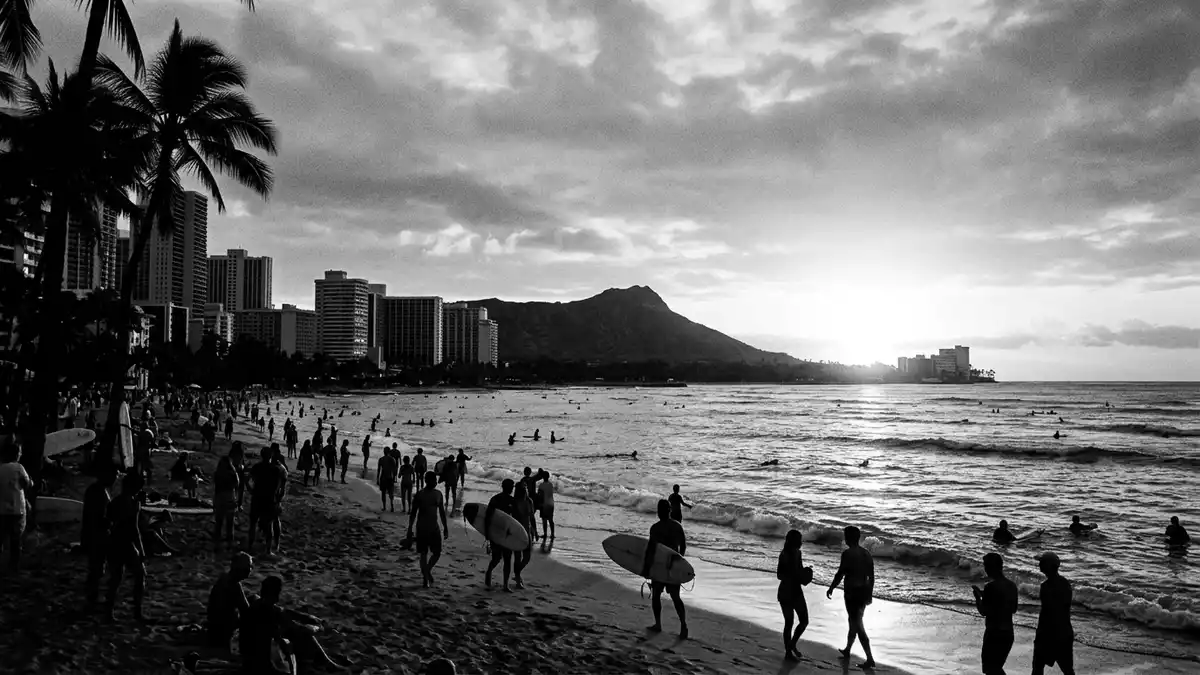
Waikiki in Honolulu is the narrow coastal neighbourhood where a long strip of Pacific sand runs between the Ala Wai Canal and the volcanic cone of Diamond Head, combining dense city streets with an open shoreline that has helped define modern surf culture on O?ahu in Hawaii.
A ribbon of shore framed by canal and crater
Waikiki occupies the south shore of Honolulu on the island of O?ahu, set on Mamala Bay and framed inland by the Ala Wai Canal and seaward by the Pacific Ocean. The neighbourhood stretches along the coast towards Diamond Head, a prominent volcanic crater that closes the south-eastern end of Waikiki and forms a landmark backdrop for the beaches and streets.Mamala Bay between canal and crater The land between canal and ocean is narrow, so Waikiki’s blocks of hotels, apartments and shops stand close to the shoreline, with parks and beachside lawns opening towards the water.
The Ala Wai Canal, completed in 1928, transformed the landscape of Waikiki by draining former wetlands and defining the northern and western boundary of the district.the construction of the Ala Wai was completed in 1928 Streets run across the strip from the canal towards the sea, many ending at beach parks or small access paths beside hotels. From the sand, views take in the curve of the bay, the low rise of the reef offshore and the profile of Diamond Head at the far end of the coast, giving Waikiki a clearly defined setting between water, canal and crater.
From “spouting waters” to resort district
The name Waikiki comes from a Hawaiian phrase meaning “spouting water”, referring to the springs and streams that once flowed from the Ko?olau mountain range through the area towards the sea.Waik?k? translates as “fresh spouting waters” Historically, the land around these waters supported taro fields and fishponds and formed part of an ahupua?a, a traditional Hawaiian land division that extended eastwards beyond the modern district.the Waik?k? ahupua?a extended from kou eastward to maunalua In the fifteenth century, irrigation systems were laid out to use the freshwater resources for agriculture, turning the wetlands into productive land.
Waikiki later became closely linked with Hawaiian royalty. In 1794 Kamehameha I landed his warriors on Waikiki’s shore during a major campaign that culminated at Nu?uanu Pali, and after victory he established his residence in Waikiki, using it as a centre of government in the early nineteenth century.Kamehameha then set up residence in Waik?k? Through the nineteenth century Waikiki combined agricultural use with its role as a retreat for the Hawaiian royal family, and by the late 1800s it was associated with surf riding on long boards off the beaches.
Surf breaks, city blocks and a celebrated beachfront
Waikiki today is a resort district of south-eastern Honolulu, with beaches lined by hotels, apartment towers and shopping streets, while the shoreline itself remains a long, narrow band of pale sand fronting Mamala Bay.resort district on the southern coast of Oahu The main thoroughfare near the shore is Kal?kaua Avenue, which runs parallel to the beach and carries a sequence of hotels, luxury shops and restaurants through the neighbourhood.Kalakaua Avenue runs parallel to the beach Between buildings and sea lie parks, promenades and access paths, with areas of lawn, palm trees and beachside walls giving structure to the waterfront.
The coast along Waikiki includes several distinct beaches that together are often referred to simply as Waikiki. Offshore, the fringing reef creates defined surf breaks that have played a central role in the development of modern surfing, with long, rolling waves breaking some distance out and surfboards ridden back towards the shallows.the beach is perhaps best known for being the home of modern surfing Inland from the sand, Waikiki contains attractions such as an aquarium, a zoo and garden areas, as well as markets and shopping complexes that specialise in crafts and goods from across the Pacific basin.an aquarium, zoo, garden attractions, and the International Market Place
Visiting Waikiki: what travellers from Western Europe should know
- Waikiki lies on the south shore of Honolulu on the island of O?ahu in Hawaii. It is reached from the rest of the city by roads that cross the Ala Wai Canal and run towards the beaches.
- The neighbourhood’s shoreline is mostly level, with paved promenades and sections of sand. Inland streets are laid out on a grid between canal and coast, and some beach access routes include short flights of steps.
- Diamond Head rises to the south-east of Waikiki and is visible from many points along the shore. The crater stands beyond the end of the main hotel strip and marks the outer limit of the coastal district.
- The official language of Hawaii as part of the United States is English, and the currency is the US dollar.
Searching for Waikiki on social platforms
These links open searches for Waikiki on each platform.
Frequently asked questions about Waikiki
Where is Waikiki and how is it defined within Honolulu?
Waikiki is a coastal neighbourhood on the south shore of Honolulu on O?ahu, bounded inland by the Ala Wai Canal and extending along Mamala Bay towards Diamond Head.
What should visitors expect when walking through Waikiki?
Visitors encounter a narrow strip of land where beaches, parks and surf breaks line the shore, while parallel streets such as Kal?kaua Avenue carry hotels, shops and restaurants between canal and coast.
What makes Waikiki distinctive compared with other parts of Honolulu?
Waikiki’s combination of a long, sand-fringed bay, defined surf breaks, the framing of Ala Wai Canal and Diamond Head, and its history as a centre of Hawaiian royalty and modern surfing gives it a character strongly tied to both landscape and culture.


