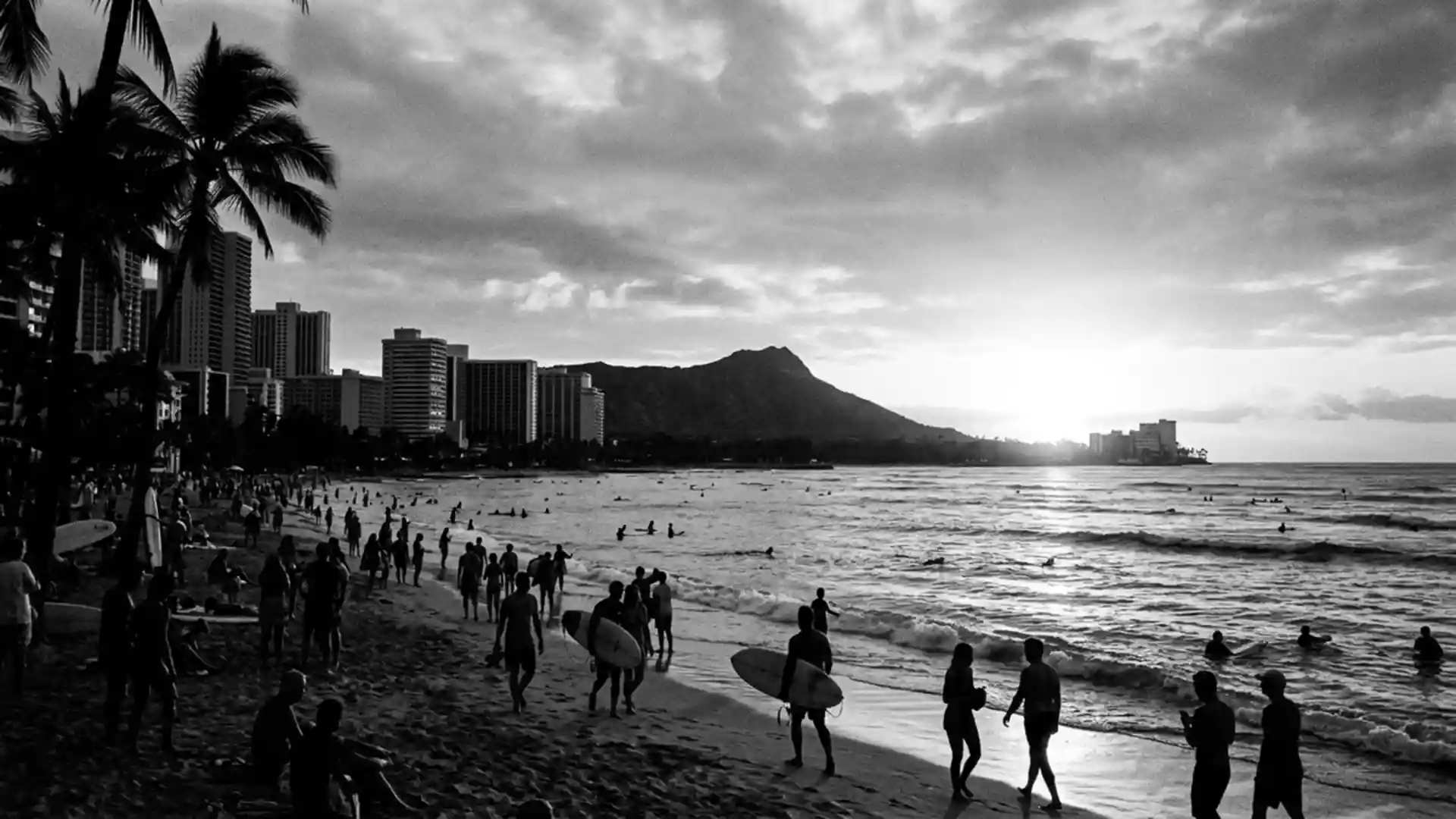
Waikiki between Ala Wai Canal and Diamond Head
Published on 09/07/2026 at 14:36 | Editorial responsibility: Rafael Müller, Editor-in-Chief AD HOC NEWS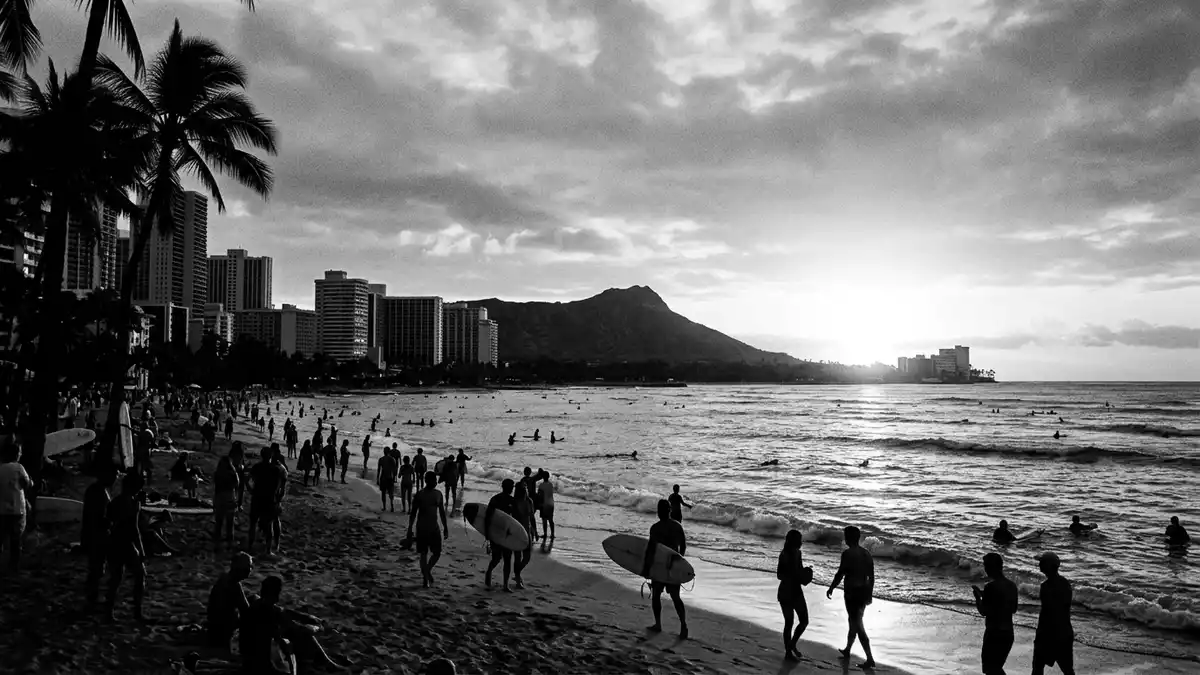
Waikiki in Honolulu is a narrow coastal district on the south shore of Oahu, framed by the Ala Wai Canal on one side and Diamond Head crater on the other. Its Hawaiian name translates as “spouting waters”, a reminder that this resort skyline grew out of springs, streams and wetlands that once fed taro fields and fishponds.
From “spouting waters” to resort district
Waikiki lies along Mamala Bay on the southern coast of Oahu and forms a distinct neighbourhood within Honolulu, separated from inland areas by the Ala Wai Canal and opening seaward towards the wide curve of the Pacific.Resort district on Mamala Bay The shoreline faces the open ocean with the volcanic cone of Diamond Head anchoring the view to the east, while the canal defines Waikiki’s landward edge as an engineered waterway.
Long before hotels rose along the sand, Waikiki was a productive wetland landscape nourished by streams from the valleys of M?noa and P?lolo, supporting irrigated taro terraces and fishponds within an ahupua?a, a traditional Hawaiian land division stretching from mountain to sea.Wetlands, taro fields and fishponds The meaning “spouting waters” refers to the springs and streams that once flowed freely through this low-lying terrain before drainage projects reshaped it into solid ground for urban development.Name linked to spouting water
Royal retreat and early tourism
In the nineteenth century Waikiki served as a favoured retreat for Hawaiian royalty, who maintained residences near the shore and enjoyed surfing the rolling waves using long wooden boards that predate modern surf culture.Resort of Hawaii’s royals King Kamehameha I established his home on land by the ocean, and royal households cultivated coconut groves, taro patches and fishponds that stretched inland across what was then still a watery, agricultural landscape.Royal residence and cultivated groves
The modern tourism era began in the early twentieth century, when the Moana Surfrider opened as Waikiki’s first luxury hotel in 1901, introducing the area to visitors drawn from beyond the islands.Opening of the Moana Surfrider Within a few decades the Royal Hawaiian Hotel followed, built with distinctive architecture and promoted internationally, signalling Waikiki’s transformation from coastal farmland and royal retreat into a dense urban resort district focused on beachfront accommodation.
Ala Wai Canal, imported sand and the beach today
One of the most enduring features shaping Waikiki is the Ala Wai Canal, constructed in the 1920s to divert freshwater streams away from the wetlands and to drain the taro fields and fishponds that had once covered the area.Construction of Ala Wai Canal Completed in 1928, the canal created a clear northern boundary and opened up land for streets, hotels and apartment blocks, turning the former agricultural basin into a built-up district characterised by concrete towers and paved promenades.Drainage works finished in 1928
Waikiki’s narrow strip of sand fronting Mamala Bay is widely recognised as one of Hawaii’s best-known beaches, though much of its white sand has been brought in to counter chronic erosion along the shoreline.Imported sand on the beach Behind the seawall, the district functions as Honolulu’s principal hotel and resort area, where surf schools share space with shopping arcades, gardens and recreational facilities set between the surf and the canal.
Visiting Waikiki: what travellers from Western Europe should know
- Waikiki is a coastal neighbourhood of Honolulu on the island of Oahu in Hawaii, reached by travelling to Honolulu and continuing towards the south shore along Mamala Bay.
- The district lies on flat, low-lying land between the Pacific shoreline and the Ala Wai Canal, with paved promenades, beach access points and urban streets rather than steep terrain.
- Diamond Head crater rises to the south-east of Waikiki and is visible from many parts of the beachfront, giving the area a distinctive volcanic backdrop across the water.
- The official language is English and the currency is the United States dollar.
- Entry requirements depend on your nationality; UK travellers can check the FCDO travel advice at gov.uk/foreign-travel-advice, Irish travellers the Department of Foreign Affairs at ireland.ie.
Searching for Waikiki on social platforms
These links open searches for Waikiki on each platform.
Frequently asked questions about Waikiki
Where is Waikiki located?
Waikiki is a coastal neighbourhood of Honolulu on the south shore of Oahu in Hawaii, bordered inland by the Ala Wai Canal and facing Mamala Bay.
What should visitors expect on a visit to Waikiki?
Visitors encounter an urban resort district with high-rise hotels, surf schools and shopping streets lining a narrow beachfront backed by the Ala Wai Canal and views of Diamond Head.
What makes Waikiki distinctive among Hawaii’s coastal areas?
Waikiki combines a historic setting of former wetlands and royal retreats with a modern skyline between an engineered canal and a volcanic crater, creating a concentrated resort landscape.