Waikiki and the arc of coast between canal and crater
Published on 08/20/2026 at 15:43 | Editorial responsibility: Rafael Müller, Editor-in-Chief AD HOC NEWS
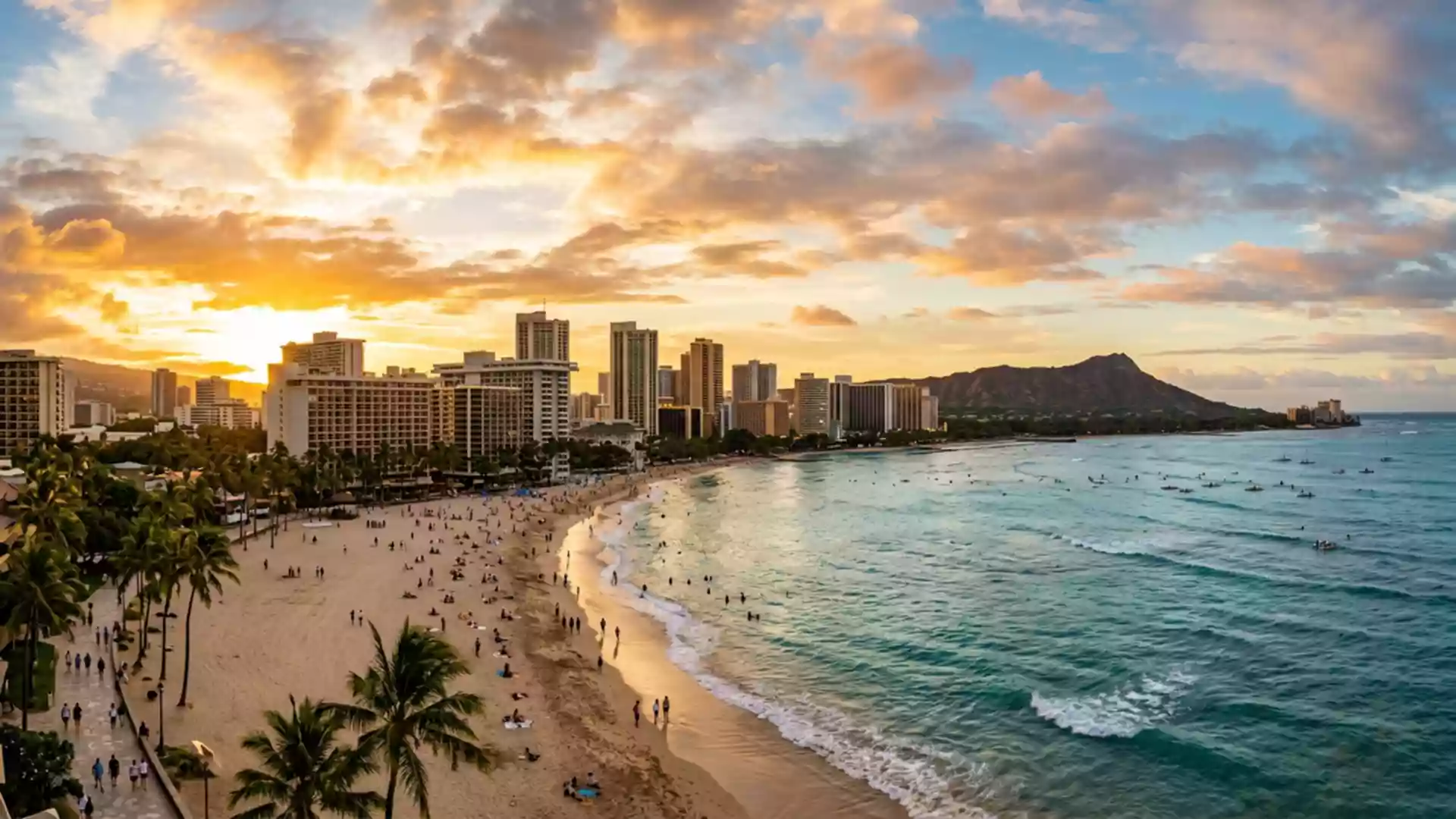
Waikiki in Honolulu is the coastal district where a long band of pale sand, resort towers and the volcanic outline of Diamond Head share the same frame along Oahu’s south shore. On land the neighbourhood sits between the Ala Wai Canal and the Pacific, and in Hawaiian the name Waikiki refers to spurting or spouting water, a reminder of the springs and streams that once fed this low-lying plain in the nineteenth century.
A crescent of shore framed by crater and canal
Viewed on a map, Waikiki stretches along the south-eastern edge of Honolulu, occupying a strip of land between the straight line of the Ala Wai Canal to the north and Mamala Bay to the south, with Diamond Head crater rising to the east as a natural landmark. The Ala Wai Canal was completed in 1928 to drain wetlands and redirect the small rivers that once crossed this plain into the sea, and its artificial waterway now forms the inland boundary of the district as the tourist centre of the Hawaiian Islands.Ala Wai Canal
Along the ocean side, Waikiki presents a sequence of beaches backed by promenades, palms and hotel terraces that stand close to the sand, facing the broad expanse of Mamala Bay and the open Pacific Ocean.south shore of Honolulu The arc of sand is punctuated by groins and seawalls built in the twentieth century, and erosion has led to replenishment projects that have added imported sand to maintain a continuous beach. Offshore, the sea floor and wave patterns create conditions for surf breaks that have become part of the district’s identity, with the silhouette of Diamond Head and the line of towers behind the shore giving Waikiki its recognisable coastal profile.Mamala Bay between canal and crater
From wetlands and royal retreats to resort district
Long before high-rise hotels, Waikiki formed part of an ahupua?a, a traditional Hawaiian land division that ran from the Ko?olau Range down to the sea, and its abundance of fresh water made it an agriculturally rich coastal plain. Streams such as Pi?inaio, ??puak?hau and Kuekaunahi once flowed through the area, feeding taro ponds, fishponds, banana farms and other cultivated plots that extended inland from the shoreline.agricultural coastal plain In the fifteenth century Chief Kalamakua is associated with the creation of an irrigation system that organised these wetlands into a productive landscape, linking freshwater springs to lo?i for kalo and ponds for fish along the south shore of Oahu.irrigation system in the fifteenth century
By the nineteenth century Waikiki had become a retreat for members of the Hawaiian royal family, who maintained residences in the area and used the shoreline for leisure, including early forms of longboard surfing on the rolling waves off the coast.favourite resort of Hawaii’s royals The district even served briefly as the first capital of the Kingdom of Hawaii in the late eighteenth century, between 1795 and 1796, underscoring its political and residential importance at the time.capital from 1795 to 1796 In the early twentieth century, as territorial Hawaii oriented itself increasingly towards visitors, wetlands were drained and roads laid out, and landmark hotels such as the Moana Surfrider, opened in 1901 on the waterfront, anchored a new resort district that grew along the beach and inland towards the canal.
Resort skyline, beach culture and urban fabric
Walking through Waikiki today, the combination of dense urban fabric and coastal setting defines the experience: streets lined with shops and restaurants run parallel to the canal and the sea, while cross streets connect high-rise hotels and apartment buildings to beach access points, parks and small public spaces. The district includes attractions such as Kapiolani Park near Diamond Head, the Honolulu Zoo and Waikiki Aquarium, and the International Market Place with its focus on crafts and retail tied to the wider Pacific Basin.aquarium, zoo and International Market Place Fort DeRussy, a former coastal defence site, is now a park honouring members of the United States armed forces and contains the U.S. Army Museum of Hawaii within its grounds, adding military history to the mix of leisure and commerce along the shore.
Out on the sand and in the water, beach culture shaped by Native Hawaiian traditions of surfing and canoeing continues alongside the resort infrastructure, with sections of the beachfront dedicated to surf schools, outrigger canoes and swimming areas. The long, gently shelving beach, reinforced in parts by imported sand, provides access to the sea and views back towards the skyline, while the presence of the Ala Wai Canal and Diamond Head keeps the larger geography visible from many vantage points. At night the urban character of Waikiki asserts itself through illuminated towers and busy pavements, yet the line of palms and the sound of waves still mark it as a coastal district rather than a purely inland city quarter.
Visiting Waikiki: what travellers from Western Europe should know
- Waikiki lies on the southern coast of Oahu as a coastal district of Honolulu, between the Ala Wai Canal and Mamala Bay, and is reached via Honolulu’s Daniel K. Inouye International Airport and urban road network.
- Much of Waikiki is level ground close to sea level, but the beach itself consists of sand with some sections bounded by seawalls and groins, and access from inland streets often involves short walks on pavements and promenades.
- The official language is English and the currency is the United States dollar.
- Diamond Head rises to the east of Waikiki, and Kapiolani Park at the foot of the crater provides a large green area within walking distance of the beachfront.
Searching for Waikiki on social platforms
These links open searches for Waikiki on each platform.
Frequently asked questions about Waikiki
Where is Waikiki and what defines its location?
Waikiki is a coastal district of Honolulu on the island of Oahu in the United States, set between the Ala Wai Canal and the Pacific along Mamala Bay.
What should visitors expect on a visit to Waikiki?
Visitors encounter a dense urban resort area with a long sandy beach, surf breaks, promenades, parks, shops and attractions such as a zoo, aquarium and military museum.
What makes Waikiki distinctive compared with other parts of Honolulu?
Waikiki combines a historic shoreline associated with Hawaiian royalty and surfing, a continuous beachfront backed by towers, and a location framed by the Ala Wai Canal and Diamond Head.