
Wai-O-Tapu and the colours of a living volcanic field
Published on 09/23/2026 at 13:10 | Editorial responsibility: Rafael Müller, Editor-in-Chief AD HOC NEWS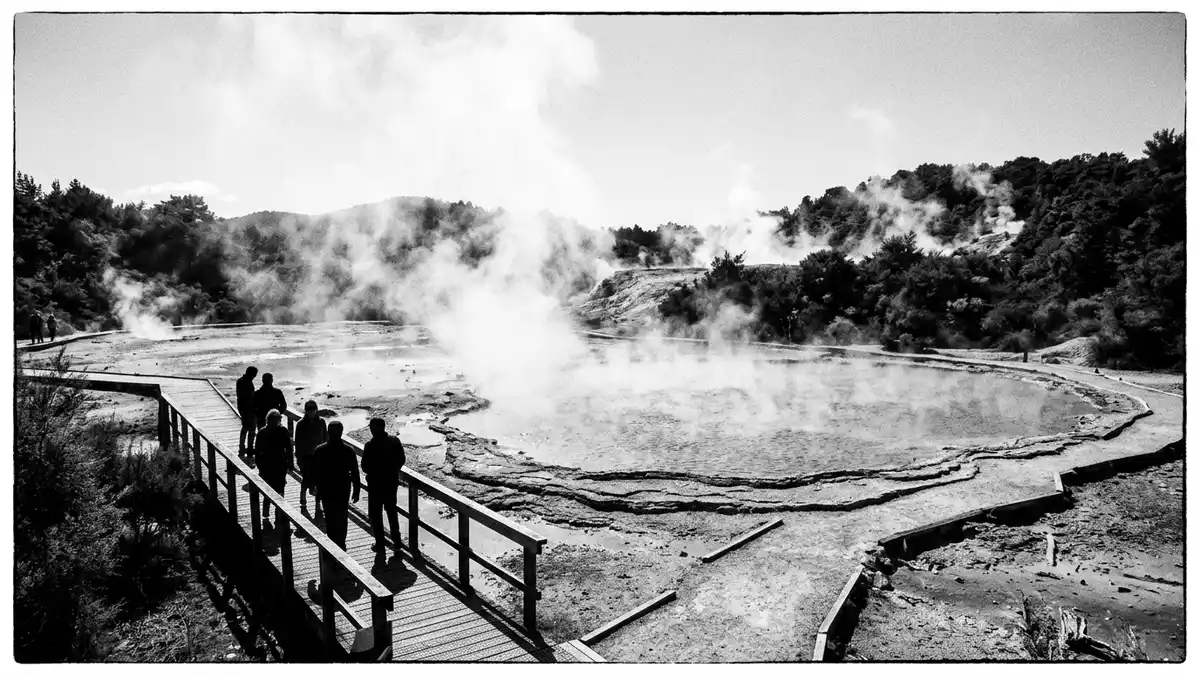
Wai-O-Tapu is a geothermal landscape south of Rotorua, where collapsed craters, steaming ground, hot springs and mineral-stained pools occupy the southern end of the Okataina Volcanic Centre. The place is recognised through colour: pale silica, orange mineral rims, green water and boiling mud appear within the same volcanic field.
Wai-O-Tapu: a landscape written in mineral colour
The name Wai-O-Tapu means Sacred Waters in M?ori. The geothermal area lies just north of the Reporoa caldera, within New Zealand’s Taup? Volcanic Zone, and extends across about 18 square kilometres. The visitor area occupies only part of that wider field.
Wai-O-Tapu Thermal Wonderland presents the volcanic features as a sequence of paths and viewing points. Craters interrupt the ground, fumaroles release steam, and mud pools break into bubbles as gases rise through their surfaces.
Champagne Pool, Artist’s Palette and the crater country
Champagne Pool is the best-known spring in the visitor area. It formed through a hydrothermal eruption around 900 years ago and measures about 65 m across. Its water is bordered by mineral deposits containing arsenic and antimony sulphides.
Artist’s Palette extends the colour range across sinter terraces and shallow geothermal waters. Other named features include Devil’s Bath, the Opal Pool, Primrose Terrace, Rainbow Crater and Thunder Crater. Their colours come from mineral-rich water, silica deposits, sulphur and iron compounds.
From volcanic activity to a protected reserve
Wai-O-Tapu’s present form includes features created by volcanic events within the last thousand years, while the underlying volcanic system reaches much further into geological time. The area has been protected as a scenic reserve since 1931.
Ng?ti Whaoa, descended from people of the Arawa waka, has ancestral connections with the wider area. M?ori use of geothermal water belongs to a cultural history that extends for centuries. The visitor park operates within a Department of Conservation concession.
The Lady Knox Geyser stands at the edge of the geothermal area. Its eruption is induced for visitors, and the vent is surrounded by pale silica deposits. The feature adds a vertical element to a landscape otherwise dominated by pools, terraces, craters and mud.
Visiting Wai-O-Tapu: what travellers from Western Europe should know
- Wai-O-Tapu lies south of Rotorua on Waiotapu Loop Road. It can be reached by road from Rotorua, with the visitor area signed from State Highway 5.
- The walking area crosses volcanic ground with viewing paths, gradients and steps. Crater edges, steaming ground and hot pools remain visible features throughout the landscape.
- The official language is English and M?ori, and the currency is the New Zealand dollar.
- Entry requirements depend on your nationality; UK travellers can check the FCDO travel advice at gov.uk/foreign-travel-advice, Irish travellers the Department of Foreign Affairs at ireland.ie.
Searching for Wai-O-Tapu on social platforms
These links open searches for Wai-O-Tapu on each platform.
Frequently asked questions about Wai-O-Tapu
Where is Wai-O-Tapu?
Wai-O-Tapu lies south of Rotorua on New Zealand’s North Island. It is part of the Taup? Volcanic Zone, near the Reporoa caldera.
What can visitors see there?
The visitor area contains craters, fumaroles, hot springs, mud pools, silica terraces and steaming ground. Named features include Champagne Pool, Artist’s Palette and Lady Knox Geyser.
What makes Wai-O-Tapu distinctive?
Its geothermal features combine strong mineral colours with active volcanic processes. Orange deposits, green water, pale terraces and bubbling mud occur across the same protected landscape.


