
Wahat Siwa, the desert oasis between dunes and palms
Published on 08/18/2026 at 14:02 | Editorial responsibility: Rafael Müller, Editor-in-Chief AD HOC NEWS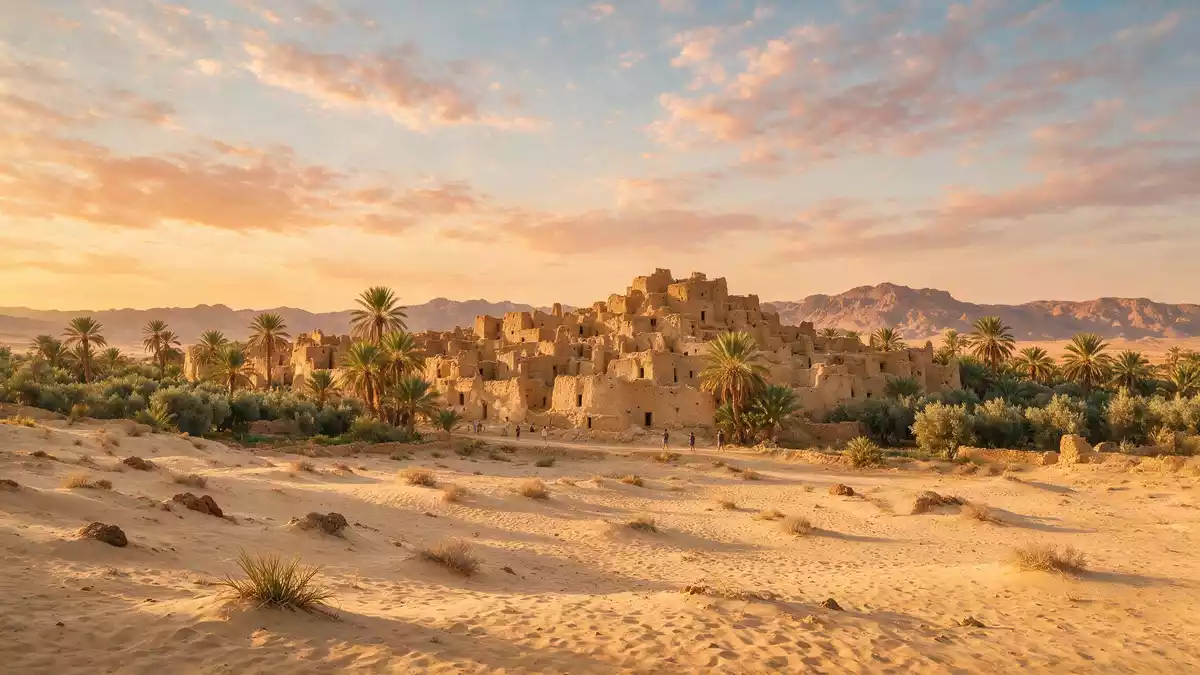
Wahat Siwa, better known internationally as the Siwa Oasis in western Egypt, is an urban oasis of palms, springs and mud-brick villages set deep in the desert between sand seas and eroded limestone ridges.Wahat Siwah lies in a natural depression below sea level, giving the landscape its distinctive ring of escarpments and shimmering salt lakes.
A remote basin in Egypt’s Western Desert
Geographically, Wahat Siwa sits between the Qattara Depression to the north and the Great Sand Sea to the south, in Egypt’s Western Desert close to the border with Libya.between the Qattara Depression and the Egyptian Sand Sea The oasis lies roughly 50 km (31 mi) east of the frontier and around 560 km (348 mi) west-southwest of Cairo, far from the Nile valley’s dense ribbon of settlements.350 miles west-southwest of Cairo
The basin extends for about 80 km (50 mi) in length and up to around 20 km (12 mi) in width, ringed by low cliffs and dunes and lying several metres below sea level at its lowest points.80 km in length and 20 km wide Within this elongated hollow, scattered springs feed agricultural gardens, date groves and olive orchards, while salt lakes occupy the lowest pockets of ground where evaporation concentrates minerals.
Springs, palms and the agricultural life of the oasis
The most immediately striking feature of Wahat Siwa is the contrast between its surrounding dunes and its interior of dense greenery supported by natural springs and wells. The oasis is recorded as having a high number of water sources, and this network of springs has long sustained extensive cultivation of date palms and olive trees.about 200 springs and thousands of date palms and olive trees Fields and groves spread around the main town, interspersed with channels, small pools and salt-encrusted hollows.
Siwa’s ancient Egyptian name, Sekht-am, meaning “palm land”, reflects how central these trees are to the oasis’s character.Sekht-am, meaning palm land In the modern period, Berber-speaking inhabitants of Wahat Siwa developed their own Siwi language and distinctive cultural practices, shaped by the isolation of this fertile pocket amid wide expanses of desert.Berber inhabitants and Siwi language Mud-brick architecture, traditional irrigation and the pattern of gardens reflect this long relationship between people, water and sand.
From oracle temple to desert settlement
Historically, Wahat Siwa is known as the seat of an oracle temple dedicated to the god Amun, which gained a reputation in antiquity and was consulted by Alexander the Great in the fourth century BC.oracle temple of Amon consulted by Alexander the Great The ruins of this temple stand on a rocky hill near the town, a reminder that the oasis once played a role in wider Mediterranean and Egyptian religious networks despite its distance from the Nile.
Modern descriptions count Wahat Siwa among Egypt’s most isolated settled oases, with a population in the tens of thousands and an urban centre surrounded by cultivated land.one of the most isolated settlements in Egypt The setting combines ancient temple sites, mud-brick fortifications and newer low-rise buildings, all enclosed by the desert basin and its ring of dunes and escarpments.
Visiting Wahat Siwa: what travellers from Western Europe should know
- Wahat Siwa lies in Egypt’s Matrouh Governorate in the Western Desert, west-southwest of Cairo and close to the border with Libya, reached overland across the desert roads that serve the oasis.
- The oasis occupies a depression below sea level, with roads descending into the basin and local tracks crossing sandy ground and salt-encrusted flats; walking between village areas frequently involves unpaved surfaces.
- The surrounding landscape consists of desert dunes and low escarpments, and within the basin cultivated gardens, groves and small lakes lie between villages; English is not an official language, and the national currency is the Egyptian pound.
- Entry requirements depend on your nationality; UK travellers can check the FCDO travel advice at gov.uk/foreign-travel-advice, Irish travellers the Department of Foreign Affairs at ireland.ie.
Searching for Wahat Siwa on social platforms
These links open searches for Wahat Siwa on each platform.
Frequently asked questions about Wahat Siwa
Where is Wahat Siwa located within Egypt?
Wahat Siwa is an oasis settlement in Egypt’s Western Desert, between the Qattara Depression and the Great Sand Sea, west-southwest of Cairo and near the Libyan border.
What should travellers expect when visiting Wahat Siwa?
Travellers encounter a desert basin with villages, springs, salt lakes and extensive date and olive groves, surrounded by dunes and escarpments and marked by ancient temple remains.
What makes Wahat Siwa distinctive among Egyptian oases?
Its combination of isolation, below-sea-level basin, long-established palm and olive cultivation, Berber-speaking community and the historic oracle temple of Amun gives Wahat Siwa a distinct character.


