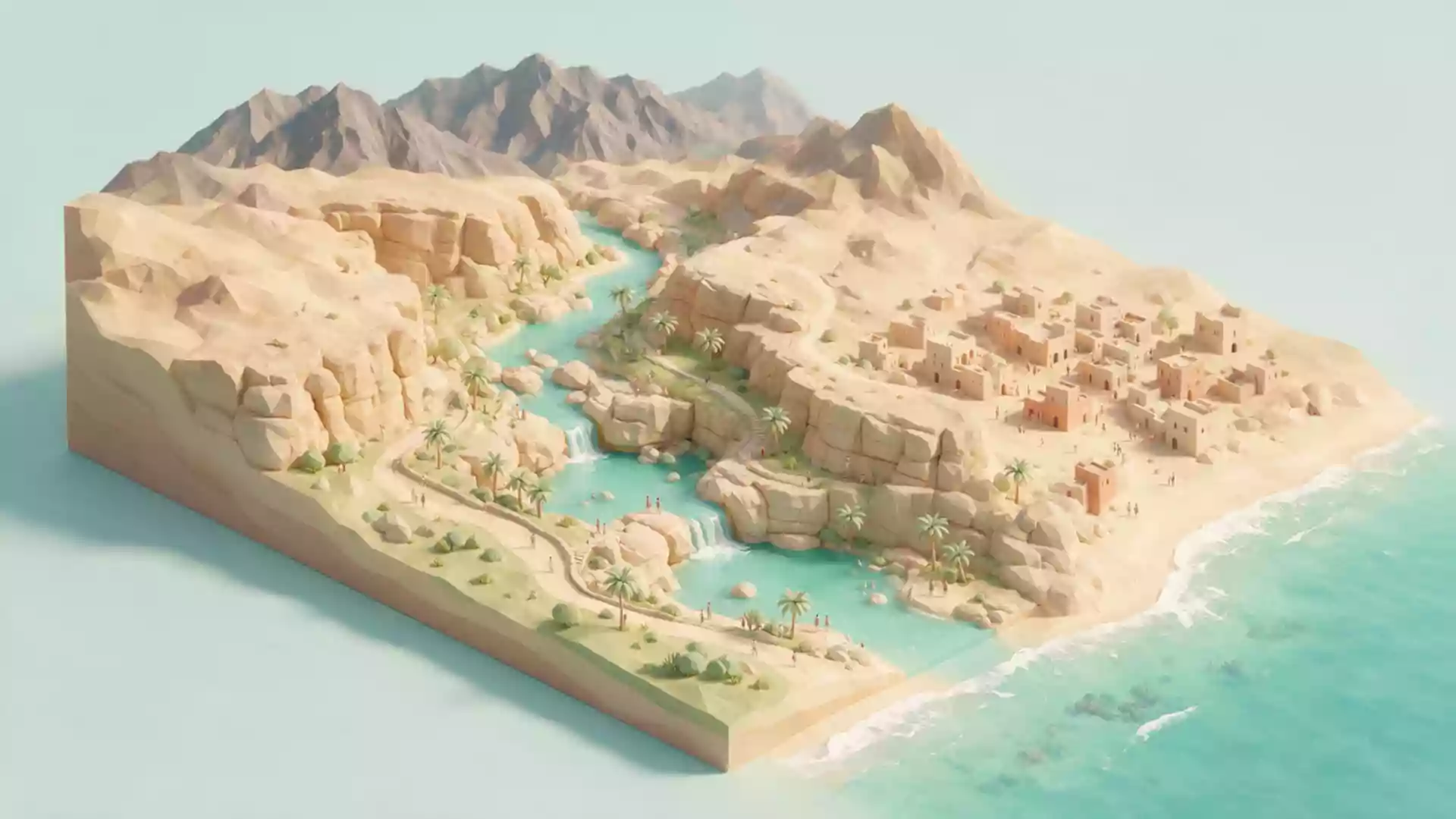
Wadi Shab’s turquoise gorge near Sur
Published on 09/09/2026 at 21:07 | Editorial responsibility: Rafael Müller, Editor-in-Chief AD HOC NEWS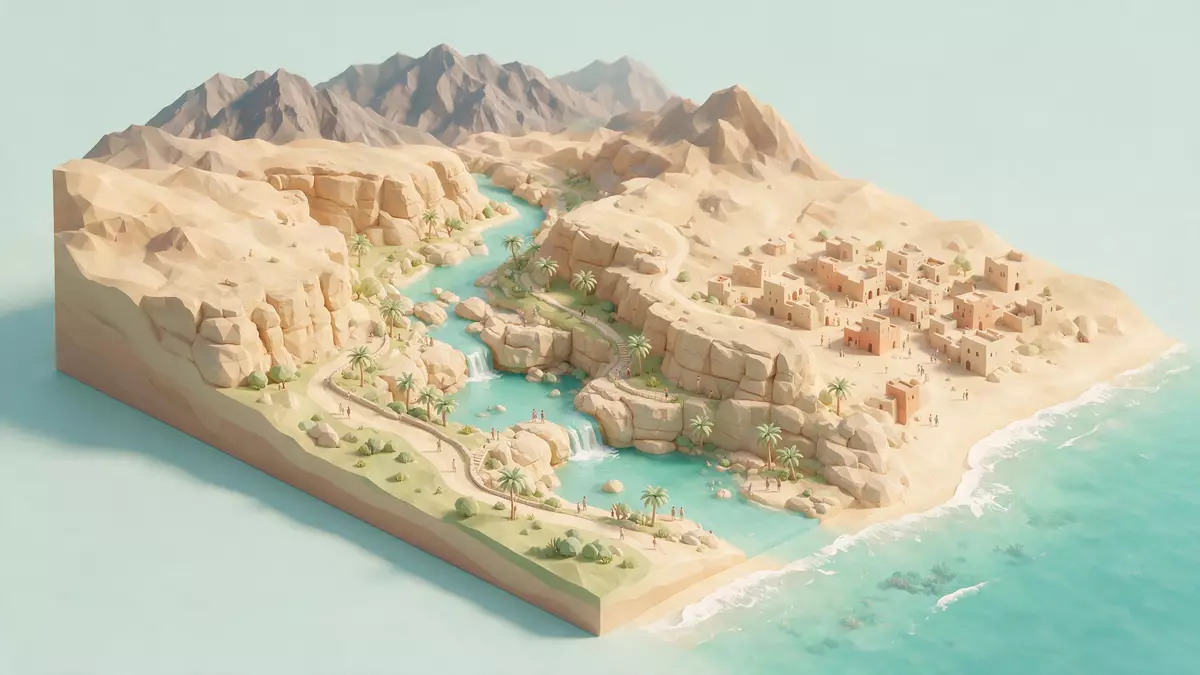
Wadi Shab near Sur in eastern Oman is a river-cut gorge where pale limestone walls rise above turquoise pools and palm groves, creating a striking contrast with the surrounding coastal plain. Set close to the small settlement of Tiwi in the Ash Sharqiyah South Governorate, the wadi cuts back from the Arabian Sea coast into the lower slopes of the Hajar Mountains, offering a sequence of water, rock and greenery that unfolds gradually as visitors move inland.
From coastal plain to canyon of water and stone
The approach to Wadi Shab begins at the edge of the coastal plain, beside the main highway that links Muscat with Sur along Oman’s eastern shore, where the river valley opens out into a broad, low-lying basin near Tiwi.inland from the highway between Muscat and Sur From this basin the valley narrows quickly as limestone walls rise on either side, and the path follows the twisting course of the river into the foothills of the Eastern Hajar.
Geologically, Wadi Shab is carved into limestone associated with the Hajar Mountains, where flowing water from springs and runoff has cut channels, terraces and fluted walls over long periods.a gorge in the Eastern Hajar Mountains Mineral deposits band the rock in places, and pockets of soil collected between boulders support date palms and other vegetation, giving the canyon alternating stretches of bare stone and garden-like clearings beneath the cliffs.turquoise pools beneath steep rock walls and palms
Pools, palms and a hidden cave in the gorge
As the trail continues further inland, the river gathers into a series of clear pools bordered by smooth rock ledges and shaded in places by overhanging palms, forming natural basins where water collects even in the drier months.turquoise pools and hanging date palms Beyond the main pools the gorge tightens to a narrower channel, where progress follows the watercourse along ledges and through shallow sections until the valley bends towards a concealed side chamber in the rock.
At the upper end of the accessible section, the canyon leads to a small cavern reached by swimming through a cleft in the rock, where a waterfall drops inside the enclosed space and light filters down from an opening above.a hidden waterfall in a cave This combination of enclosed water, falling streams and filtered daylight gives Wadi Shab a distinctive finale that contrasts with the wide, sun-exposed basin at the entrance.a cave waterfall inside a limestone cavern
Wadi Shab in the Eastern Hajar landscape
In regional terms, Wadi Shab lies along Route 17 between Muscat and Sur, close to Tiwi and a short distance inland from the Gulf of Oman, where the Eastern Hajar Mountains meet the sea.near Tiwi on the Gulf of Oman coast The wadi extends inland for several kilometres, gradually rising and narrowing as it approaches the mountain front, with the walls closing in and the valley floor becoming more uneven with boulders and ledges.located in the small village of Tiwi
The wider Eastern Hajar region is characterised by folded and uplifted rock ranges that run along much of northern Oman, and Wadi Shab is one of several river valleys that cut through these formations.a wadi issuing from the eastern Hajar Here the interaction between permanent and seasonal water, soft limestone and coastal climate has produced a landscape where dry slopes, irrigated terraces and clear pools coexist within a relatively compact area, making the gorge a notable example of how water shapes terrain on Oman’s eastern coast.signposted off the Muscat–Sur highway near Tiwi
Visiting Wadi Shab: what travellers from Western Europe should know
- Wadi Shab lies inland from the coastal highway between Muscat and Sur in eastern Oman, near the village of Tiwi and the Gulf of Oman shoreline.
- The gorge involves walking on uneven limestone, crossing boulders and following a path beside and through the river, with sections that require swimming to reach the upper cavern.
- The surrounding terrain combines exposed rock faces and shaded areas under palms, and the river valley runs for several kilometres into the foothills of the Hajar Mountains.
- The official language is Arabic and the currency is the Omani rial.
- Entry requirements depend on your nationality; UK travellers can check the FCDO travel advice at gov.uk/foreign-travel-advice, Irish travellers the Department of Foreign Affairs at ireland.ie.
Searching for Wadi Shab on social platforms
These links open searches for Wadi Shab on each platform.
Frequently asked questions about Wadi Shab
Where is Wadi Shab in relation to Sur and Muscat?
Wadi Shab lies near Tiwi on Oman’s eastern coast, inland from the highway between Muscat and Sur, in the Ash Sharqiyah South Governorate.
What can visitors expect on a visit to Wadi Shab?
Visitors encounter a limestone gorge with a river, clear pools, palm-filled terraces and, further inland, a narrow canyon leading to a cave with a waterfall.
What makes Wadi Shab distinctive among Oman’s wadis?
Its sequence from dry basin to turquoise pools, palms and a hidden cavern waterfall within a compact gorge gives Wadi Shab a distinctive character on the Eastern Hajar coast.