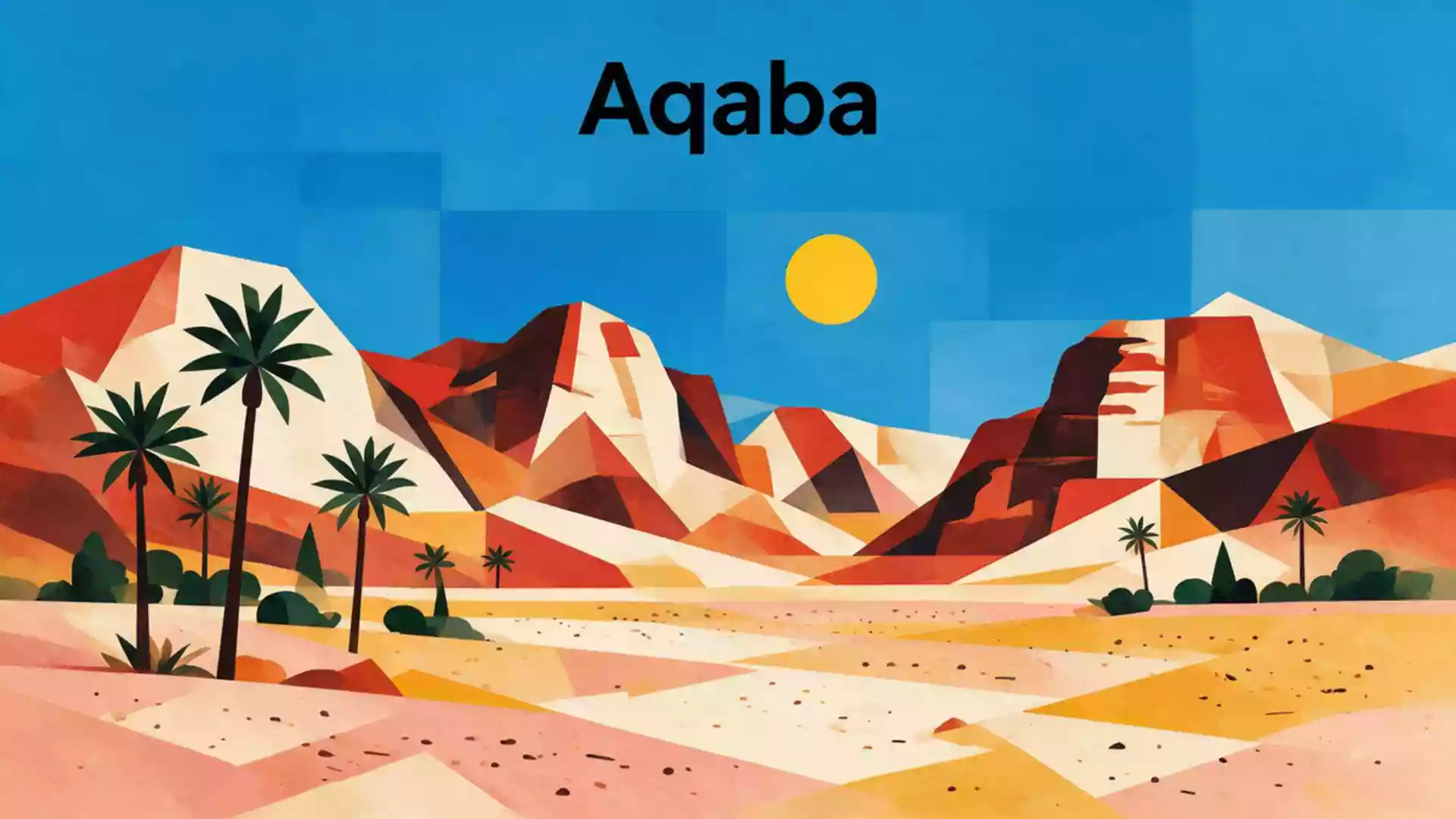
Wadi Rum’s sandstone landscapes near Aqaba
Published on 09/11/2026 at 12:41 | Editorial responsibility: Rafael Müller, Editor-in-Chief AD HOC NEWS
Wadi Rum is a broad desert valley in southern Jordan, east of Aqaba, where pale sands run between sandstone cliffs and older granite mountains that rise abruptly from the plains. The protected landscape has been recognised as the Wadi Rum Protected Area and was inscribed as a mixed natural and cultural World Heritage site in 2011, reflecting both its geology and its long human history.mixed natural and cultural World Heritage site
Sandstone cliffs and granite foundations
The striking landforms of Wadi Rum emerge from a clear geological contrast between dark, ancient granite and lighter sandstone that sits above it in thick layers. At the base of several cliffs, the exposed rocks belong to the Precambrian basement, a plutonic complex that geologists subdivide into the older Aqaba Complex and the younger Araba Complex, both formed hundreds of millions of years ago.Precambrian basement Above a noticeable erosion surface, this granite is overlain by the Rum Group, an approximately 1,000 m (3,281 ft) thick sequence of quartz-rich sandstones dating from the Lower Cambrian to the Middle Ordovician, deposited in braided rivers and shallow marine bays.
The sandstone monoliths between the desert valleys are flat-topped in many places and mark where the Rum Group has been sculpted by weathering into cliffs, domes and buttresses. Within the protected area, four named formations make up this sandstone succession: the Salab, Umm Ishrin, Disi and Umm Sahm formations, each weathering in slightly different ways and contributing to the variety of rock forms.Salab, Umm Ishrin, Disi and Umm Sahm formations Loose sands from more recent times gather along the valley floors, forming plains and dunes that emphasise the contrast between soft surfaces underfoot and the hard vertical faces of the sandstone walls.
Desert landforms shaped over millions of years
Geologists describe Wadi Rum as a desert landscape developed within continental sandstones, where tectonic movements and surface processes have worked together over millions of years to produce an intricate network of cliffs and corridors.desert landscape developed within continental sandstones Four major wadis run broadly north–south through the protected area, cutting across earlier valleys and separating sandstone massifs that rise above the sandy beds. Along these routes, water, salts and biological weathering have carved narrow gorges where the rock face closes in, and broad ramps where broken blocks and eroded slopes lead up towards the plateau tops.
Within the valleys and around the cliffs, desert landforms include natural arches, towering rock bridges, massive landslide scars and cavernous weathering pockets. At the foot of the escarpments, stepped slopes of Salab sandstone sit above the granite basement, while higher up the different sandstone units weather into ledges, vertical faces and rounded domes.natural arches and towering cliffs This variety gives Wadi Rum its distinctive character: a combination of open sandy floors and enclosing rock that shifts from ochre to pale cream with changes in lithology and light.
Human traces in a desert valley
Beyond its geology, Wadi Rum carries evidence of lengthy human presence, with rock carvings and inscriptions that span thousands of years. The protected area lies within the Aqaba Special Economic Zone in the Hashemite Kingdom of Jordan and forms a major part of the Hisma desert region in southern Jordan and northern Arabia.Hisma desert region Archaeological remains and petroglyphs document pastoral and agricultural activity across at least 12,000 years, tracing how successive communities interacted with the desert environment and its limited water sources.
In the twentieth century, Wadi Rum became associated with the Arab Revolt during the First World War through the presence of the British officer T. E. Lawrence, later known as Lawrence of Arabia. Accounts describe Lawrence using parts of the desert as a base and moving through the valleys with local fighters, a story that was echoed in cinema when scenes for the film “Lawrence of Arabia” were shot among the rock formations of southern Jordan.Lawrence of Arabia in Wadi Rum This combination of deep-time geology and more recent history contributes to the area’s designation as a mixed World Heritage property.
Visiting Wadi Rum: what travellers from Western Europe should know
- Wadi Rum lies in the southern part of Jordan within the Aqaba Governorate, east of the Jordan Rift Valley and north-east of the coastal city of Aqaba, and is reached by road across desert terrain.
- The protected area consists of sandy valley beds enclosed by sandstone cliffs and granite mountains; moving through it involves walking on soft sand and negotiating rocky slopes and steps.
- The official language is Arabic and the currency is the Jordanian dinar.
- Entry requirements depend on your nationality; UK travellers can check the FCDO travel advice at gov.uk/foreign-travel-advice, Irish travellers the Department of Foreign Affairs at ireland.ie.
Searching for Wadi Rum on social platforms
These links open searches for Wadi Rum on each platform.
Frequently asked questions about Wadi Rum
Where is Wadi Rum in relation to Aqaba?
Wadi Rum lies in southern Jordan within the Aqaba Governorate, east of the Jordan Rift Valley and about 60 km (37 mi) from the coastal city of Aqaba.about 60 km (37 mi) from Aqaba
What kind of landscape should visitors expect?
Visitors encounter sandy valley floors bordered by high sandstone cliffs and granite mountains, with gorges, natural arches, ramps and weathered rock formations shaped by desert processes.
What makes Wadi Rum distinctive compared with other deserts?
Wadi Rum combines a thick sequence of Cambrian and Ordovician quartz sandstones over Precambrian granite with extensive petroglyphs and archaeological remains, giving it both geological and cultural significance recognised in its World Heritage status.