
Wadi Rum’s sandstone and granite desert near Aqaba
Published on 08/27/2026 at 17:43 | Editorial responsibility: Rafael Müller, Editor-in-Chief AD HOC NEWS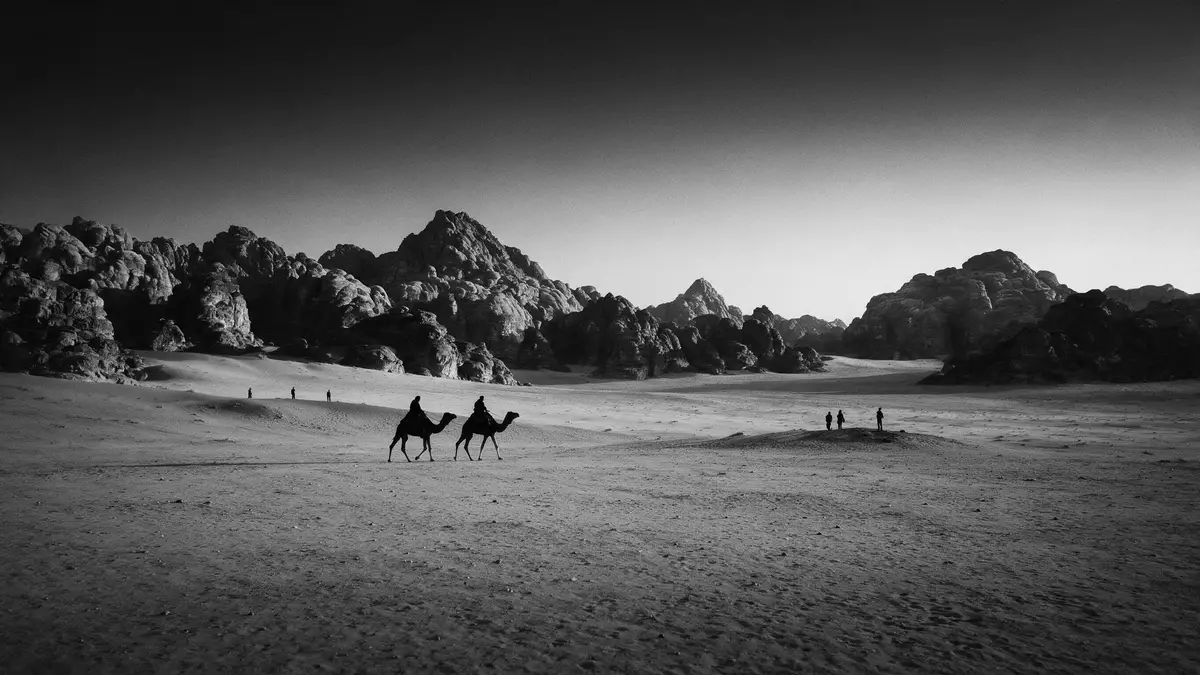
Wadi Rum in southern Jordan is a desert valley where pale sand plains meet sheer sandstone and granite massifs, forming a landscape that looks carved in layers over geological ages. Its protected area status and inscription on the UNESCO World Heritage List in 2011 anchor the place both as a natural desert landmark and as a cultural landscape shaped by thousands of years of human presence.UNESCO World Heritage site
A valley of sandstone cliffs over granite foundations
Wadi Rum lies in the Hisma desert of southern Jordan, close to the border with Saudi Arabia and to the east of Aqaba, where the ground rises into towering cliffs and mesas around wide sandy corridors.Hisma desert near Aqaba The protected area extends for several tens of kilometres from north to south and east to west, with flat valley floors framed by high red and brown rock faces that mark the edges of the wadis.extent of the protected area
The cliffs rest on a basement of granitoid rocks, part of the larger granite family, formed in the Precambrian and exposed in darker and lighter bands at the bases of the sandstone walls.granitoid basement Above them rise thick sequences of sandstones dating to the Early Palaeozoic, with harder ochre tones forming steeper faces and softer, paler layers shaping rounded domes and smoother slopes.soft and hard sandstone
Geological history written in colour and strata
In the walls and towers of Wadi Rum, the geological column stacks granite beneath dark sandstone and a lighter sandstone cap, together reaching a thickness of several hundred metres on major cliffs such as Jebel Rum.granite and sandstone sequence The sequence includes basement rocks subdivided into the Aqaba Complex and Araba Complex, followed by Cambrian sandstones and younger Ordovician and Silurian layers, so the colours on the faces correspond to different geological periods in the Early Palaeozoic.Aqaba and Araba complexes
This structure is part of a wider tectonic setting linked to the systems that formed the Jordan Rift Valley and Wadi Arabah, meaning the faults within Wadi Rum generally run in similar directions and are cut by counter faults in several orientations.fault pattern in the valley As uplift and erosion worked on the tilted blocks of granite and sandstone, deep wadis opened between the massifs, leaving vertical faces, narrow gorges, natural arches, and cavernous weathering forms that now define the protected area’s desert scenery.sandstone mountains and valleys
Rock art and long human presence in the protected area
Along the rocks of Wadi Rum, petroglyphs and inscriptions mark human occupation and use over at least twelve millennia, forming one of the key reasons why the valley is recognised as a cultural landscape as well as a natural desert site.petroglyphs and inscriptions The carvings and texts record pastoral, agricultural and urban activity in the Arabian Peninsula, reflecting nomadic herding traditions, semi?settled communities and trading routes in a region where rainfall is limited and wadis create precious corridors.
The protected area, officially titled the Wadi Rum Protected Area and managed under the Aqaba Special Economic Zone Authority, covers tens of thousands of hectares and retains large stretches of desert terrain in relatively undisturbed condition.Wadi Rum Protected Area Its designation as a mixed property under cultural criteria (iii) and (v) and natural criterion (vii) reflects both the density of rock art and inscriptions and the aesthetic qualities of its sandstone mountains, valley systems and honeycomb weathering features across the desert.mixed natural and cultural criteria
Visiting Wadi Rum: what travellers from Western Europe should know
- Wadi Rum lies in southern Jordan, around east of Aqaba, in a region reached by road from the coastal city and other parts of the country.
- The terrain combines soft sand with rocky outcrops and high cliffs, so routes on foot cross loose surfaces and some viewpoints sit at altitude above the valley floors.
- The wider landscape includes other desert features and escarpments linked to the Jordan Rift Valley, so horizons can take in distant plateaus beyond the main wadis.
- The official language is Arabic and the currency is the Jordanian dinar.
- Entry requirements depend on your nationality; UK travellers can check the FCDO travel advice at gov.uk/foreign-travel-advice, Irish travellers the Department of Foreign Affairs at ireland.ie.
Searching for Wadi Rum on social platforms
These links open searches for Wadi Rum on each platform.
Frequently asked questions about Wadi Rum
Where is Wadi Rum in relation to Aqaba?
Wadi Rum is in southern Jordan in the Hisma desert, around east of Aqaba and near the border with Saudi Arabia.
What kind of landscape should visitors expect?
The valley combines wide sandy floors with high sandstone cliffs on granite bases, natural arches, narrow gorges and domed rock formations.
What distinguishes Wadi Rum among desert valleys?
It is a protected area recognised by UNESCO for both desert scenery and dense rock art and inscriptions recording around 12,000 years of human activity.


