
Wadi Al-Hitan: whale fossils in the desert of Fayyum
Published on 09/15/2026 at 18:05 | Editorial responsibility: Rafael Müller, Editor-in-Chief AD HOC NEWS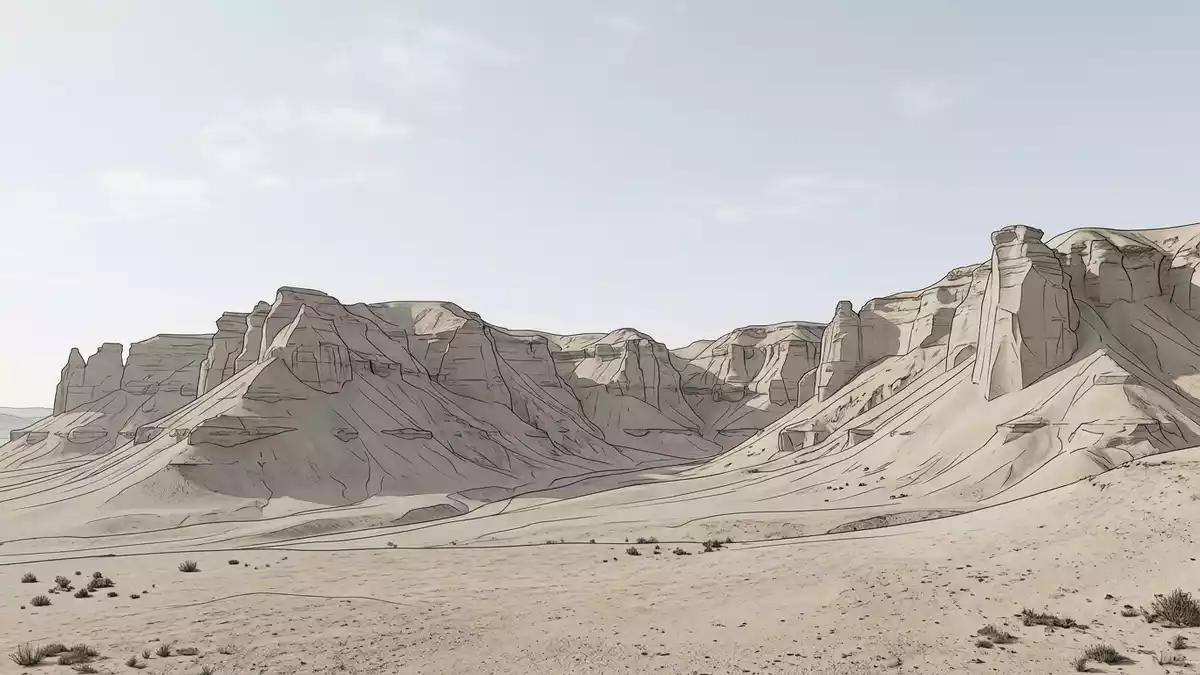
Wadi Al-Hitan in Fayyum, Egypt, is a broad desert valley where whale skeletons lie exposed among layered sandstone and limestone, revealing an ancient shallow sea from the Eocene period. Set within the Western Desert and recognised as a UNESCO World Heritage Site in 2005, it offers a rare combination of large fossil assemblies and readable rock strata in one landscape.
A desert valley shaped by an ancient sea
Wadi Al-Hitan occupies part of the Western Desert within the Faiyum Governorate, forming a section of the Wadi El-Rayan Protected Area south of the Fayoum Oasis.Western Desert location in Faiyum The valley lies some distance south-southwest of Cairo, reached through the surrounding desert plateau where low escarpments give way to open sandy ground.position within Wadi El-Rayan Protected Area Seen from ground level, the landscape extends as a flat, gently undulating basin with scattered rock ridges and isolated hills that have been carved by wind and occasional water.
The exposed rocks belong to sedimentary formations laid down during the Eocene, when this part of Egypt formed a nearshore marine environment linked to the ancient Tethys Sea.Eocene nearshore marine strata Alternating bands of sandstone and limestone record changes in sea level, from shallow bays to slightly deeper water, and later uplift and erosion brought those strata to the surface. In places the valley floor displays wave-like ridges of consolidated sand, while low cliffs and terraces expose cross-sections where fossil bones sit within the layers.
Whale skeletons and other Eocene fossils in the open
The defining feature of Wadi Al-Hitan is the density of whale fossils, many preserved as near-complete skeletons lying horizontally within the sediment, with vertebrae, ribs and skulls closely associated.invaluable fossil remains of archaeoceti whales These remains belong to archaeoceti, an extinct suborder representing some of the earliest whales, and show a mixture of traits that link fully aquatic cetaceans to land mammals.inscription for earliest forms of whale At Wadi Al-Hitan the skeletons lie where they were embedded in the Eocene seabed, and erosion has uncovered them without removing all surrounding sediment, so bones often appear partly raised yet still set in the original rock.
Among the whales, skeletons of Basilosaurus isis and Dorudon atrox are especially prominent, representing large predatory and smaller toothed forms from the same period.Basilosaurus isis and Dorudon atrox occurrences Other marine vertebrates and invertebrates also appear in the valley, including sea cows, crocodiles, turtles, bony fishes and sharks, alongside macro-invertebrate fossils within the surrounding formations.rich content of vertebrate and invertebrate fossils The result is an open-air fossil field where multiple groups of marine animals from about 40 million years ago can be observed together.
A World Heritage landscape of science and interpretation
Wadi Al-Hitan was inscribed on the UNESCO World Heritage List in July 2005 under natural criteria recognising both the scientific importance of its fossils and the clarity with which they document whale evolution.World Heritage inscription in 2005 The property covers a core area of about 200.15 km2 (77.29 sq mi), with a surrounding buffer zone protecting the broader landscape of desert plains and escarpments.core area and buffer zone figures Within this area, shallow valleys, low ridges and rock shelves form a setting where both fossils and stratigraphic sequences are accessible for study.
Scientific teams have documented hundreds of whale and sea cow skeletons in Wadi Al-Hitan, mapping their distribution across several formations that include Gehannam, Birket Qarun and Qasr el Sagha.expedition mapping work and formations Interpretive trails and designated viewing areas present selected skeletons and rock features, while leaving wider zones reserved for research and conservation. The combination of accessible fossils, readable rock layers and protected desert scenery contributes to Wadi Al-Hitan’s role as both a scientific reference site and a place where visitors encounter evidence of major evolutionary change.
Visiting Wadi Al-Hitan: what travellers from Western Europe should know
- Wadi Al-Hitan lies within the Wadi El-Rayan Protected Area in the Western Desert, south of the Fayoum Oasis in Egypt’s Faiyum Governorate, reached by road across desert terrain.
- Paths in the fossil field cross sandy ground and low rock ledges, and approaches to skeletons may involve walking over uneven surfaces with occasional short climbs.
- The valley sits in an arid desert environment where daytime conditions can be hot and exposed, with little natural shade away from built structures.
- The official language is Arabic and the currency is the Egyptian pound.
- Entry requirements depend on your nationality; UK travellers can check the FCDO travel advice at gov.uk/foreign-travel-advice, Irish travellers the Department of Foreign Affairs at ireland.ie.
Searching for Wadi Al-Hitan on social platforms
These links open searches for Wadi Al-Hitan on each platform.
Frequently asked questions about Wadi Al-Hitan
Where is Wadi Al-Hitan located?
Wadi Al-Hitan is in the Faiyum Governorate of Egypt, within the Wadi El-Rayan Protected Area in the Western Desert south of the Fayoum Oasis.
What can visitors expect to see at Wadi Al-Hitan?
Visitors encounter exposed whale skeletons and other marine fossils embedded in Eocene sandstone and limestone, set within a broad desert valley with low escarpments and sandy plains.
What makes Wadi Al-Hitan distinctive?
Wadi Al-Hitan combines hundreds of archaeocete whale fossils with readable Eocene strata in an open desert setting, earning UNESCO World Heritage recognition for its exceptional evolutionary record.


