
Wadi Al-Hitan: whale fossils in Egypt’s Western Desert
Published on 09/12/2026 at 15:11 | Editorial responsibility: Rafael Müller, Editor-in-Chief AD HOC NEWS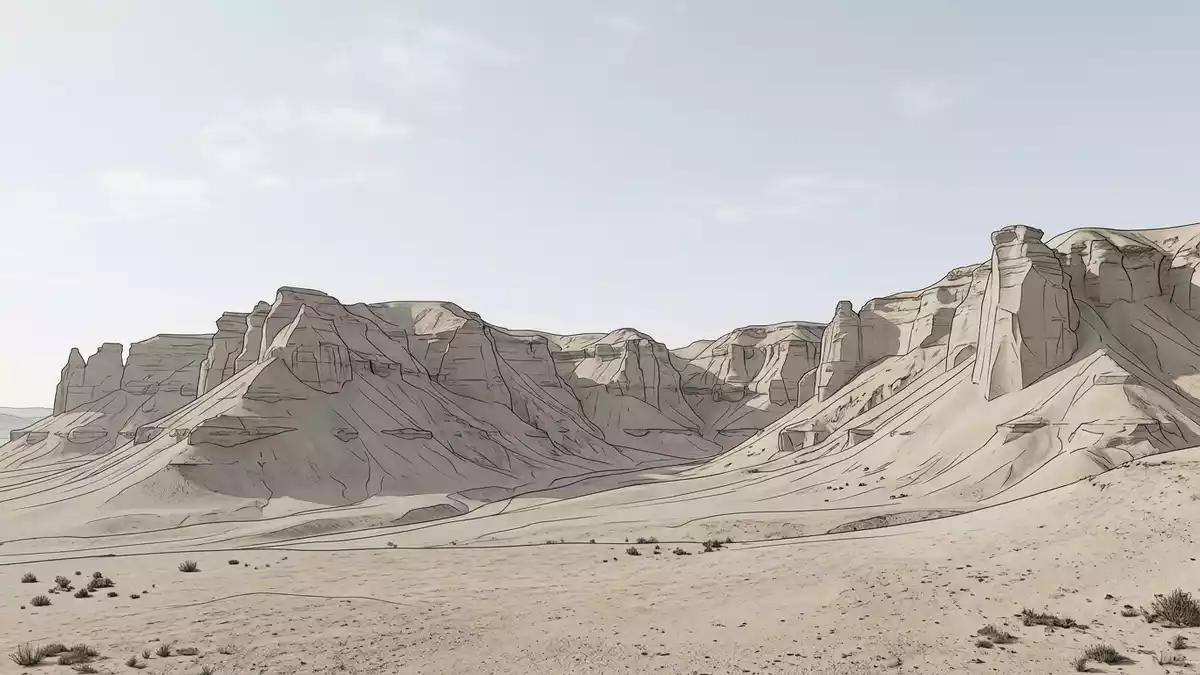
In the Fayyum region of Egypt, Wadi Al-Hitan is a desert valley where ancient whale skeletons lie exposed in the sand, forming a landscape that reads like a long chapter in the history of life on Earth. The site sits in Egypt’s Western Desert within the Wadi El-Rayan Protected Area and was inscribed as a natural UNESCO World Heritage Site in 2005, recognised for the extraordinary fossil record of early whales from the Eocene epoch.natural UNESCO World Heritage Site
A desert valley filled with ancient seas
Wadi Al-Hitan lies in the Western Desert of Egypt, in the Fayyum Depression south-west of Cairo, where low hills of sandstone and shale frame a broad sandy basin. The valley forms part of the Wadi El-Rayan Protected Area, a wider landscape of desert escarpments and shallow basins that once lay beneath a warm, shallow sea during the middle to late Eocene period.Wadi El-Rayan Protected Area Rock formations around the valley preserve layers of marine sediments, including the Gahannam and Birket Qarun formations that host vertebrate fossils and the overlying Qasr El-Sagha formation with shallow marine invertebrates.Gahannam and Birket Qarun formations
Standing in Wadi Al-Hitan means standing on what was once the floor of that sea, now transformed into wind-shaped ridges, low plateaus and natural amphitheatres of sand and eroded rock. The light-coloured sediments contrast with the darker fossil bones that emerge from them, and pathways marked across the valley guide visitors across gently undulating ground between clusters of skeletal remains and small interpretive structures.
Whale evolution written in bone
Wadi Al-Hitan is renowned for its concentration of fossil skeletons from the earliest, now extinct, suborder of whales known as Archaeoceti, preserved in situ within the Eocene marine sediments.earliest suborder of whales Among the most abundant and best-known of these archaic whales are Basilosaurus isis and Dorudon atrox, species whose skeletons have been studied intensively for what they reveal about the transition from land mammals to fully marine cetaceans.Basilosaurus isis and Dorudon atrox
Many of the skeletons at Wadi Al-Hitan are remarkably complete, with skulls, vertebral columns and limb elements preserved, and some individuals retain vestigial hind limbs that no longer supported walking but testify to their terrestrial ancestry.vestigial rear limbs The fossils date to tens of millions of years ago, within the late Eocene, and lie alongside remains of other marine animals including sirenians, shark teeth, turtles and crocodilians that together sketch a picture of a rich shallow marine ecosystem.sirenians and other marine fauna
A World Heritage open-air museum of fossils
In 2005 Wadi Al-Hitan was inscribed on the UNESCO World Heritage List for the way it demonstrates a key stage in whale evolution, recognised under natural criteria that emphasise the number, concentration and quality of its fossils and their presentation in an accessible landscape.inscribed on the World Heritage List in 2005 The valley is often described as an open-air museum, with exposed skeletons carefully stabilised and signposted, and with a small visitor centre that introduces the geological history and palaeontological significance of the site.open museum of fossils
Explanatory panels near many of the skeletons help visitors distinguish the long, serpentine vertebral columns of Basilosaurus from the more compact bodies of Dorudon, and highlight features such as the small hind limb bones preserved near the pelvis or the structure of the skull and jaws. Walking between these displays, it becomes clear that Wadi Al-Hitan is not a single fossil exposure but a broad area of desert surface where many skeletons lie distributed across several kilometres, some partly buried, others fully prepared and presented.
Visiting Wadi Al-Hitan: what travellers from Western Europe should know
- Wadi Al-Hitan lies in the Fayyum region of Egypt’s Western Desert, within the Wadi El-Rayan Protected Area south-west of Cairo, reached over desert roads by vehicle.
- The valley floor consists of soft sand and eroded sedimentary rock, with low rises and gentle slopes, so visiting involves walking on uneven desert ground along marked paths.
- Wadi Al-Hitan is in Egypt, where the official language is Arabic and the currency is the Egyptian pound.
- Entry requirements depend on your nationality; UK travellers can check the FCDO travel advice at gov.uk/foreign-travel-advice, Irish travellers the Department of Foreign Affairs at ireland.ie.
Searching for Wadi Al-Hitan on social platforms
These links open searches for Wadi Al-Hitan on each platform.
Frequently asked questions about Wadi Al-Hitan
Where is Wadi Al-Hitan located?
Wadi Al-Hitan is in the Fayyum region of Egypt’s Western Desert, within the Wadi El-Rayan Protected Area south-west of Cairo, in the broader Fayyum Depression.
What can visitors expect when they arrive at Wadi Al-Hitan?
Visitors encounter a desert valley with marked paths across sandy ground, where exposed whale skeletons and other marine fossils are displayed alongside information panels and a small interpretive centre.
What makes Wadi Al-Hitan distinctive among fossil sites?
Wadi Al-Hitan is distinctive for its concentration of well-preserved Eocene whale skeletons, including species such as Basilosaurus isis and Dorudon atrox, presented in their original marine sediment setting.


