
Volubilis and its Roman mosaics on the edge of Mauretania
Published on 09/16/2026 at 22:18 | Editorial responsibility: Rafael Müller, Editor-in-Chief AD HOC NEWS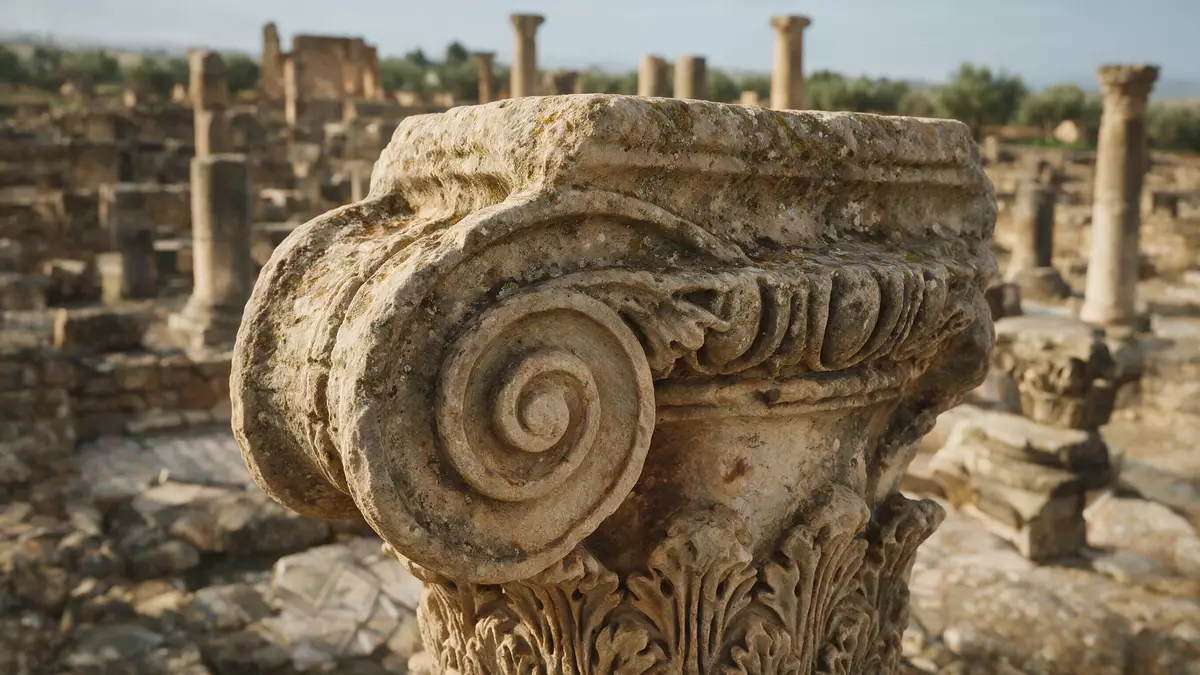
Volubilis, on the plain north of Meknes in Morocco, is a partly excavated ancient city where Roman houses and mosaic floors stand open to the sky, outlining everyday life on a distant frontier of empire. The site is traditionally dated to the third century BC as a Carthaginian-founded settlement, later absorbed into the Kingdom of Mauretania and then the Roman world.
A frontier city between Mauretania and Rome
Volubilis lies at the foot of the Zerhoun hills, on a fertile agricultural plain that once supported intensive cultivation of grain and olives for export across the Mediterranean. The ruins extend across more than 40 ha of ground, with the regular street grid, paved thoroughfares and house plots of a Roman provincial town still legible on the surface.over 40 hectares of excavated structures The city became closely tied to the Kingdom of Mauretania under Juba II and was probably the capital of that realm before its annexation to the Roman Empire in the first century AD.capital of ancient Mauretania
In AD 44 Volubilis and its hinterland were incorporated into the Roman province of Mauretania Tingitana, marking a political transition from royal court to colonial municipium.annexed and raised to a municipium The town developed a forum, basilica and triumphal arch aligned with the main street, imposing stone houses with internal courtyards, and public baths supplied by aqueducts from the surrounding hills. Latin inscriptions carved into gates and monuments record dedications and imperial titles, while reused blocks and fragments lie scattered across the excavated sectors, hinting at phases of rebuilding across centuries.
Mosaics, houses and public buildings in the open air
One of the most striking aspects of Volubilis is the concentration of domestic mosaics preserved in situ, still covering the floors of house rooms and reception spaces under open daylight. These mosaics depict scenes such as marine life, hunting and mythological figures, framed by geometric borders in black-and-white or coloured stone tesserae.exceptionally well-preserved mosaics The grander houses are organised around central courtyards, with columns marking porticoes and side rooms opening off the main axes; the outlines of staircases, latrines and service areas can be traced in the foundations.
Public buildings occupy the centre of the site, where the forum square, basilica and triumphal arch form a stone ensemble against the horizon. The basilica’s rows of columns and the arch’s surviving façade show the scale of civic architecture commissioned under Roman rule.forum, basilica and triumphal arch Thermae complexes, including the Thermae of Gallien, sit within the urban fabric, with their apses, pools and service rooms arranged along corridors that still stand to several courses of stone.Thermae of Gallien Agricultural presses and storage installations, visible in some houses and courtyards, underline how closely domestic life was linked to olive oil production and trade.
Continuity, heritage status and the surrounding landscape
The occupation history of Volubilis reaches back into the Neolithic period, with early settlements on the site preceding its Carthaginian and Roman phases.Neolithic occupation After Roman authority in Mauretania weakened in the third century AD, the city continued as a regional centre under later powers, and Latin remained in use in daily life for centuries after the formal end of Roman administration.Latin as spoken language until Arab conquests In the late eighth century Volubilis became the seat of Idris ibn Abdallah, associated with the foundation of the Idrisid dynasty and the first Muslim state in Morocco, before political focus shifted towards Fez and other centres.capital for Idris ibn Abdallah
Volubilis is inscribed on the UNESCO World Heritage List, recognised as an exceptionally well preserved example of a large Roman colonial town on the fringes of the Empire.inscription under criteria (ii), (iii), (iv) and (vi) The site lies a short distance west of the holy town of Moulay Idriss Zerhoun, with the Zerhoun hills rising behind and wide fields stretching away from the ruins.on the edge of a vast plain below the Zerhoun hills Standing on the preserved streets and in the remains of houses, visitors encounter a city that carries traces of Berber, Carthaginian, Roman and early Islamic periods within a single, coherent archaeological landscape.
Visiting Volubilis: what travellers from Western Europe should know
- Volubilis lies north of Meknes in northern Morocco, near the town of Moulay Idriss Zerhoun, reached by road across an agricultural plain from Meknes or Fez.
- Within the ruins, movement follows uneven stone streets and earth paths, with low walls, steps and loose surfaces that demand attention when walking.
- The surrounding landscape consists of cultivated fields and low hills, and the exposed setting means sun and weather act directly on the site throughout the year.
- The official language is Arabic and the currency is the Moroccan dirham.
- Entry requirements depend on your nationality; UK travellers can check the FCDO travel advice at gov.uk/foreign-travel-advice, Irish travellers the Department of Foreign Affairs at ireland.ie.
Searching for Volubilis on social platforms
These links open searches for Volubilis on each platform.
Frequently asked questions about Volubilis
Where is Volubilis and what kind of place is it?
Volubilis is an archaeological site north of Meknes in northern Morocco, containing the ruins of an ancient city with strong Roman-period remains.
What can visitors expect when walking through Volubilis?
Visitors walk along stone streets and earth paths past low walls, columns, mosaic floors and public buildings, with wide views across the surrounding fields and hills.
What makes Volubilis distinctive among ancient sites?
Volubilis combines extensive in situ mosaics, a clearly readable Roman urban layout and later layers linked to the Idrisid dynasty within one continuous archaeological landscape.


