
Volubilis, a Roman city on the plains near Meknes
Published on 08/27/2026 at 11:14 | Editorial responsibility: Rafael Müller, Editor-in-Chief AD HOC NEWS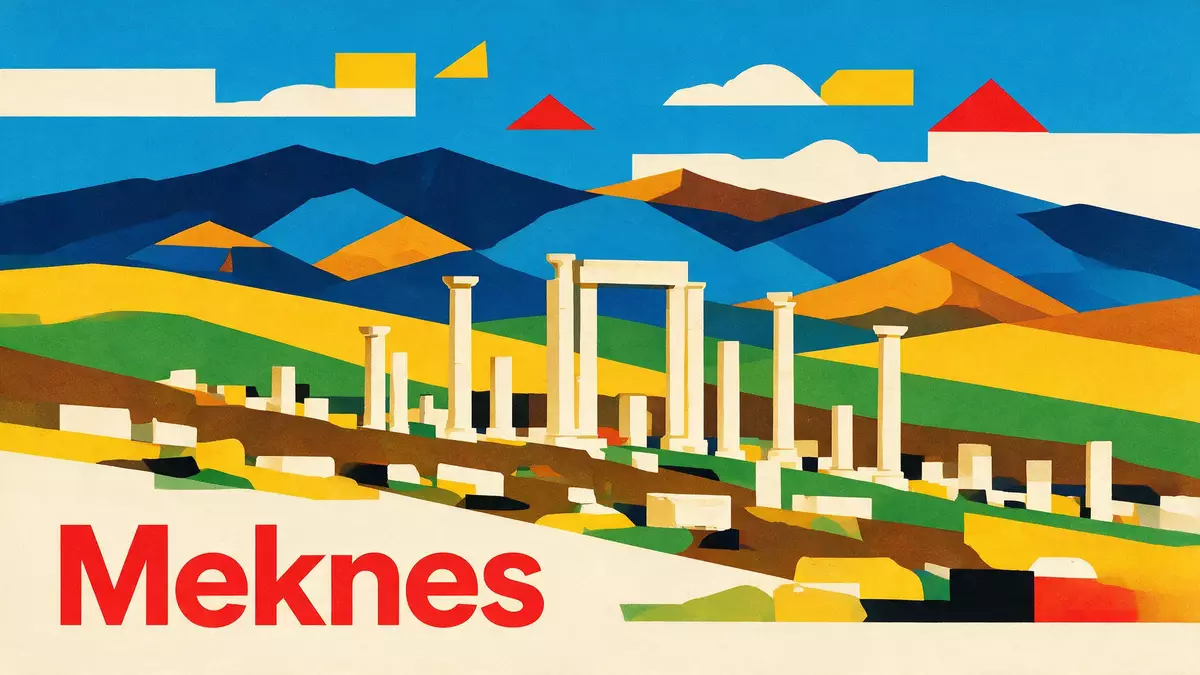
On a broad agricultural plain north of Meknes in Morocco, Volubilis preserves the stone skeleton of a Roman-era city laid out beneath the slopes of Jebel Zerhoun. Built on a low plateau between river valleys, the site brings together Berber roots, Roman urban planning and later Islamic history in a landscape of columns, arches and mosaic floors.
From Mauretanian centre to Roman municipium
Volubilis stands in the Meknès Prefecture of the Fès-Meknès region, on the Jebel Zerhoun Plain that rises towards a low mountain ridge.Jebel Zerhoun Plain Archaeology has identified the city as a Berber settlement that became a centre of the Kingdom of Mauretania under King Juba II in the first century BC and first century AD.King Juba II When Rome annexed Mauretania in the first century AD, Volubilis entered the imperial system as a municipium within the province of Mauretania Tingitana, linking local elites to Roman administration.
The core of the surviving city dates from the second and third centuries AD, when its layout and public buildings took the form that visitors see today.second and third centuries AD Prosperity drew on the surrounding olive-growing estates, and the plateau was ringed by presses and mills feeding a trade in oil towards the wider Mediterranean. Stone streets, lined with town houses and workshops, radiated from a forum and basilica towards the edges of the walled city, giving Volubilis the appearance of a compact but complete Roman urban centre at the south-western edge of empire.Roman urban centre
Streets, arches and mosaics in the open air
Visitors entering Volubilis step into a grid of stone-paved streets where wheel ruts and kerbs still mark the traffic patterns of ancient carts. The decumanus maximus, the main east–west axis, runs past the forum and the basilica, whose tall columns and wall segments give a sense of civic scale against the surrounding countryside.forum and basilica Around these public buildings, lines of broken columns trace the outlines of porticoes and shops, their fragments scattered on the ground in recognisable patterns.
One of the most photographed structures on the site is the Triumphal Arch of Caracalla, built in the early third century AD and standing near the centre of the ruins.Triumphal Arch of Caracalla Its single opening and flanking columns rise from a stepped base that marks the crossing of two main streets. Beyond the civic core, houses of prosperous residents preserve mosaic floors with mythological and everyday scenes, visible directly under the sky. Olive presses carved from stone blocks sit beside courtyards, showing the industrial side of the town. Together, the arches, mosaics and mills give Volubilis a mixture of domestic and ceremonial spaces that can be walked through in a single circuit.olive mills and mosaics
Layers of history and UNESCO recognition
Roman administration withdrew from Mauretania Tingitana in the late third century AD, but occupation of Volubilis continued for centuries in different forms.late third century AD In the late eighth century, Idris I, founder of the Idrisid dynasty, established his capital in the town, linking the site to an early Islamic polity in Morocco.Idris I capital Over the medieval period, settlement shifted towards the nearby town of Moulay Idriss Zerhoun, leaving the plateau with its ancient stonework increasingly exposed.
In the twentieth century, systematic excavation and conservation turned Volubilis into an archaeological park that presents the remains of a Berber-Roman city with clear street lines and major monuments. The Archaeological Site of Volubilis entered the UNESCO World Heritage List in 1997 as a cultural property, recognising its Roman vestiges and the continuity of occupation across different historical periods.UNESCO World Heritage List The inscription highlights the combination of fortified municipium, agricultural hinterland and architectural remains such as the basilica and arch, all set at the foot of the Jebel Zerhoun hills.fortified municipium
Visiting Volubilis: what travellers from Western Europe should know
- Volubilis lies north of Meknes in northern Morocco, reached by road through the agricultural plain towards Moulay Idriss Zerhoun and the slopes of Jebel Zerhoun.
- Within the site, movement follows stone streets and packed earth paths; the terrain includes uneven paving, steps and low rises between residential quarters and the civic core.
- The ruins stand in an open landscape with little shade across the plateau, and the basilica, forum and arch rise above surrounding fields and low hills.
- Nearby, the town of Moulay Idriss Zerhoun sits on higher ground to the east, while the wider Fès-Meknès region includes other historic centres such as Meknes and Fès.
- The official language is Arabic and the currency is the Moroccan dirham.
Searching for Volubilis on social platforms
These links open searches for Volubilis on each platform.Frequently asked questions about Volubilis
Where is Volubilis in relation to Meknes?
Volubilis stands on a plain north of Meknes in northern Morocco, near the slopes of Jebel Zerhoun and the town of Moulay Idriss Zerhoun.
What can visitors expect to see at Volubilis?
Visitors walk through stone streets lined with ruined houses, the basilica and forum, olive presses and the Triumphal Arch of Caracalla, with mosaic floors exposed to the sky.
What makes Volubilis distinctive among Roman sites?
Volubilis combines a Roman municipium, Berber origins and later Idrisid history in a single plateau landscape, recognised as a UNESCO World Heritage Site since 1997.


