
Volcanoes National Park and the volcanic spine of Rwanda
Published on 09/07/2026 at 09:31 | Editorial responsibility: Rafael Müller, Editor-in-Chief AD HOC NEWS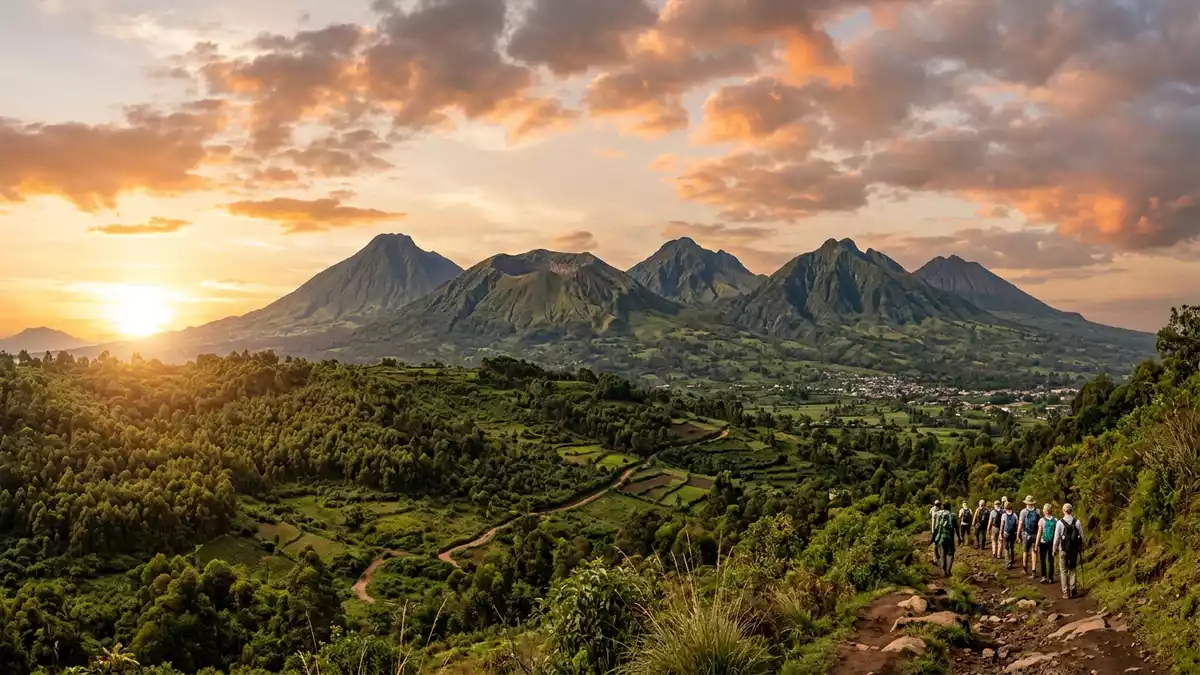
Volcanoes National Park in northern Rwanda is a landscape where a chain of volcanic peaks, montane forest and high-altitude farmland meet in one compact protected area. The park forms Rwanda’s share of the Virunga Mountains and stands near the town of Musanze, giving travellers a clear sense of how wild slopes and settled valleys interlock in this corner of the Great Rift Valley.
Virunga volcanoes on the Rwandan skyline
The defining feature of Volcanoes National Park is its string of dormant volcanoes, which form part of the broader Virunga Massif spanning Rwanda, Uganda and the Democratic Republic of the Congo.The park covers about 160 square kilometres of protected terrain in this mountain chain. The best known summits on the Rwandan side include Karisimbi, Bisoke, Muhabura, Gahinga and Sabyinyo, their flanks rising above fields and small settlements around Musanze.
Karisimbi, which reaches around 4,507 m (14,787 ft), is the highest of these peaks and forms a constant reference point on clear days from Musanze and the surrounding countryside.The Virunga volcanoes stretch along the country’s borders, giving the park a strong sense of being part of a cross-border landscape that also includes Virunga National Park in Congo and Mgahinga Gorilla National Park in Uganda. The volcanic origins of the region are also visible in features such as lava flows and the Musanze Caves, where old lava tunnels form a system of caverns inside the wider protected area.
A century of conservation in Rwanda’s highlands
Volcanoes National Park has a long history within African conservation, with its roots in the early twentieth century.In 1925 the Belgian colonial administration created Albert National Park in the Virunga region, recognised as the first national park on the African continent. The area that is now Volcanoes National Park formed part of that wider protected zone, which stretched across what are now Rwanda and the Democratic Republic of the Congo.
Over the decades, the boundaries and name of the park changed, with the Rwandan section eventually becoming a distinct national park focused on the slopes of the Virunga volcanoes.UNESCO recognises the Volcans Biosphere Reserve in this region, highlighting its combination of bamboo and rainforest, high-altitude moorland and volcanic peaks. Conservation in the park became closely associated with mountain gorilla research in the later twentieth century, especially through the work of primatologist Dian Fossey at the Karisoke Research Center, which lies between Karisimbi and Bisoke.
Mountain gorillas and montane ecosystems
Volcanoes National Park is best known for its role in protecting mountain gorillas, an endangered subspecies that lives only in the Virunga Massif and Uganda’s Bwindi Impenetrable National Park.The park forms part of a transboundary conservation landscape where Rwanda, Uganda and Congo share responsibility for this high-altitude habitat. Within its bamboo and montane forests, mountain gorilla groups move across the slopes, crossing between national borders that are invisible in the vegetation.
The park’s ecosystems extend beyond gorilla habitat.The protected area includes evergreen forest, bamboo stands, open grassland, swamp and heath that climb in bands up the volcanoes. Species lists compiled for the wider biosphere reserve highlight more than one hundred mammal species and a rich birdlife, reflecting the mix of habitats across the altitude range. Inside the park boundaries, sites such as Buhanga Eco-Park, an ancient patch of woodland associated with Rwandan royal traditions, and the Musanze Caves add cultural and geological variety to the predominantly forested slopes.
Visiting Volcanoes National Park: what travellers from Western Europe should know
- Volcanoes National Park lies in north-western Rwanda near Musanze, a major town that serves as the main gateway to the park and the wider Virunga region.
- The terrain rises quickly from cultivated valleys into steep volcanic slopes, and many routes within the park involve walking on uneven ground and ascending paths at altitude.
- Road access from Kigali leads north towards Musanze, which acts as the hub for journeys to the park headquarters at Kinigi and other trailheads in the surrounding highlands.
- Within the park, weather conditions can change rapidly at higher elevations, and temperatures drop noticeably on the upper slopes compared with the lowland areas around Musanze.
- The official language in Rwanda is Kinyarwanda alongside English and French, and the currency is the Rwandan franc; entry requirements depend on your nationality, UK travellers can check the FCDO travel advice at gov.uk/foreign-travel-advice, Irish travellers the Department of Foreign Affairs at ireland.ie.
Searching for Volcanoes National Park on social platforms
These links open searches for Volcanoes National Park on each platform.
Frequently asked questions about Volcanoes National Park
Where is Volcanoes National Park in Rwanda?
Volcanoes National Park is in north-western Rwanda near the town of Musanze, in a section of the Virunga Mountains close to the borders with Uganda and Congo.
What can visitors expect on a visit?
Visitors encounter montane forest, bamboo zones and volcanic slopes, with trails that climb into cooler high-altitude terrain and views towards peaks such as Karisimbi and Bisoke.
What makes Volcanoes National Park distinctive?
The park combines a chain of dormant volcanoes with high-altitude ecosystems and forms part of a wider conservation area that safeguards mountain gorillas in the Virunga region.


