
Volcanoes National Park and the volcanic skyline of Musanze
Published on 09/12/2026 at 19:04 | Editorial responsibility: Rafael Müller, Editor-in-Chief AD HOC NEWS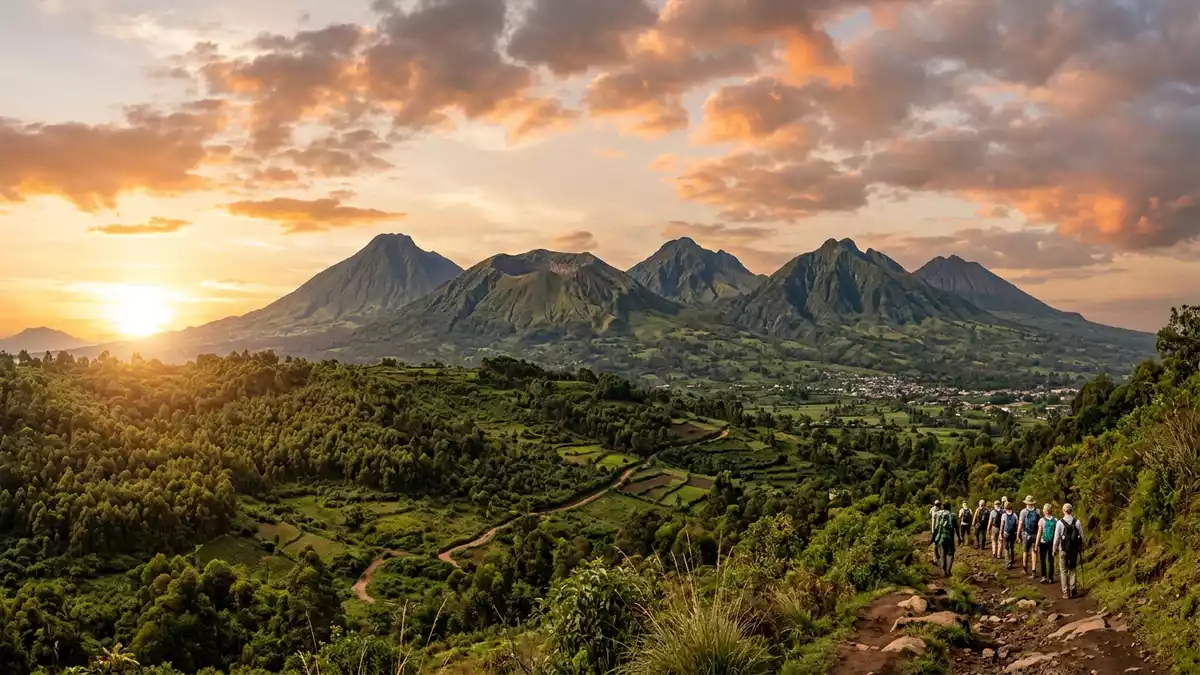
Volcanoes National Park in northern Rwanda is a protected highland where volcanic peaks rise above dense montane forest and bamboo, forming a steep skyline above the town of Musanze. The park anchors Rwanda’s share of the Virunga Mountains, a chain of dormant volcanoes that has shaped the landscape and the way visitors move through it.
Virunga volcanoes above the Rwandan highlands
Volcanoes National Park lies in north-western Rwanda, in and around the Musanze District, close to the borders with Uganda and the Democratic Republic of the Congo.Located in northwestern Rwanda The protected area covers roughly 160 sq km (62 sq mi) along the Virunga Mountains, where a line of volcanic summits marks the divide between countries.covers approximately 62 square miles
The park is named after the Virunga Massif, a group of dormant volcanoes including Karisimbi, Bisoke, Sabinyo, Gahinga and Muhabura.chain of dormant volcanoes Karisimbi, at 4,507 m (14,787 ft), is the highest of these peaks and forms one of the dominant landmarks on the skyline above Musanze.Karisimbi – the highest at 4,507m Other volcanoes in the group carry crater lakes and high-altitude moorland, adding further contrasts in colour and vegetation to the slopes.
Forest mosaics and mountain gorillas
Across its steep slopes Volcanoes National Park protects a series of montane ecosystems, from evergreen forest and bamboo stands to grassland, swamp and heath.rich mosaic of montane ecosystems These plant communities form belts at different elevations, so travellers watching from Musanze see bands of vegetation climbing towards the volcanic summits, interrupted by cliffs and old lava flows.
The park is best known as a centre for mountain gorilla conservation within the greater Virunga landscape, which extends across Rwanda, Uganda and the Democratic Republic of the Congo.global center for mountain gorilla conservation Several habituated gorilla families live on these Rwandan slopes, with groups such as Susa, Amahoro, Sabyinyo, Kwitonda and Agashya among those named in park information.Gorilla families in volcanoes national park Alongside gorillas, the forests support other wildlife typical of the Albertine Rift highlands, including golden monkeys and a range of bird species associated with bamboo and afro-montane forest.
From early protection to a modern national park
The origins of Volcanoes National Park lie in the early twentieth century, when parts of the Virunga Mountains were set aside as a gorilla sanctuary under Belgian colonial administration. In 1925 a decree created Albert National Park in the triangle formed by the Karisimbi, Mikeno and Visoke volcanoes, described as a protected area for gorillas.Albert National Park was established by the decree of 21 April 1925 A further decree on 12 November 1935 defined its boundaries, with a portion of the park on Rwandan territory that corresponds to the area now known as Volcanoes National Park.A further decree on 12 November 1935 determined the final boundaries
Over the following decades, repeated reductions of the protected area cut back forest cover for agricultural projects, including a pyrethrum-growing scheme in 1969 that removed a significant share of the park’s land.some 40% of the area of the park were cut to make place for the ambitious pyrethrum growing project Despite these losses, the remaining Rwandan section of the original Albert National Park evolved into the present Volcanoes National Park, which now forms part of a continuous conservation landscape with Virunga National Park in the Democratic Republic of the Congo and Mgahinga Gorilla National Park in Uganda.connects directly with Virunga National Park and Mgahinga Gorilla National Park
Visiting Volcanoes National Park: what travellers from Western Europe should know
- Volcanoes National Park sits in northern Rwanda near Musanze, a town sometimes described as Rwanda’s third largest, with the protected area extending across several districts in the highlands.
- The terrain within the park is mountainous, with steep slopes, volcanic summits and forested paths that can involve sustained ascents over uneven ground.
- Musanze is connected to Rwanda’s capital Kigali by tarmac roads, and serves as a common base for journeys towards the park and the settlement of Kinigi close to the park headquarters.Tarmac roads in fair conditions link Kigali and Gisenyi to Musanze
- The official language is Kinyarwanda alongside French and English, and the currency is the Rwandan franc.
- Entry requirements depend on your nationality; UK travellers can check the FCDO travel advice at gov.uk/foreign-travel-advice, Irish travellers the Department of Foreign Affairs at ireland.ie.
Searching for Volcanoes National Park on social platforms
These links open searches for Volcanoes National Park on each platform.
Frequently asked questions about Volcanoes National Park
Where is Volcanoes National Park in Rwanda?
Volcanoes National Park is in north-western Rwanda, near the town of Musanze and close to the borders with Uganda and the Democratic Republic of the Congo.
What kind of landscape should visitors expect?
The park encompasses steep volcanic slopes, crater highlands and belts of montane forest, bamboo and moorland rising towards peaks such as Karisimbi and Bisoke.
What makes Volcanoes National Park distinctive among African parks?
It combines a chain of dormant volcanoes with montane forest that supports mountain gorillas, forming part of a transboundary conservation area with neighbouring national parks.


