
Volcan Villarrica above Pucon’s lakes and forests
Published on 08/30/2026 at 11:04 | Editorial responsibility: Rafael Müller, Editor-in-Chief AD HOC NEWS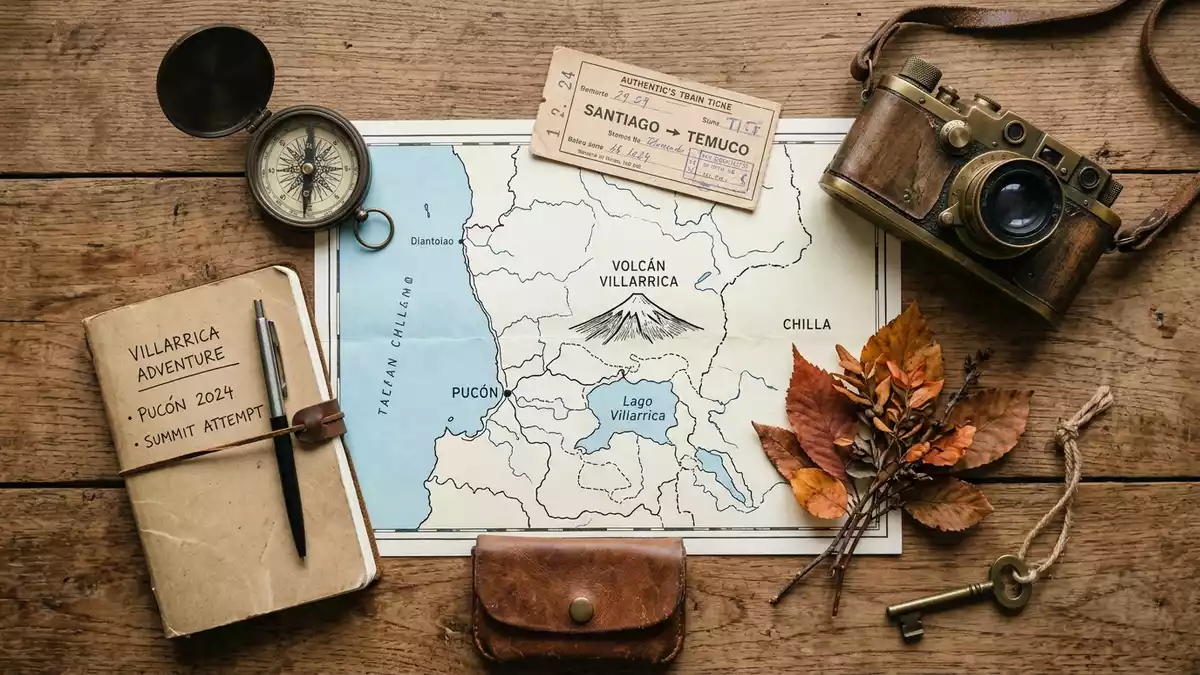
Volcan Villarrica dominates the landscape south of Villarrica Lake, rising above the town of Pucon in southern Chile as a glacier?clad cone with an active summit crater. Its regular activity since the sixteenth century and its setting among forests and lakes make this stratovolcano a defining landmark of the Araucanía region.
An active Andean cone shaped by fire and ice
Villarrica is a basaltic to basaltic?andesite stratovolcano in the northern part of Chile’s Lakes District, standing within a broader caldera complex that extends over tens of square kilometres.The glacier?covered stratovolcano rises south of the town and lake that share its name, forming an almost symmetrical cone that is visible for many kilometres around.Villarrica in southern Chile
The summit reaches around 2,847 m (9,341 ft) above sea level, with a crater that is almost circular and several hundred metres deep, frequently containing an active lava lake.Historical eruptions documented since 1558 have included mild to moderate explosive events, lava flows and Strombolian activity within and around this crater. The contrast between dark volcanic rock and bright ice fields gives the upper slopes a stark appearance, while the lower flanks merge into green temperate woodland.
Villarrica’s eruptive history and monitoring
Written records of Villarrica’s eruptions go back to the sixteenth century, and more than sixty significant eruptions have been documented over the past 460 years.A long record of activity places Villarrica among the most active volcanoes in South America. Larger events have occurred roughly once per decade in the twentieth century, with notable eruptions in the 1960s, 1970s and the mid?1980s, and an explosive episode in March 2015 that produced high lava fountains and ash plumes from the summit.
The volcano is closely watched by Chile’s geological and mining authority, SERNAGEOMIN, and by international observatories, which track seismic activity, gas emissions and thermal anomalies around the crater.Reports on the March 2015 eruption describe lava fountains reaching well over a kilometre in height and tephra falling across the upper slopes. For travellers, this level of monitoring translates into a landscape where an active summit is set above towns, lakes and forests that have learned to live with periodic ashfall and changing alert levels.
Pucon, forests and the climb towards the crater
Volcan Villarrica rises around 15 km south of Pucon, a small town on the shore of Villarrica Lake that serves as the main base for excursions on and around the volcano.The glacier?covered cone near Pucon sits within a protected area of woodland and high?altitude slopes, where lava flows and ash deposits have shaped ridges and valleys. From Pucon, roads climb through forest towards the ski and park infrastructure on the lower flanks, where hiking routes start on volcanic ash and gradually lead onto snow and ice.
Guided ascents from the town have made Villarrica one of the more accessible active volcanoes in the Andes, with established routes that guide groups across the broad slopes to viewpoints near the crater when conditions permit.The volcano as a major attraction lies within a wider region of lakes, rivers, hot springs and other volcanic cones, so a visit often combines summit?side views of steam rising from the crater with days spent exploring surrounding forests and the shoreline of Villarrica Lake.
Visiting Volcan Villarrica: what travellers from Western Europe should know
- Volcan Villarrica stands in southern Chile’s Araucanía region, south of the town of Villarrica and close to Pucon on the shore of Villarrica Lake; Pucon is the usual base for trips onto the volcano’s slopes.
- The ascent towards the upper slopes involves walking on loose volcanic ash and sections of snow or ice, with long gradients and stretches where the path crosses open, exposed terrain above the tree line.
- In winter months the higher slopes carry extensive snow cover, while the lower approaches pass through dense temperate forest that can feel markedly cooler than the open ash fields above.
- The official language is Spanish and the currency is the Chilean peso.
- Entry requirements depend on your nationality; UK travellers can check the FCDO travel advice at gov.uk/foreign-travel-advice, Irish travellers the Department of Foreign Affairs at ireland.ie.
Searching for Volcan Villarrica on social platforms
These links open searches for Volcan Villarrica on each platform.
Frequently asked questions about Volcan Villarrica
Where is Volcan Villarrica located?
Volcan Villarrica stands in southern Chile’s Araucanía region, just south of Villarrica Lake and around 15 km from the town of Pucon.
What should travellers expect when visiting the volcano?
Travellers encounter a broad stratovolcano with lower slopes in forest, higher slopes of ash, snow and ice, and distant views towards the active summit crater.
What makes Volcan Villarrica distinctive among Andean volcanoes?
Villarrica combines frequent historical eruptions, an accessible cone rising directly above a lakeside town, and a summit crater that has hosted an active lava lake.


