
Volcan Poas and the crater rim above Alajuela
Published on 08/13/2026 at 14:24 | Editorial responsibility: Rafael Müller, Editor-in-Chief AD HOC NEWS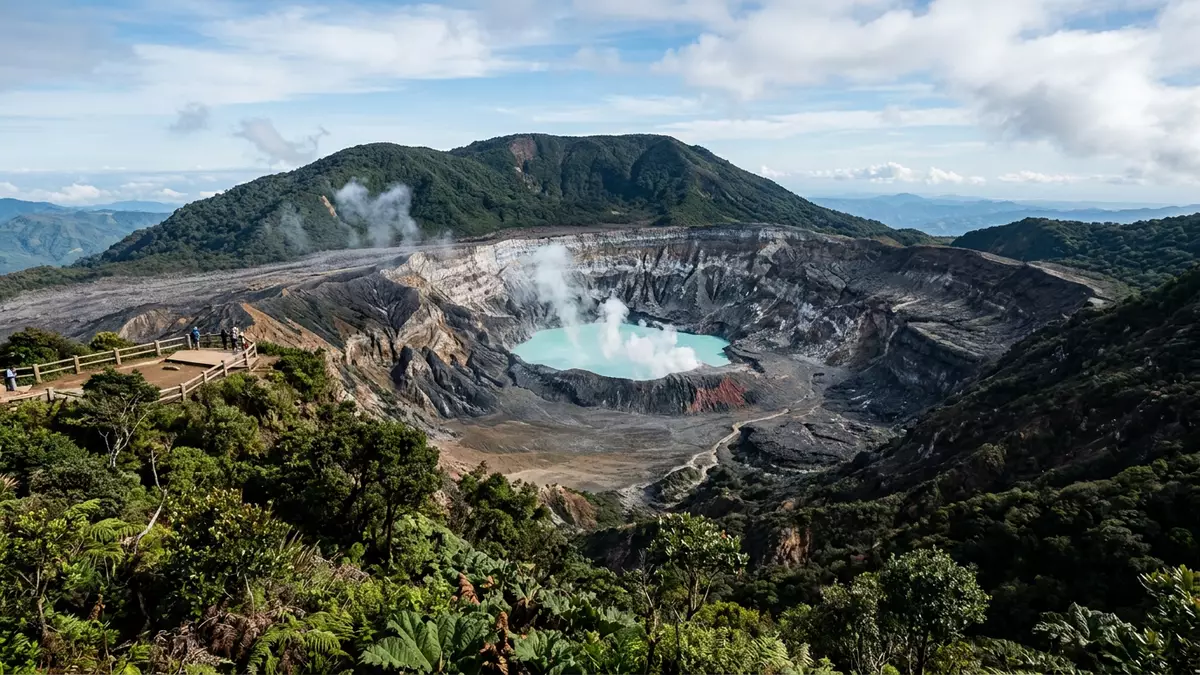
Volcan Poas rises above Alajuela as an active stratovolcano in central Costa Rica, with a summit elevation of 2,697 m (8,848 ft). Its profile is dominated by a large crater and a volcanic landscape that reaches into Poás Volcano National Park.
The summit crater and the high rim
The mountain’s upper slopes lead to the main crater, where the opening, walls and vapour fields form the most immediate part of the view. The Smithsonian Institution gives the summit elevation as 2,697 m, while the national park records 2,708 m for the volcano.
That small difference does not change the place itself: Volcan Poas is a high volcanic summit with a crater lake and a second crater basin nearby. The park also notes a principal crater about 1.5 km across and 300 m deep, and a Botos lagoon fed by rainwater.
summit elevation and principal crater are the figures most often used to describe its upper landscape.
Crater lakes, ash and sulphur
Volcan Poas is known for the contrast between the acidic water of the main crater and the calmer basin of Lake Botos. The upper crater has been described as an active volcanic depression, while Botos sits in an inactive crater to the south.
NASA describes Poás as one of Costa Rica’s most active volcanoes, and the volcano registry records its latest known eruption in 2025 CE. Those details place the mountain within the country’s active volcanic arc, but the visible centre of attention remains the summit landscape itself.
one of Costa Rica’s most active volcanoes and latest known eruption are stable anchors for the volcano’s character.
Volcan Poas in the Central Valley landscape
The volcano sits within reach of Alajuela and the wider Central Valley, so its flanks belong to a settled agricultural and roaded landscape rather than a remote cordillera. Costa Rica Tourism Board places the park in Alajuela province and describes routes running through Alajuela, Heredia and Poasito.
That setting matters because Volcan Poas is not only a summit view. It is part of a broader volcanic region, a park, and a route network that threads up from the valley towards the high rim.
Poás Volcano National Park and routes through Alajuela place the volcano firmly within the province.
Visiting Volcan Poas: what travellers from Western Europe should know
- The volcano lies in Alajuela province, within Poás Volcano National Park, and road access runs through the Central Valley. The approach passes through named towns and upland settlements rather than a single direct mountain road.
- The terrain is high and exposed, with the summit above 2,700 m and crater edges visible from marked viewpoints. The main crater and the Botos basin are the two most notable landforms.
- The official language is Spanish and the currency is the Costa Rican colón.
- Entry requirements depend on your nationality; UK travellers can check the FCDO travel advice at gov.uk/foreign-travel-advice, Irish travellers the Department of Foreign Affairs at ireland.ie.
Searching for Volcan Poas on social platforms
These links open searches for Volcan Poas on each platform.
Frequently asked questions about Volcan Poas
Where is Volcan Poas?
Volcan Poas is in Alajuela province, central Costa Rica, inside Poás Volcano National Park. It rises above the Central Valley and can be reached by road through the province.
What does a visit involve?
The visit centres on high volcanic ground, crater edges and the contrast between the main crater and Lake Botos. The landscape is open, steep in places and clearly shaped by volcanic activity.
What makes Volcan Poas distinctive?
Its summit crater, acidic crater lake and the separate Botos basin give it a landscape with two very different volcanic faces. The mountain’s recorded height and active status add to that identity.


