
Volcan Poas and its crater lakes above Alajuela
Published on 09/22/2026 at 23:53 | Editorial responsibility: Rafael Müller, Editor-in-Chief AD HOC NEWS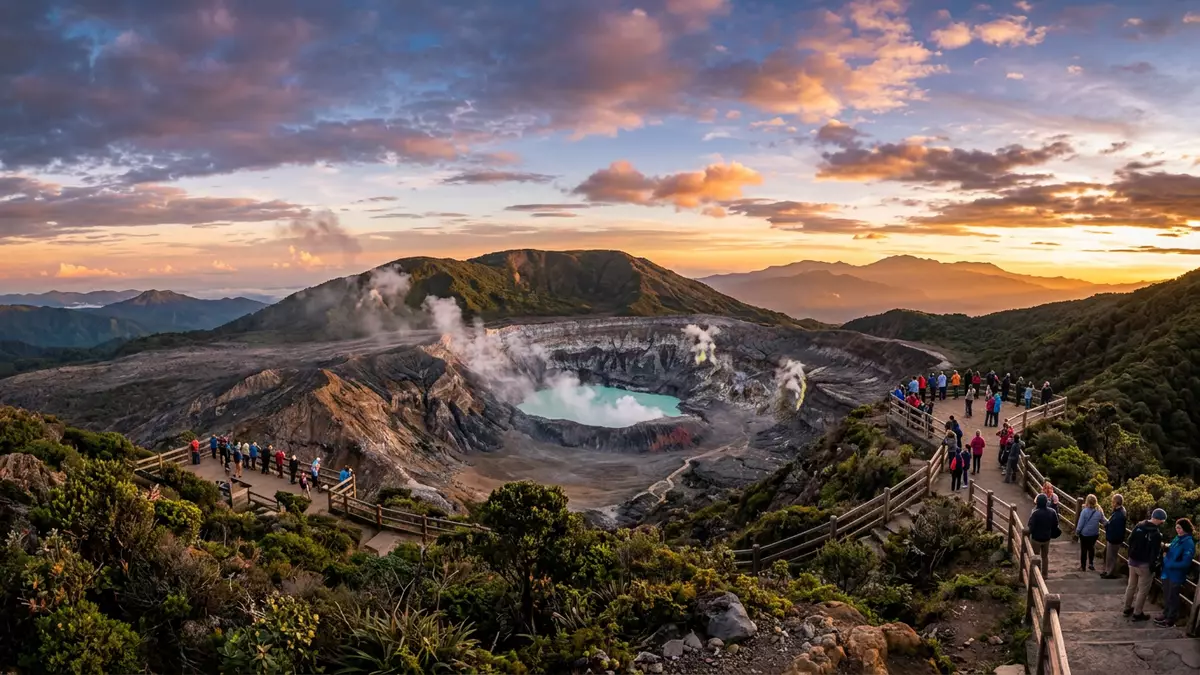
Volcan Poas rises above Alajuela as a broad stratovolcano whose summit contains several volcanic depressions and crater lakes. The active crater and its acidic lake form the mountain’s defining landscape, while Botos Lagoon occupies a separate, inactive crater nearby.
At 2,697 m (8,848 ft), the summit belongs to Costa Rica’s Central Cordillera and the Central America Volcanic Arc. Volcan Poas is not a single cone viewed from below, but a high volcanic complex gathered around a summit area shaped by eruptions, collapse and water.
Volcan Poas: a summit divided between fire and water
The main crater contains Laguna Caliente, a hot, highly acidic lake set below the crater rim. Its water belongs to the active volcanic system, where heat, gases and mineral-rich fluids meet in a steep-walled depression. The lake’s colour and surface appearance can change with volcanic activity and rainfall.
The crater measures about 1.5 km across and reaches roughly 300 m in depth. A broad opening in the summit exposes the lake below, with bare volcanic ground around the active area and high-elevation vegetation farther from the crater.
The volcanic complex above Alajuela
Volcan Poas is a composite stratovolcano, formed from successive layers of lava, ash and other volcanic material. The mountain belongs to the Cordillera Volcanica Central, the inland range that extends across Costa Rica’s central highlands.
The Smithsonian volcano record gives the summit elevation as 2,697 m (8,848 ft) and identifies Poas as a composite stratovolcano. Historical activity has been recorded since 1747, with eruptions involving steam, ash, gases and fragments of older volcanic rock.
Botos Lagoon and the mountain’s older crater
South of the active crater lies Botos Lagoon, a cold-water lake occupying an inactive crater. Forest covers much of the surrounding ground, creating a clear contrast with the exposed volcanic surfaces around Laguna Caliente.
Botos crater has been inactive for about 7,500 years. The Botos crater record places the lake among the older volcanic features within the summit complex. Another crater, Von Frantzius, is named after the German physician and explorer Alexander von Frantzius.
The surrounding protected landscape became Poas Volcano National Park in 1971. The park covers volcanic craters, cloud forest, streams and vegetation adapted to a high-elevation environment affected by acidic gases.
Visiting Volcan Poas: what travellers from Western Europe should know
- Volcan Poas lies in Alajuela Province, north-west of San Jose, within the Cordillera Volcanica Central. Roads climb towards the summit area from the Alajuela side.
- The approach reaches high volcanic terrain, with crater viewpoints and walking sections across exposed ground and forest. The summit elevation is 2,697 m (8,848 ft).
- The landscape includes acidic volcanic ground around Laguna Caliente and forested terrain around Botos Lagoon. These environments sit within the protected area of Poas Volcano National Park.
- The official language is Spanish and the currency is the Costa Rican colon.
Searching for Volcan Poas on social platforms
These links open searches for Volcan Poas on each platform.
Frequently asked questions about Volcan Poas
Where is Volcan Poas?
Volcan Poas is in Alajuela Province, Costa Rica, within the Cordillera Volcanica Central north-west of San Jose.
What can visitors expect at the volcano?
The summit area contains crater viewpoints, exposed volcanic ground, high-elevation vegetation and walking sections within Poas Volcano National Park.
What makes Volcan Poas distinctive?
Its summit combines an active crater with acidic Laguna Caliente and an inactive crater containing the forest-framed Botos Lagoon.


