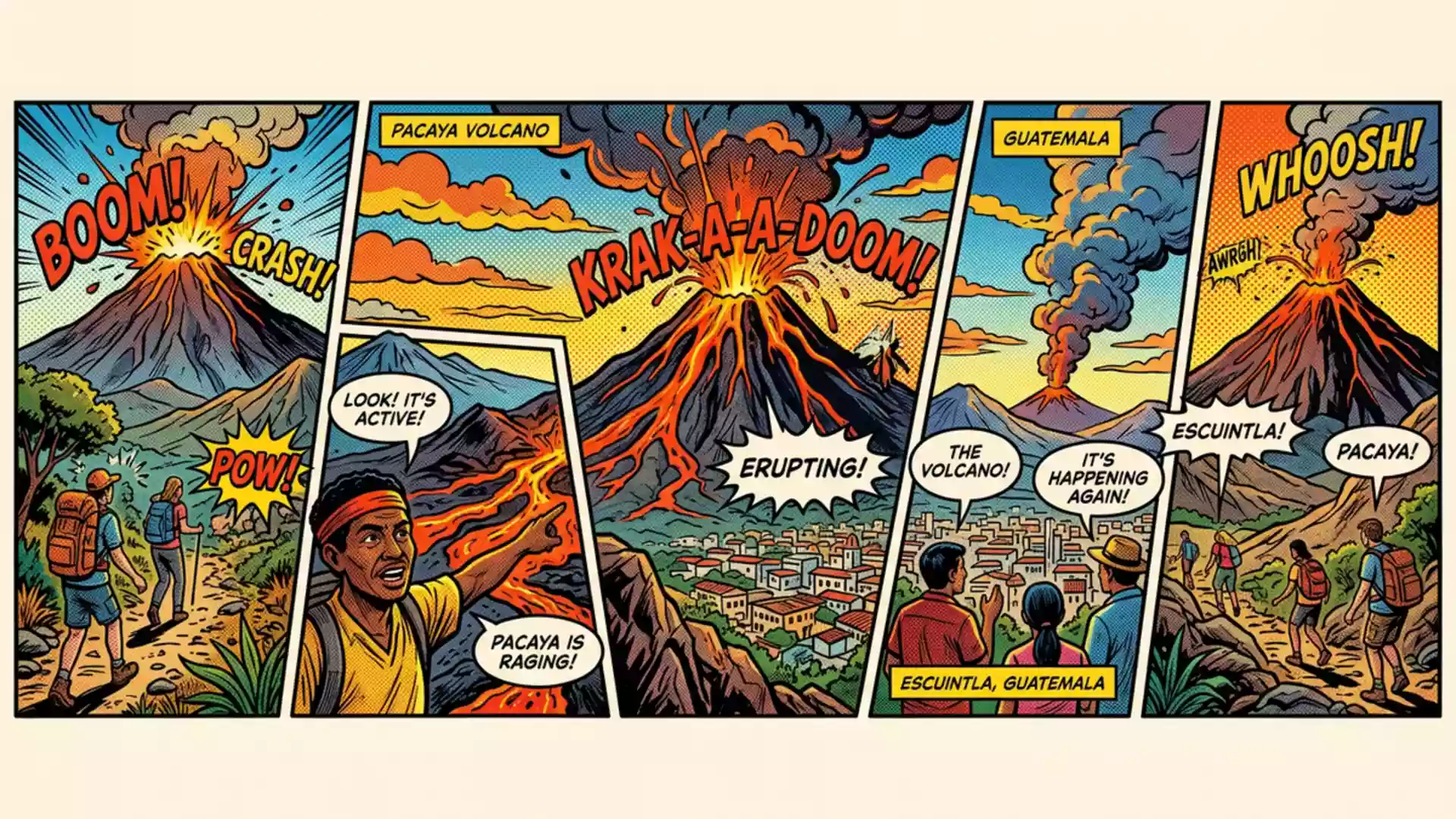
Volcan Pacaya: walking the lava slopes above Escuintla
Published on 09/09/2026 at 21:06 | Editorial responsibility: Rafael Müller, Editor-in-Chief AD HOC NEWS
Volcan Pacaya in southern Guatemala is an active basaltic volcano rising above the Escuintla landscape, where recent lava fields and a young cone make the mountain feel strikingly alive. It forms part of the Central America volcanic arc linked to the subduction of the Cocos Plate beneath the Caribbean Plate, giving the volcano a long, episodic history of eruptions over thousands of years.
A young basaltic cone on an ancient caldera rim
Volcan Pacaya stands on the southern rim of the Amatitlán caldera in Guatemala, occupying ground shaped by much older volcanic activity.Pacaya Volcano in Guatemala The wider complex includes several cones and domes, with Pacaya itself forming a basaltic stratovolcano that developed over roughly the last 23,000 years.Pacaya is a complex rising to 2,569 meters The volcano reaches an elevation a little above 2,500 m (around 8,200 ft), giving clear views across the surrounding departments of Escuintla and Guatemala on days with open skies.Volcán Pacaya rises 2,552 meters above sea level
The mountain forms part of a chain of Guatemalan volcanoes aligned roughly parallel to the Pacific coast, each fed by magma generated where the oceanic Cocos Plate descends beneath Central America.Pacaya Volcano in Guatemala Pacaya’s rocks are dominated by basalt and related low-viscosity lavas, producing dark, fine-grained surfaces across its slopes and forming the extensive lava fields that visitors see on guided walks.The complex volcano is composed of several cones and domes This basaltic character distinguishes Pacaya from some of Guatemala’s higher, more explosive composite volcanoes and gives its slopes a distinctive, rugged texture.
Layers of cones, craters and lava fields
Volcan Pacaya is not a single peak but a volcanic complex containing several eruptive centres, including Cerro Grande, Cerro Chiquito and the Cerro Chino scoria cone, as well as the presently active cone often referred to as Mackenney.The Pacaya volcanic complex is part of the Central America volcanic arc These overlapping cones and domes create a broken skyline, with ridges, low summits and craters arranged around the main active vent. The surfaces record alternating episodes of lava effusion and tephra deposition, giving the slopes patchwork colours and textures where older weathered rock meets younger black flows.
The active cone has produced numerous eruptions in historical times, with activity documented since at least the sixteenth century and continuing through the twentieth and twenty-first centuries.Pacaya is an active complex volcano in Guatemala Strombolian-style explosions, lava flows and small pyroclastic events have repeatedly reshaped the summit area, enlarging and modifying the principal crater and sending lava down the flanks.A 1989 eruption produced a 4.5-km-tall eruption column The current landscape therefore combines relatively fresh lava fields with older cones whose slopes have stabilised, offering a clear view of how an arc volcano evolves over centuries.
Pacaya as a national park and hiking landscape
Volcan Pacaya lies between the departments of Guatemala and Escuintla, with the standard access routes beginning near the municipality of San Vicente Pacaya.Ubicación: Municipio de San Vicente Pacaya The mountain and its immediate surroundings are designated as Pacaya National Park, administered by Guatemala’s national protected areas system.The volcano sits within Pacaya National Park Trails climb through agricultural land and pine forest before reaching open volcanic terrain, where the ground underfoot changes to loose scoria, compacted ash and hardened lava.
Hiking routes cross lava fields formed in recent eruptive episodes, giving close views of fractured blocks, lava channels and ash deposits that illustrate the volcano’s basaltic nature.Short lava flows, small pyroclastic flows and debris avalanches The active summit cone rises beyond these fields, sometimes emitting gas and minor lava flows, while surrounding ridges offer vantage points towards neighbouring volcanoes in the Guatemalan highlands. As a protected area, Pacaya combines access to an active volcanic landscape with conservation of its geological features and the vegetation that clings to its slopes.
Visiting Volcan Pacaya: what travellers from Western Europe should know
- Volcan Pacaya stands on the southern rim of the Amatitlán caldera, south of Guatemala City, and is reached by road via the Escuintla and Guatemala departments before trails start near San Vicente Pacaya.
- The hiking terrain includes steep volcanic paths on loose ash and scoria, sections of hardened lava and exposed ridges above 2,000 m (6,562 ft), so ascents involve sustained gradients and uneven footing.
- Pacaya forms part of Pacaya National Park in Guatemala, where the official language is Spanish and the currency is the Guatemalan quetzal.
- Entry requirements depend on your nationality; UK travellers can check the FCDO travel advice at gov.uk/foreign-travel-advice, Irish travellers the Department of Foreign Affairs at ireland.ie.
Searching for Volcan Pacaya on social platforms
These links open searches for Volcan Pacaya on each platform.
Frequently asked questions about Volcan Pacaya
Where is Volcan Pacaya located?
Volcan Pacaya is in southern Guatemala, on the border between the departments of Escuintla and Guatemala, near the municipality of San Vicente Pacaya.
What should visitors expect on a visit to Pacaya?
Visitors encounter steep volcanic trails, loose ash and lava underfoot, and expansive views over the broader Guatemalan volcanic chain, including fresh lava fields from recent eruptions.
What makes Volcan Pacaya distinctive among Guatemalan volcanoes?
Pacaya is distinctive for its active basaltic cone, its position on the Amatitlán caldera rim and its combination of overlapping cones and lava fields within a compact national park landscape.