
Volcan Pacaya and the ring of lava cones
Published on 09/19/2026 at 14:38 | Editorial responsibility: Rafael Müller, Editor-in-Chief AD HOC NEWS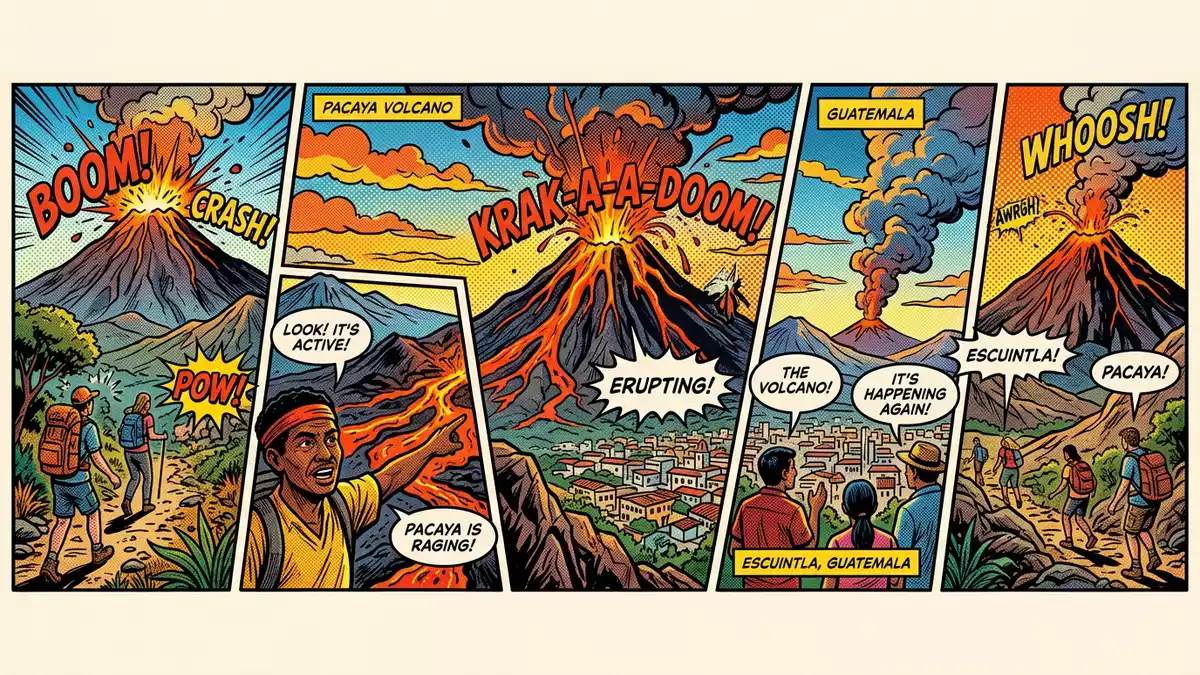
Volcan Pacaya is a complex active volcano in Escuintla, Guatemala, built around lava cones and an older caldera rim. The name belongs to a landscape of basaltic andesite, ash and overlapping volcanic forms rather than to a single summit.
Pacaya’s layered volcanic complex
Pacaya sits within the Central American Volcanic Arc, a chain shaped by subduction along the Pacific side of Central AmericaCentral American Volcanic Arc. It is commonly described as a complex volcano, with multiple cones and vents gathered into one volcanic massifcomplex volcano.
The volcano rises to about 2,552 m (8,373 ft), a figure that places its height firmly among the defining features of the site2,552 m. A scientific description places the complex on the southern rim of the Amatitlán caldera, a broad geological basin that frames much of Pacaya’s present formsouthern rim of the Amatitlán caldera.
MacKenney cone and the older volcanic layers
The active MacKenney cone is the part most closely associated with Pacaya’s modern volcanic activity, while older cones and lava domes remain part of the wider complexMacKenney cone. That layering gives the volcano a profile of nested forms, with younger volcanic structures sitting inside older ones.
Pacaya’s lavas and eruptive products include basaltic to basaltic-andesitic material, with ash and scoria among the visible volcanic depositsbasaltic to basaltic-andesitic. The complex first formed in the Holocene, and one scholarly overview places its broader development in the last 23,000 yearslast 23,000 years.
Pacaya in Guatemala’s volcanic landscape
Pacaya lies south of Guatemala City and within reach of Antigua, making it a familiar reference point in Guatemala’s volcanic geographysouth of Guatemala City. The volcano also belongs to the Escuintla side of the country’s south-central volcanic belt, where volcanic landforms run towards the Pacific lowlandsEscuintla side.
Its identity rests on that combination of scale, structure and active geology. Pacaya is not a single isolated cone but a volcanic system made of older and younger parts, set within a wider arc of volcanoes and calderas.
Visiting Volcan Pacaya: what travellers from Western Europe should know
- The volcano is reached from the Escuintla side of Guatemala, with access commonly associated with San Vicente Pacaya and the roads running south from Guatemala City.
- The ground is volcanic, uneven and exposed in places, with lava fields, ash and steep gradients in the approach to the active cone.
- Pacaya sits high enough for altitude to be part of the setting, and the landscape shifts between open slopes, rough lava and older volcanic ridges.
- The official language is Spanish and the currency is the Guatemalan quetzal.
- Entry requirements depend on your nationality; UK travellers can check the FCDO travel advice at gov.uk/foreign-travel-advice, Irish travellers the Department of Foreign Affairs at ireland.ie.
Searching for Volcan Pacaya on social platforms
These links open searches for Volcan Pacaya on each platform.
Frequently asked questions about Volcan Pacaya
Where is Volcan Pacaya?
Volcan Pacaya is in Guatemala, on the Escuintla side of the country’s volcanic south. It lies south of Guatemala City and within the volcanic belt that crosses the region.
What does a visit involve?
A visit means a volcanic landscape of rough ground, lava deposits and high slopes rather than a polished monument. The terrain is the main feature, with the active cone and older volcanic forms around it.
What makes Volcan Pacaya distinctive?
Its distinction lies in the volcanic complex itself: a high, active system made of multiple cones, domes and caldera-related landforms. The MacKenney cone and the older structures give the site a layered profile.


