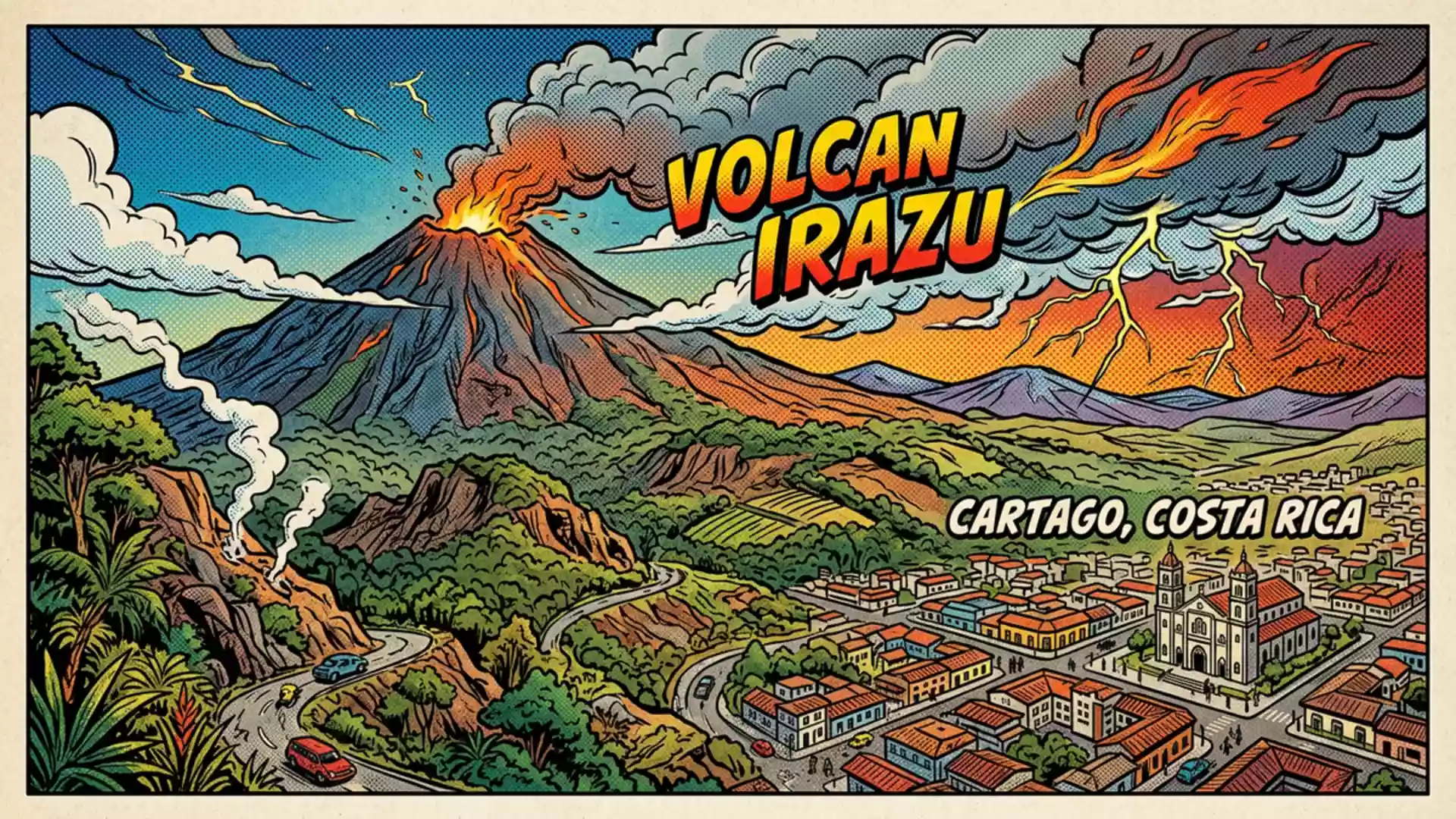
Volcan Irazu and the high rim above Cartago
Published on 09/15/2026 at 07:41 | Editorial responsibility: Rafael Müller, Editor-in-Chief AD HOC NEWS
Volcan Irazu rises above Cartago in Costa Rica’s Cordillera Central, its summit forming a broad volcanic rim punctuated by craters and ash slopes. At around 3,432 m (11,260 ft) above sea level, it is the highest active volcano in Costa Rica and a dominant feature of the eastern edge of the Central Valley.
The high summit plateau and its craters
The upper part of Volcan Irazu forms a wide summit area where visitors encounter a series of craters set into a broad volcanic cone. The most accessible depression at the top is commonly referred to as the Principal Crater, an active crater that has been measured with a diameter of about 1,050 m and a depth of roughly 300 m.Principal Crater dimensions A further hollow known as the Diego de la Haya crater lies nearby, sharing the summit zone with older features such as the Playa Hermosa depression, which together give the mountain a layered volcanic profile.summit craters alignment
The main crater’s floor has at times held a small lake, and the surrounding inner walls are formed from ash, rock and compacted volcanic deposits. Around the craters, the summit plateau opens to views over volcanic ridges and, on clear days, towards the valleys and plains below. The height and exposed position mean that cloud can move across the rim quickly, revealing and hiding the crater basin in turn without altering the underlying volcanic structure.
A shield volcano in the Cordillera Central
Geologically, Volcan Irazu is described as an andesitic shield volcano within the Central America Volcanic Arc, built on older Pliocene volcanic foundations.andesitic shield volcano The volcanic edifice covers a substantial area, sharing its base with neighbouring Turrialba volcano and forming part of the Central Volcanic Range that runs across Costa Rica’s interior.highest volcano in Costa Rica Its rock is largely andesite, a volcanic material that reflects the subduction of the Cocos Plate beneath the Caribbean Plate along this section of Central America.
Records of eruptions at Volcan Irazu extend back to at least 1723, when Governor Diego de la Haya Fernández documented a strong eruption affecting the province of Cartago.1723 eruption record In the twentieth century, the volcano experienced a notable period of activity between March 1963 and February 1965, a Vulcanian eruptive episode that deposited ash over surrounding areas and reshaped parts of the summit landscape.1963–1965 eruption dates These events sit within a longer eruptive history that volcanological studies have framed as a mix of phreatomagmatic, Strombolian and phreatic activity.
Irazú Volcano National Park and access from Cartago
The summit and surrounding slopes of Volcan Irazu are encompassed by Irazú Volcano National Park, a protected area in Cartago Province created officially in August 1955 by Costa Rican law.national park creation in 1955 Later amendments expanded the park to include forest reserves such as the area now known as the Prusia Forest Reserve, bringing wooded terrain and volcanic ground under a single conservation framework.park and Prusia Forest Reserve
Roads connect the park with Cartago and the wider Central Valley, and paved access routes reach close to the summit area, making the high volcanic rim accessible without specialised mountaineering. Approaches from Cartago typically follow the main highway into the Cordillera Central and continue through upland settlements before reaching the national park entrance. Once inside the park, paths and viewpoints lead towards the crater edges and across stretches of volcanic ash and rock, with altitude and exposure shaping the character of a visit.
Visiting Volcan Irazu: what travellers from Western Europe should know
- Volcan Irazu stands in Cartago Province in the Cordillera Central of Costa Rica, reached by paved road from Cartago and the wider Central Valley.
- The summit area lies at high altitude, and approaches within the park include walking over volcanic ash and rock with sections exposed to wind and cloud.
- The national park surrounds the volcano and includes forested sectors such as the Prusia area alongside open volcanic terrain on the upper slopes.
- The official language is Spanish and the currency is the Costa Rican colón.
- Entry requirements depend on your nationality; UK travellers can check the FCDO travel advice at gov.uk/foreign-travel-advice, Irish travellers the Department of Foreign Affairs at ireland.ie.
Searching for Volcan Irazu on social platforms
These links open searches for Volcan Irazu on each platform.
Frequently asked questions about Volcan Irazu
Where is Volcan Irazu located?
Volcan Irazu is in Cartago Province in east-central Costa Rica, forming part of the Cordillera Central above the Central Valley and linked by road with Cartago.
What should visitors expect on a visit to Volcan Irazu?
Visitors encounter a high-altitude volcanic landscape with crater viewpoints, ash and rock surfaces and paths within Irazú Volcano National Park leading towards the summit area.
What makes Volcan Irazu distinctive among Costa Rican volcanoes?
Volcan Irazu is the highest active volcano in Costa Rica and combines a broad summit plateau with multiple craters, including the Principal and Diego de la Haya craters within a protected national park.